







Critical thinking in modern classrooms has become one of the most important skills for preparing students to succeed in an increasingly complex and technology-driven world. While memorization remains essential for building foundational knowledge, today’s learners are expected to do much more than simply recall facts—they must analyze information, solve real-world problems, evaluate evidence, think creatively, and make informed decisions.
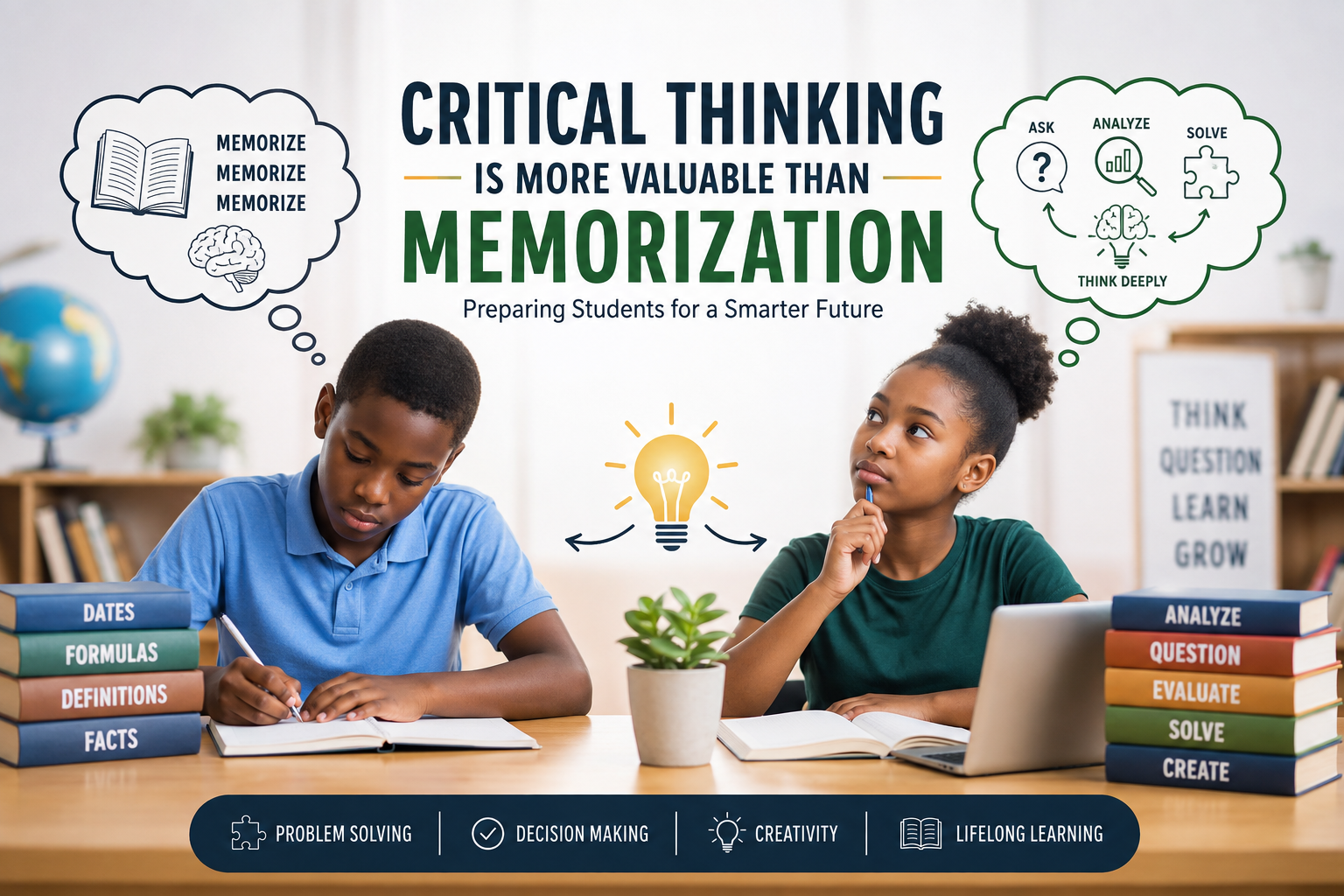
For generations, education systems around the world have relied heavily on memorization. Students were expected to remember dates, formulas, definitions, and facts in order to succeed in examinations. While memorization remains an important part of learning, modern education increasingly recognizes that success in school, work, and everyday life requires much more than the ability to recall information.
In my observations of classrooms, educational programs, and student learning activities, one pattern appears repeatedly: students often remember concepts longer and apply them more effectively when they actively engage with ideas rather than simply memorize them. Learners who participate in discussions, solve real-world problems, conduct research, or defend their viewpoints tend to develop a deeper understanding of subjects than those who rely solely on rote learning.
This shift reflects the realities of the twenty-first century. Today, information is available almost instantly through smartphones, digital libraries, and the internet. The challenge is no longer finding information but determining whether it is accurate, relevant, and useful. As a result, employers, universities, and policymakers increasingly value critical thinking, problem-solving, creativity, communication, and adaptability.
Organizations such as UNESCO, the OECD, and the World Economic Forum consistently emphasize the importance of higher-order thinking skills in preparing learners for rapidly changing social and economic environments. These skills enable individuals to evaluate evidence, make informed decisions, solve unfamiliar problems, and contribute meaningfully to their communities.
This article explores why critical thinking has become more valuable than memorization in modern classrooms, how both skills complement one another, and what students, teachers, and parents can do to promote deeper and more meaningful learning.
Why Educational Experts Emphasize Critical Thinking
Educational research has long demonstrated that effective learning goes beyond remembering information.
One of the most widely recognized frameworks in education is Bloom’s Taxonomy, which classifies learning into different cognitive levels. While remembering information forms the foundation, higher levels include:
- Understanding
- Applying
- Analyzing
- Evaluating
- Creating
According to this framework, the highest levels of learning require students to think critically, evaluate evidence, solve problems, and generate new ideas rather than simply recall facts.
This explains why modern educational systems increasingly prioritize inquiry-based learning, project-based learning, and collaborative problem-solving activities.
Classroom Example
Consider two students studying environmental pollution.
Student A memorizes the definition of pollution and reproduces it during an examination.
Student B investigates waste disposal practices in their community, interviews local residents, analyzes findings, and proposes solutions.
Both students have learned something, but Student B has developed analytical, research, communication, and problem-solving skills that are more likely to be useful beyond the classroom.
Critical Thinking in Nigerian and African Classrooms
Across Nigeria and many African countries, educational reforms increasingly encourage learner-centered teaching methods.
During interactions with educators and school administrators, a common observation is that students become more engaged when they participate actively in lessons rather than spending entire periods copying notes from the board.
Examples include:
- Classroom debates
- Group projects
- Practical science experiments
- Entrepreneurship projects
- Community research activities
- Problem-solving exercises
For example, rather than merely memorizing information about waste management, students may investigate waste disposal challenges within their communities and recommend practical solutions. Such activities help learners connect academic knowledge with real-world experiences.
UNESCO has repeatedly emphasized the importance of developing critical thinking, creativity, collaboration, and problem-solving skills to prepare young people for the demands of modern societies.
Why Employers Value Critical Thinking
The World Economic Forum’s Future of Jobs reports consistently identify analytical thinking, creative thinking, problem-solving, resilience, and lifelong learning among the most important skills for the future workforce.
As automation and artificial intelligence continue to handle routine tasks, human abilities such as judgment, innovation, ethical reasoning, and decision-making become increasingly valuable.
Employers are not only asking:
- What do you know?
They are also asking:
- Can you solve problems?
- Can you adapt to change?
- Can you work with others?
- Can you evaluate information effectively?
- Can you learn continuously?
Critical thinking supports all these competencies.
Practical Activities That Build Critical Thinking
For Students
- Read from multiple credible sources before forming conclusions.
- Ask “why” and “how” questions regularly.
- Compare opposing viewpoints.
- Analyze real-life problems and propose solutions.
- Reflect on mistakes and identify lessons learned.
For Teachers
- Use open-ended questions.
- Introduce project-based learning activities.
- Encourage classroom discussions and debates.
- Incorporate real-world case studies.
- Allow students to explain their reasoning.
For Parents
- Discuss current events together.
- Encourage children to explain their thinking.
- Play strategy games and puzzles.
- Involve children in household decision-making.
- Promote reading across different subjects.
Self-Assessment: Are You Developing Critical Thinking Skills?
Use this quick checklist:
✓ I regularly ask questions about what I learn.
✓ I compare information from different sources.
✓ I evaluate evidence before accepting claims.
✓ I consider alternative viewpoints.
✓ I explain the reasons behind my opinions.
✓ I learn from mistakes and adjust my thinking.
The more boxes you can check, the stronger your critical-thinking habits are becoming.
Frequently Asked Questions
Is memorization still important?
Yes. Memorization provides foundational knowledge that supports deeper understanding and critical analysis. The goal is not to eliminate memorization but to use it as a stepping stone toward higher-level thinking.
Can critical thinking improve examination performance?
Research suggests that students who understand concepts deeply often perform better in assessments that require analysis, application, and problem-solving.
Why is critical thinking important in the age of artificial intelligence?
As AI makes information more accessible, individuals must be able to evaluate information, identify misinformation, make ethical decisions, and apply knowledge effectively.
How can schools encourage critical thinking?
Schools can promote critical thinking through inquiry-based learning, project work, classroom discussions, collaborative activities, and practical problem-solving experiences.
References
- UNESCO – Education for Sustainable Development and Future Learning Initiatives
- OECD Learning Compass 2030
- World Economic Forum Future of Jobs Report
- Bloom’s Taxonomy of Educational Objectives
- Partnership for 21st Century Learning (P21) Framework
- Brookings Institution Research on Education and Learning
- American Psychological Association Educational Resources
Conclusion
Memorization remains an essential component of education, providing learners with the knowledge required to understand the world around them. However, in an era defined by rapid technological advancement, abundant information, and complex societal challenges, memorization alone is no longer sufficient.
Critical thinking empowers students to evaluate evidence, solve unfamiliar problems, communicate effectively, make informed decisions, and adapt to change. These skills are increasingly valued by educators, employers, and communities because they prepare learners not only for examinations but also for lifelong success.
The most effective educational approach is not choosing between memorization and critical thinking. Rather, it is creating a balance where knowledge acquisition supports deeper analysis, creativity, and meaningful action. By fostering curiosity, evidence-based reasoning, and practical problem-solving, schools, teachers, and parents can help develop learners who are prepared to thrive in the modern world.