








Written by: Hauwa Yusuf Barau
Educational Review: Don Michaels
Published: 7 August 2026
Last Updated: 7 August 2026
Editorial note: This article combines educational research, Nigerian education policy, and practical school-based strategies. Any first-hand observations should be added only where the author or reviewer has genuinely experienced or verified them.
Education is about more than helping students pass examinations. Schools also help young people develop the knowledge, habits, relationships, and social and emotional skills they need to participate responsibly in family, community, civic, and working life.
In Nigeria, this broader purpose is reflected in the National Policy on Education, which identifies ethical, moral, security and civic values among the foundations of lifelong learning and includes the development of morally upright young people, civic responsibility, harmonious coexistence and respect for human dignity among the goals of basic education.
Character education is one way schools can contribute to these goals. It involves helping learners understand positive values, practise them in everyday situations, reflect on their decisions, and gradually develop habits that support responsible behaviour.
This does not mean turning every lesson into a lecture about right and wrong. Effective character development is better understood as part of the wider school experience: how teachers behave, how rules are applied, how students resolve disagreements, how responsibilities are shared, and how learners are given opportunities to practise positive behaviour.
Research on social and emotional skills also indicates that these skills are teachable and are associated with a range of educational and life outcomes, although the strength and nature of those relationships vary by skill and context.
The practical question, therefore, is not simply “How do we teach good character?” but:
How can schools create everyday conditions in which students understand, practise and gradually develop positive values?
What Is Character Education?
Character education refers broadly to intentional efforts to help learners develop positive qualities, dispositions and habits that influence how they think, make decisions, behave and relate to other people.
Examples include:
- Honesty
- Respect
- Responsibility
- Integrity
- Empathy
- Fairness
- Self-discipline
- Courage
- Patience
- Cooperation
- Perseverance
- Accountability
These qualities overlap with areas commonly discussed in social and emotional learning. The OECD’s framework for social and emotional skills, for example, considers skills that influence how students manage themselves, relate to others and respond to situations. It also recognises that these skills can develop and change and that family, school and peer environments influence their development.
Character Education, Moral Education and Discipline Are Not the Same
These terms are related but should not be treated as identical.
Character education focuses on developing positive qualities, habits and dispositions.
Moral education is more concerned with helping learners think about values, ethical questions, responsibilities, fairness and the consequences of choices.
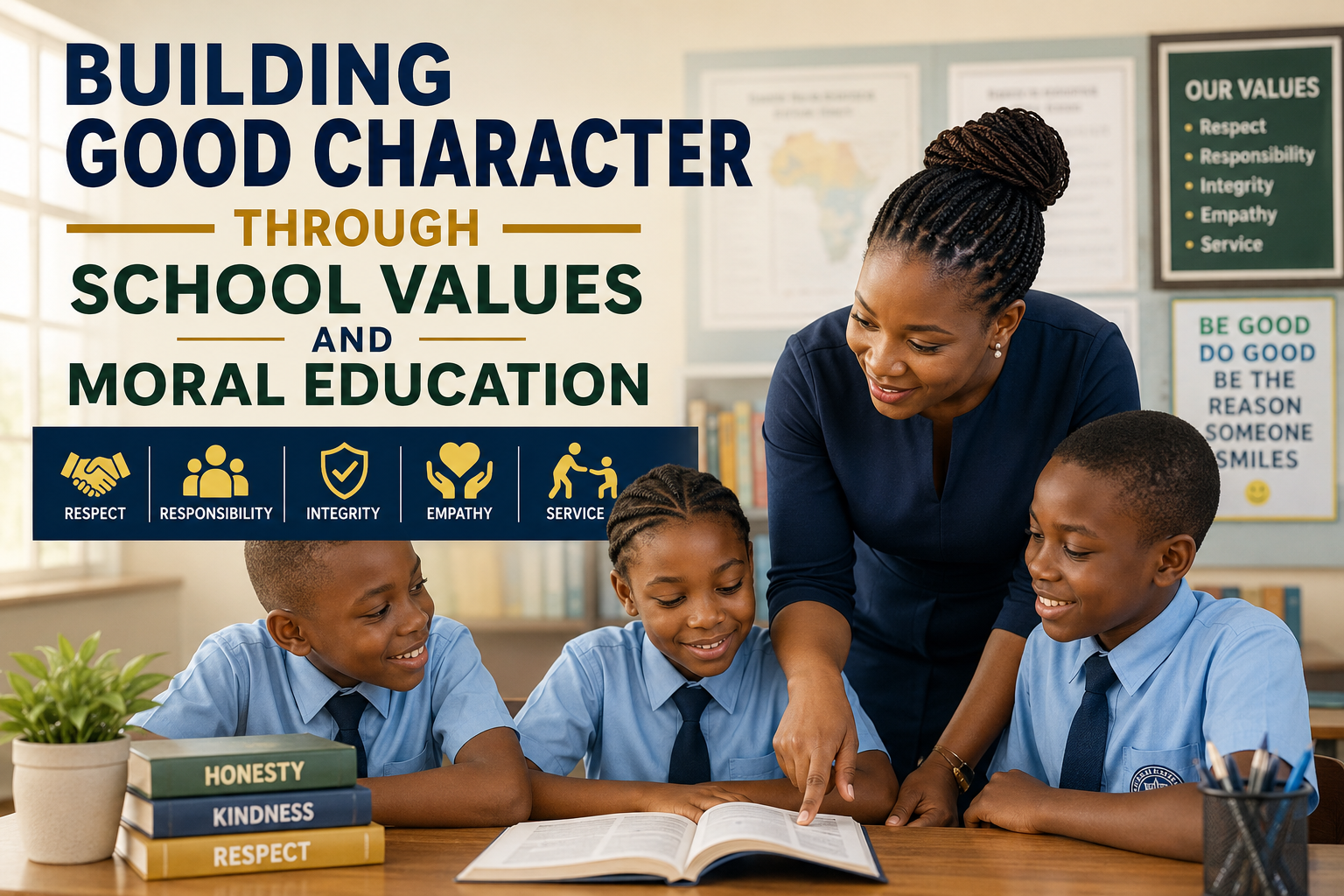
School values are the principles a school chooses to emphasise in its community—for example, respect, integrity, responsibility and service.
Discipline refers to the systems and responses schools use to maintain a safe, orderly and productive learning environment and to guide behaviour.
A strong school can use all four without reducing character education to punishment.
Why School Values Matter
A school’s values are most meaningful when they influence everyday behaviour rather than remaining words in a handbook or on a wall.
Suppose a school identifies respect as one of its core values. That value becomes more meaningful when students are taught what respectful behaviour looks like:
- Listening when another person is speaking.
- Disagreeing without insults.
- Respecting differences.
- Caring for shared facilities.
- Speaking appropriately to teachers, classmates and support staff.
- Avoiding behaviour that humiliates or excludes others.
The same principle applies to responsibility.
A school that values responsibility might teach students to:
- Complete assigned work.
- Care for learning materials.
- Arrive prepared for lessons.
- Keep agreed commitments.
- Accept appropriate consequences for their choices.
- Contribute to group activities.
The OECD’s work on school climate highlights the importance of positive learning environments, teacher practices and shared responsibility. Its research has also linked school participation, mutual support and shared responsibility with lower reported levels of student misbehaviour.
This suggests an important principle:
School values are strongest when students can see them operating in the behaviour and systems of the school itself.
The Teacher’s Role in Building Character
Teachers cannot single-handedly determine a student’s character, but they have frequent opportunities to influence the learning environment.
Research on social and emotional development increasingly emphasises the importance of supportive teacher-student relationships and classroom environments. The OECD reports that socially and emotionally supportive classrooms are associated with positive learning and non-cognitive outcomes, while also emphasising the importance of explicitly teaching and practising social and emotional skills.
1. Model the Behaviour You Expect
Students notice how adults respond to mistakes, disagreements and pressure.
A teacher who:
- listens carefully;
- admits a genuine mistake;
- keeps reasonable promises;
- treats students fairly;
- communicates respectfully; and
- accepts responsibility for errors
provides a practical example of the values being taught.
For example, imagine a teacher accidentally records a student’s mark incorrectly.
Instead of quietly ignoring the mistake, the teacher could acknowledge it, correct the record and explain that accuracy and honesty matter.
The lesson is no longer only theoretical.
The student has seen the value demonstrated.
2. Give Students Meaningful Responsibilities
Responsibility becomes easier to understand when students have appropriate opportunities to practise it.
Depending on age and school circumstances, students might:
- organise learning materials;
- lead part of a group project;
- care for classroom resources;
- help coordinate a school activity;
- maintain a class reading area; or
- support younger learners under appropriate adult supervision.
The purpose should not simply be to make students perform chores.
The purpose is to help them understand contribution, accountability and shared responsibility.
3. Discuss Ethical Situations
Literature, history, civic education, social studies and everyday classroom experiences can create opportunities for ethical discussion.
Consider this example:
A student discovers that a close friend has copied another student’s assignment.
Instead of immediately asking students to memorise the “correct” answer, a teacher could ask:
- What values are involved?
- Who could be affected?
- Is loyalty to a friend the same as supporting everything the friend does?
- What responsibilities does the student have?
- What could the student do next?
- How could the situation be handled fairly?
The goal is not to encourage students to judge one another. It is to develop their ability to consider different perspectives and consequences.
Parents, Guardians and Schools: Working Together
Character development does not take place only inside classrooms.
Children encounter expectations at home, at school, online, among friends and within their wider communities.
Nigeria’s education policy recognises parents, communities and other stakeholders as important participants in children’s development, particularly within early childhood education.
Families can reinforce school values through ordinary activities.
If a school promotes responsibility, for example, parents or guardians can encourage age-appropriate responsibilities such as:
- caring for personal belongings;
- completing agreed household tasks;
- preparing school materials;
- returning borrowed items;
- acknowledging mistakes; and
- following through on reasonable commitments.
Schools should also communicate clearly with families about expectations.
This does not mean every family must approach every moral question identically. Families have different cultural, religious and social backgrounds.
The practical goal is to establish respectful communication and provide children with clear, age-appropriate expectations.
A Practical School Values Framework
A school does not need twenty different values.
A manageable framework of three to five core values can be easier for students and staff to understand and practise.
Here is an example:
| Core value | What it means | Observable student behaviour | Adult behaviour |
|---|---|---|---|
| Respect | Treating people with dignity | Listening, avoiding insults, caring for shared spaces | Speaking respectfully and listening to students |
| Responsibility | Taking ownership of duties and choices | Completing work and accepting appropriate consequences | Keeping commitments and applying expectations consistently |
| Integrity | Acting honestly and consistently | Being truthful about work and mistakes | Admitting errors and avoiding favouritism |
| Empathy | Considering how others may feel | Listening to different perspectives | Taking students’ concerns seriously |
| Service | Contributing positively to others | Helping appropriately and caring for the school community | Creating meaningful opportunities to contribute |
The school should then translate each value into observable behaviours.
For example:
Respect: “We listen when others speak and disagree without insulting them.”
This is more useful to a student than simply displaying the word Respect on a poster.
Five Practical Ways to Teach Moral and Character Values
1. Use Stories and Real-Life Scenarios
Stories allow students to examine choices and consequences without necessarily discussing their own personal experiences.
Teachers can ask:
- What decision was made?
- Who was affected?
- What alternatives existed?
- Which values were involved?
- What could have been done differently?
Teachers should avoid turning every discussion into a search for one predetermined answer. Some ethical situations involve competing values and require thoughtful judgment.
2. Integrate Values Into Ordinary Lessons
Character education does not have to be restricted to a separate subject.
Literature
Students can discuss motivation, responsibility, fairness and consequences.
History
Students can examine leadership decisions, civic responsibility and competing perspectives.
Science
Students can discuss honesty in recording observations, responsible use of knowledge and ethical questions surrounding scientific discoveries.
Civic Education
Students can explore rights, responsibilities, participation, fairness and peaceful coexistence.
Group Projects
Students can practise communication, cooperation, accountability and respectful disagreement.
This approach makes values part of learning rather than an occasional speech.
3. Encourage Service and Community Participation
Age-appropriate service activities can give students opportunities to practise cooperation and responsibility.
Examples include:
- maintaining a school garden;
- caring for shared spaces;
- environmental activities;
- reading with younger pupils;
- organising a class resource project;
- participating in supervised community initiatives.
Schools should ensure that activities are appropriate for students’ ages, abilities and safety needs.
The emphasis should be on meaningful participation and reflection rather than simply collecting certificates.
After an activity, students could discuss:
- What did we contribute?
- What problems did we encounter?
- How did we work together?
- What would we improve?
- Who benefited?
Reflection helps connect activity with learning.
4. Recognise Positive Behaviour Carefully
Recognition can help students notice desirable behaviour, but schools should avoid creating systems in which students behave responsibly only to receive prizes.
Recognition might include:
- specific verbal acknowledgement;
- a certificate;
- a leadership opportunity;
- a classroom responsibility;
- a written note of appreciation;
- recognition of improvement rather than only “best” performance.
For example, instead of saying:
“You are a good student.”
a teacher could say:
“You acknowledged your mistake and corrected it. That showed responsibility.”
The second statement identifies the behaviour and connects it to the underlying value.
5. Teach Conflict Resolution
Disagreements are part of social life. Schools can use appropriate conflicts as opportunities to teach students how to respond constructively.
Students can learn to:
- Listen to the other person’s perspective.
- Explain their own concern calmly.
- Identify the actual problem.
- Consider possible solutions.
- Take responsibility for their own part.
- Seek adult help when a situation cannot be resolved safely.
Not every conflict should be handled directly by students.
Bullying, threats, serious misconduct, safeguarding concerns and situations involving safety require appropriate adult intervention according to school policies and applicable laws.
Character education should never be used as a reason to leave students to manage serious safety issues themselves.
Character Education in Nigerian and African Schools
Character education in Africa needs to be connected to the realities of African education systems rather than treated as a one-size-fits-all imported programme.
Nigeria’s National Policy on Education provides an important national reference point. Among the stated goals of basic education are developing young people who can contribute to social development and civic responsibilities, cultivating morally upright individuals, appreciating the dignity of labour, and promoting harmonious coexistence across differences in religion, ethnicity, socioeconomic background and other characteristics.
This provides a useful foundation for schools developing values programmes.
However, schools operate in very different circumstances.
A school in a large Nigerian city may face different challenges from a rural school. Class sizes, resources, languages, community expectations, technology access and teacher workload can all affect how a values programme is implemented.
A practical Nigerian approach could therefore connect school values with everyday situations such as:
- caring for school property;
- honesty in assignments and examinations;
- respectful communication across cultural and linguistic differences;
- responsible use of mobile phones and digital platforms;
- punctuality and attendance;
- teamwork;
- community service;
- environmental responsibility;
- civic responsibility;
- peaceful resolution of disagreements.
The aim should not be to erase cultural differences.
Instead, schools can identify values that support dignity, responsibility, fairness, peaceful cooperation and respectful participation while allowing appropriate room for local culture and context.
Character Education and Digital Citizenship
Character does not disappear when students move online.
The same values that matter in a classroom—respect, responsibility, honesty and empathy—also matter when students communicate digitally.
Schools can discuss questions such as:
- Is it respectful to forward an embarrassing photograph of another student?
- What should you do when you see harmful information online?
- Why should students verify information before sharing it?
- What does honesty mean when completing online schoolwork?
- How should students communicate when they disagree online?
Digital citizenship should be taught in age-appropriate ways and connected to the school’s broader values framework.
Discipline Should Teach, Not Merely Punish
Character education should not be confused with punishment.
When a student breaks a rule, an effective response should consider:
- What happened?
- Who was affected?
- What responsibility does the student have?
- What needs to be repaired?
- What support or instruction is needed to prevent a recurrence?
- What response is proportionate and consistent with school policy?
This does not mean schools should ignore misconduct.
Clear boundaries remain important for safety and learning.
The key distinction is that discipline can be both firm and educational.
For example, if a student damages shared school property, a school might apply its established disciplinary process while also helping the student understand the impact, take appropriate responsibility and participate in repairing the harm where feasible and safe.
Measuring Character Development Without Labelling Children
Character is more complex than a single examination score.
Schools should therefore be cautious about reducing students to labels such as:
- “good child”;
- “bad child”;
- “honest student”; or
- “problem student.”
A student may behave responsibly in one context and struggle in another.
Instead, schools can look for patterns over time.
Possible evidence includes:
- teacher observations;
- student reflections;
- classroom participation;
- group-project behaviour;
- records of completed responsibilities;
- discussions;
- age-appropriate self-assessment;
- feedback from families where appropriate.
The OECD’s social and emotional skills work demonstrates the complexity of assessing these competencies and highlights the importance of carefully designed assessment approaches.
A simple school reflection framework
Teachers could periodically consider:
| Question | Beginning | Developing | Consistent |
|---|---|---|---|
| Does the student take responsibility for assigned work? | ☐ | ☐ | ☐ |
| Can the student listen to different perspectives? | ☐ | ☐ | ☐ |
| Does the student acknowledge mistakes? | ☐ | ☐ | ☐ |
| Can the student manage ordinary disagreements appropriately? | ☐ | ☐ | ☐ |
| Does the student contribute to group activities? | ☐ | ☐ | ☐ |
This should be used to support learning and conversation—not as a permanent label or high-stakes judgement of a child’s character.
A 30-Day Character Education Implementation Plan
Schools looking for a practical starting point can begin with a simple four-week process.
Week 1: Identify the Values
Choose three to five core values.
For each one, answer:
- What does this value mean?
- What does it look like?
- What does it sound like?
- What behaviours would contradict it?
Avoid vague definitions.
Week 2: Involve Teachers and Students
Ask teachers and age-appropriate student groups:
- Which behaviours make our school a better place?
- Which behaviours make learning difficult?
- Which values should our school emphasise?
- What should adults model?
- What should students practise?
This creates ownership rather than making the values feel like instructions imposed from above.
Week 3: Put Values Into Practice
Connect values to:
- classroom routines;
- assemblies;
- lessons;
- group projects;
- student leadership;
- school communication;
- behaviour expectations;
- community activities.
Teachers should identify specific examples of the values in action.
Week 4: Review and Improve
Collect feedback.
Ask:
- Which values are students beginning to understand?
- Which behaviours are improving?
- Where are staff expectations inconsistent?
- Which activities were useful?
- What needs to change?
- What should the school continue next month?
Character education should be treated as an ongoing school-improvement process, not a one-month campaign.
Common Mistakes Schools Should Avoid
Mistake 1: Too Many Values
Ten or fifteen values can become difficult to remember.
Better: Start with three to five clearly defined values.
Mistake 2: Values Without Examples
“Respect” is too abstract for some younger learners.
Better: Explain the behaviours that demonstrate respect.
Mistake 3: Adults Ignoring the Values
Students may notice when rules apply differently to adults and learners.
Better: Make staff modelling part of the programme.
Mistake 4: Using Rewards for Everything
External rewards can distract from the values themselves.
Better: Use specific feedback that explains why a behaviour matters.
Mistake 5: Treating Discipline as Character Education
Punishment alone does not teach every skill a student needs.
Better: Combine appropriate boundaries with instruction, reflection and opportunities to improve.
Mistake 6: Measuring Character as a Simple Score
A single number cannot capture the full complexity of character development.
Better: Look at behaviour patterns, reflections and multiple sources of evidence.
Mistake 7: Ignoring Context
A programme developed for one country or school environment may not transfer perfectly to another.
Better: Adapt examples and implementation to the school’s community, resources, age groups and cultural context.
Frequently Asked Questions
What is the difference between moral education and character education?
Moral education generally focuses on helping learners understand values, ethical questions, responsibilities and moral reasoning. Character education places greater emphasis on developing positive qualities and habits that influence behaviour. The two can complement each other.
Why are school values important?
School values provide shared principles for behaviour and decision-making. They become particularly useful when schools translate abstract values into clear, observable behaviours and apply them consistently.
What values should schools teach?
There is no universal list that every school must adopt. Common examples include respect, responsibility, honesty, integrity, empathy, fairness, cooperation and perseverance. Nigerian schools can also connect their values frameworks with relevant national educational goals, including moral, civic and social development.
Can character education improve academic learning?
Character education should not be presented as a guaranteed way to raise examination scores. However, research on social and emotional skills has found associations between stronger social and emotional skills and outcomes including academic success, employment and civic engagement. The relationships vary by skill and context, so schools should avoid promising automatic academic gains.
What can parents do to support character development?
Parents and guardians can reinforce values through everyday responsibilities, respectful communication, discussions about difficult decisions, and consistent expectations that are appropriate for the child’s age.
How can teachers teach character without adding another subject?
Teachers can integrate values into classroom routines, literature, history, civic education, group projects, discussions, conflict resolution and everyday interactions.
Can character development be measured?
Some aspects of behaviour and social-emotional development can be observed and assessed, but character should not be reduced to a simplistic label or single score. Schools should use multiple forms of evidence and focus on development over time.
How can Nigerian schools implement character education with limited resources?
Schools do not necessarily need expensive programmes. They can begin with a small number of clearly defined values, teacher modelling, classroom discussions, student responsibilities, community participation and regular reflection. The most important requirement is consistency rather than expensive materials.
Is character education the responsibility of teachers alone?
No. Teachers, school leaders, families, students and communities all influence the environment in which children develop social and moral habits. A coordinated approach is more practical than expecting one group to carry the entire responsibility.
A Practical Checklist for School Leaders
Before introducing or reviewing a character-education programme, ask:
School Values
- Have we selected a manageable number of core values?
- Are the values clearly defined?
- Have we identified observable behaviours for each value?
Teachers
- Do staff understand the values?
- Are adults expected to model them?
- Do teachers have practical strategies for teaching them?
Students
- Do students understand what the values mean?
- Do they have opportunities to practise them?
- Are their views considered?
Families
- Are parents and guardians informed?
- Can families reinforce the values at home?
- Is communication respectful and accessible?
Discipline
- Are expectations clear?
- Are responses proportionate and consistent?
- Do students have opportunities to learn from mistakes?
Assessment
- Are we observing development rather than labelling children?
- Are multiple sources of evidence considered?
- Do we review the programme periodically?
What Makes Character Education Effective?
There is no single activity that automatically produces good character.
A stronger approach combines several elements:
Clear values
Adults who model those values
Explicit teaching and discussion
Opportunities to practice
Fair and consistent expectations
Reflection and feedback
Ongoing partnership with families and the community
Research on school environments supports the importance of positive relationships, supportive classroom climates and opportunities to develop social and emotional skills.
The important point is that character education is not a slogan campaign.
It is a process.
Conclusion
Building good character through school values and moral education is an important part of preparing young people for life beyond the classroom.
Academic knowledge remains essential, but students also need opportunities to develop qualities such as responsibility, integrity, empathy, respect, cooperation and self-discipline. Nigeria’s education policy itself recognises moral, ethical and civic development as part of the broader purpose of basic education.
The most effective approach is unlikely to come from occasional lectures or posters alone. Character development is better supported when schools define their values clearly, demonstrate them through adult behaviour, discuss ethical situations, give students meaningful opportunities to practise responsibility, maintain fair expectations and work constructively with families.
Schools should also recognise the limits of what character education can accomplish on its own. It should complement—not replace—quality teaching, safeguarding, inclusive education, pastoral support, appropriate behaviour management and the wider responsibilities of education.
For Nigerian and other African schools, the strongest approach is one that combines sound educational evidence with local realities.
Ultimately, the question is not simply whether a school has values.
The more important question is:
Can students see those values being taught, modelled, practised and fairly applied in everyday school life?
When the answer is yes, school values become more than words on a wall. They become part of the culture in which young people learn, make decisions, relate to others and prepare to participate responsibly in society.
Selected References and Further Reading
- Federal Ministry of Education, Nigeria — National Policy on Education. The policy identifies ethical, moral, security and civic values among the foundations of lifelong learning and sets goals concerning morally upright individuals, civic responsibility and harmonious coexistence.
- Federal Ministry of Education, Nigeria — National Policy on Early Childhood Care, Development and Education. The policy addresses areas including equity and inclusion, early learning, safety, responsive caregiving and the roles of parents, communities and government stakeholders.
- OECD — Assessment Framework of the OECD Study on Social and Emotional Skills. The framework reviews research on social and emotional skills, their development and the influence of family, school and peer environments.
- OECD — Social and Emotional Skills: Latest Evidence on Teachability and Impact on Life Outcomes. This review examines evidence concerning the teachability of social and emotional skills and their relationships with educational and life outcomes.
- OECD — Improving School Climate and Students’ Opportunities to Learn. This work examines relationships among school climate, teacher practices, shared responsibility and student behaviour.
- OECD — Providing Social-Emotional Support: Unlocking High-Quality Teaching. This work examines supportive classroom climates, teacher-student relationships and explicit teaching and practice of social-emotional skills.
- Google Search Central — Creating Helpful, Reliable, People-First Content. Google’s guidance explains its approach to helpful content, E-E-A-T, first-hand experience, authorship, sourcing, originality and the “Who, How, and Why” framework.