







What Is Science?
What makes the Sun shine? Why does rain fall from the sky? How do plants grow? Why does a ball fall when you drop it?
These are examples of questions that science helps us investigate.
Science is the systematic study of the natural world through observation, investigation, evidence, and reasoning.
In simple words, science is a way of learning how the world works.
This science definition for kids is useful because science is not simply a collection of facts found in a textbook. It is also a process. Scientists ask questions, make observations, collect evidence, test ideas, analyze results, and communicate what they discover.
Children can use the same basic approach when they investigate things around them.
Science Definition for Kids
Here is a simple definition that children can remember:
Science is a way of asking questions about the natural world, investigating those questions, and using evidence to understand what happens.
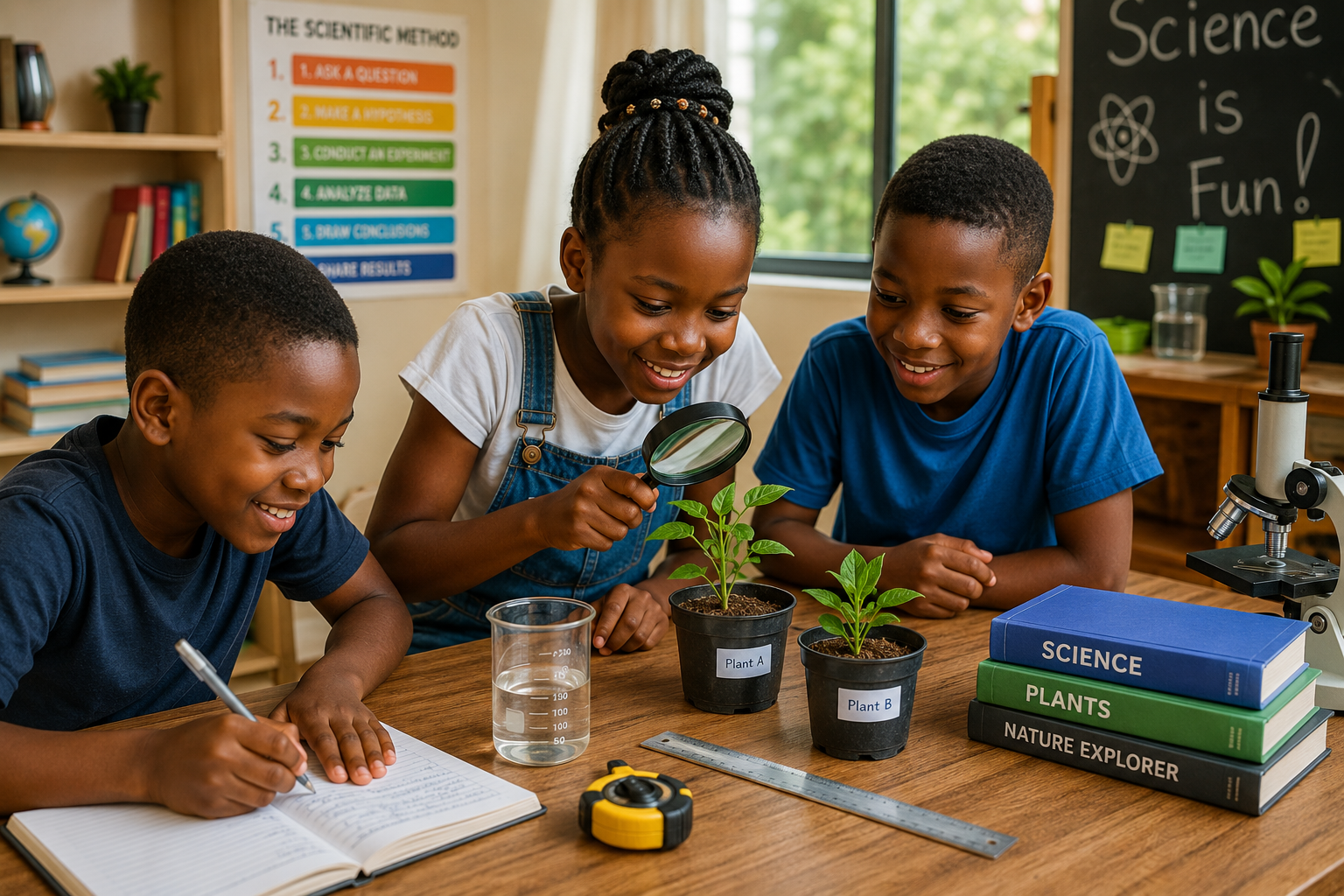
For example, imagine that you notice a plant beside a sunny window appears to be growing better than another plant kept in a darker location.
You might ask:
“Does the amount of light affect plant growth?”
You could investigate the question by growing similar plants under controlled conditions, measuring their growth, recording your observations, and comparing the results.
That is an example of scientific thinking.
What Does Science Study?
Scientists study almost every part of the natural world, including:
- Living things
- Humans and other animals
- Plants
- Microorganisms
- Matter
- Energy
- Forces and motion
- Earth and its atmosphere
- Oceans and weather
- The solar system
- Stars and galaxies
Science is therefore a very broad field with many specialized areas.
How Does Science Work?
Science often begins with curiosity.
A person notices something and wonders why or how it happens.
Scientific investigations can take different forms depending on the question. Scientists may conduct experiments, make observations, take measurements, analyze existing data, build models, or use other research methods.
A simplified investigation may include these steps.
1. Ask a Question
Scientists begin with a question that can be investigated.
For example:
“Which type of soil helps bean plants grow best?”
A good scientific question is specific enough to investigate.
2. Make Observations
An observation is information gathered using our senses or scientific instruments.
For example, you might notice that one plant is taller than another.
Scientists can use instruments such as:
- Microscopes
- Thermometers
- Rulers
- Scales
- Cameras
- Telescopes
- Sensors
Scientific tools allow researchers to observe and measure things more accurately.
3. Make a Testable Prediction
Scientists may propose an explanation or prediction that can be tested.
For example:
“I predict that the bean plant grown in nutrient-rich soil will grow taller.”
A testable prediction can be investigated using evidence.
4. Carry Out an Investigation
The investigation is designed to answer the question.
If an experiment is being conducted, scientists try to control important variables so that they can understand what may have caused the results.
5. Collect Evidence
Scientists carefully record what they observe.
Evidence can include:
- Measurements
- Written observations
- Photographs
- Experimental results
- Survey or field data
- Samples
- Computer-generated measurements
Keeping accurate records is an important part of scientific work.
6. Analyze the Results
Scientists examine the evidence they have collected.
They may use tables, graphs, calculations, statistical methods, or scientific models to identify patterns and relationships.
7. Draw Conclusions
Scientists use the evidence to determine what their investigation suggests.
Sometimes the evidence supports their original prediction.
Sometimes it does not.
A result that does not support a prediction is not necessarily a failure. It can provide useful information and lead to new questions.
Science develops as people investigate questions, compare evidence, communicate findings, and continue testing explanations.
What Are the Main Branches of Science?
Science covers a huge range of subjects. Because there is so much to learn, scientists often specialize in particular fields.
Biology
Biology is the study of living organisms.
Biologists investigate plants, animals, humans, microorganisms, ecosystems, cells, and many other aspects of life.
Questions in biology include:
- How do plants grow?
- How do animals survive?
- How do cells function?
- How do living things interact with their environments?
Chemistry
Chemistry is the study of matter and the changes and interactions of substances.
Chemists investigate what substances are made of, how they behave, and how they interact.
For example, chemistry helps us understand processes such as rusting, dissolving, and chemical reactions.
Physics
Physics is the study of matter, energy, motion, forces, and interactions.
Physics helps us understand phenomena such as:
- Gravity
- Light
- Sound
- Electricity
- Magnetism
- Motion
- Heat
When you ride a bicycle, throw a ball, or hear music, you are experiencing phenomena that can be studied using physics.
Earth Science
Earth science focuses on Earth and its natural systems.
It includes areas such as:
- Geology
- Meteorology
- Oceanography
- Atmospheric science
Earth scientists study rocks, Earth’s structure, weather, oceans, earthquakes, and other natural processes.
Astronomy
Astronomy is the scientific study of objects and phenomena beyond Earth.
Astronomers study:
- Stars
- Planets
- Moons
- Asteroids
- Galaxies
- Black holes
- Other astronomical objects and phenomena
Astronomy helps scientists learn more about our solar system and the universe.
Science Is All Around You
You do not need to be inside a laboratory to experience science.
Science can be found in ordinary activities.
When you cook food, physical and chemical changes can occur.
When you ride a bicycle, forces and motion are involved.
When you hear music, sound waves travel through a medium.
When sunlight passes through raindrops, the interaction of light and water can produce a rainbow.
When a seed develops into a plant, biological processes are taking place.
Even melting ice provides an opportunity to observe a change of state.
The world around you can become your science classroom.
Science and Technology: Are They the Same?
Science and technology are closely related, but they are not the same thing.
Science seeks to understand the natural world through systematic investigation and evidence.
Technology involves using knowledge, skills, tools, and processes to accomplish goals or solve practical problems.
For example, scientific research can help people understand how a disease-causing organism behaves. Engineers, medical researchers, and other professionals may then use scientific knowledge as part of developing tools, diagnostic methods, treatments, or other technologies.
Science and technology can therefore influence each other.
Can Kids Be Scientists?
Absolutely!
Children are naturally curious. Asking questions, observing carefully, making predictions, testing ideas, and recording results are all activities associated with scientific thinking.
You can start with simple questions such as:
- Which paper airplane design flies the farthest?
- Does the amount of light affect plant growth?
- Which objects float or sink in water?
- Does the temperature of water affect how quickly ice melts?
- Which surfaces create more friction?
The goal is not simply to get the “right” answer.
The goal is to ask a good question, gather evidence, think carefully about the results, and learn from what happens.
A Simple Science Investigation Kids Can Try
Does Sunlight Affect Plant Growth?
This activity can help children practice scientific thinking.
Question: Does the amount of sunlight affect plant growth?
What you need:
- Two similar plants or seeds
- Two suitable containers
- Similar growing medium
- Water
- A ruler
- A notebook
Method:
- Place the plants in locations receiving different amounts of light.
- Keep other conditions as similar as reasonably possible.
- Give them appropriate amounts of water.
- Measure their growth regularly.
- Record your observations.
- Compare the results after an agreed period.
What should you record?
You might record:
- Plant height
- Number of leaves
- Appearance
- Date of each measurement
What Can You Learn?
The results can help you investigate whether the amount of light was associated with differences in plant growth.
However, a simple home experiment may not control every factor that affects plant growth. Soil composition, temperature, water, plant variety, pests, and other conditions can also influence the results.
This is an important lesson in science:
Good investigations require careful thinking about other factors that could affect the result.
For younger children, an adult should help choose appropriate materials and supervise the activity.
Why Is Science Important for Kids?
Science is important because it helps children understand the world and develop useful ways of thinking.
1. Critical Thinking
Science encourages children to ask:
“What evidence supports this claim?”
This can help them distinguish between evidence-based information, opinions, guesses, and unsupported claims.
2. Problem-Solving
Scientific investigations give children opportunities to break problems into smaller questions and look for evidence-based solutions.
3. Curiosity
Science encourages children to ask questions about things they see every day.
4. Observation
Children learn to pay attention to details, measure things, and record information.
5. Creativity
Designing investigations and finding ways to test ideas can involve creativity.
6. Communication
Scientists need to explain their questions, methods, evidence, and conclusions clearly.
These skills are useful both inside and outside the science classroom.
Science in Everyday Life
Science affects many parts of modern life.
Scientific knowledge contributes to fields such as:
- Medicine and healthcare
- Agriculture
- Environmental protection
- Engineering
- Transportation
- Communication
- Energy
- Weather forecasting
- Food production
- Space exploration
For children, understanding science can also help make everyday experiences more meaningful.
A simple walk outside can become an opportunity to observe insects, plants, clouds, rocks, shadows, sounds, and changes in temperature.
Common Misconceptions About Science
Science Is Just Memorizing Facts
Science includes learning facts, but scientific learning also involves asking questions, examining evidence, investigating problems, and explaining observations.
Scientists Always Know the Answer
Scientists do not know everything. Research often begins because an important question does not yet have a complete answer.
An Experiment Must Always Prove Your Prediction
Not necessarily. An experiment can produce evidence that does not support the original prediction. That result can still be useful.
Science Only Happens in Laboratories
Scientists work in many environments, including laboratories, hospitals, oceans, forests, observatories, farms, classrooms, field sites, and computer environments.
Frequently Asked Questions About Science
What is science in simple words?
Science is a way of learning about the natural world by asking questions, making observations, investigating ideas, collecting evidence, and using that evidence to develop explanations.
What is a simple science definition for kids?
A simple science definition for kids is: Science is a way of studying the natural world and using evidence to understand how things work.
Why is science important?
Science helps us understand the natural world, investigate problems, develop knowledge, and contribute to solutions in areas such as health, agriculture, engineering, and environmental protection.
What are the main branches of science?
Major areas of science include biology, chemistry, physics, Earth science, and astronomy. Each area contains many specialized fields.
Can children do science experiments?
Yes. Children can conduct simple, age-appropriate investigations at home or at school. Activities should be selected with safety in mind, and adult supervision should be provided when appropriate.
Is science only done in laboratories?
No. Scientists conduct research in many environments, including laboratories, fields, oceans, hospitals, observatories, classrooms, and other locations.
What is the scientific method?
The phrase scientific method is commonly used to describe approaches scientists use to investigate questions. However, real scientific research does not always follow one fixed sequence. Different scientific fields use different methods depending on the question being investigated.
What Kids Should Remember About Science
The most important ideas are:
- Science helps us investigate and understand the natural world.
- Science begins with questions and curiosity.
- Scientists use observations, evidence, investigations, and reasoning.
- Science has many branches, including biology, chemistry, physics, Earth science, and astronomy.
- Scientific results do not always match our predictions.
- Evidence is an important part of scientific explanations.
- Children can practice scientific thinking through simple investigations.
- Science is part of everyday life.
Final Thoughts: Keep Asking Questions
So, what is science?
Science is more than a school subject. It is a systematic way of investigating the natural world and building knowledge from observations and evidence.
The next time you see something you do not understand, don’t be afraid to ask:
Why does this happen?
How does it work?
What evidence could help me find out?
Those questions are the beginning of scientific thinking.
Stay curious. Observe carefully. Ask questions. Test ideas safely. Record what you discover.
Every scientific discovery begins with a question.
Sources & Further Reading
Recommended sources for readers and editorial verification include:
- NASA — educational resources explaining science, Earth, space, and scientific exploration.
- National Science Foundation (NSF) — information about science and scientific research.
- National Academies of Sciences, Engineering, and Medicine — scientific and educational resources.
- Smithsonian Institution — educational materials covering science, nature, history, and technology.
- National Oceanic and Atmospheric Administration (NOAA) — educational resources about Earth, oceans, weather, and climate.
Editorial note: Before publication, the editor should verify every external source link and ensure that claims in the article are supported by the cited source.
About the Author
Written by: Hauwa Yusuf Barau
Hauwa Yusuf Barau is an education writer and content creator focused on producing accessible, accurate, and useful educational resources for students, parents, teachers, and lifelong learners.
Relevant expertise: M.Ed. Special Education (Learning Disabilities/Biology)
Editorial policy: Educational content should be reviewed for factual accuracy before publication. Where appropriate, articles should be updated when reliable scientific evidence or educational guidance changes.
Original Publication Date: 28/8/2026
Last Updated: 28/8/2026
Fact-Checked/Reviewed By: Mary Ajayi Adedayo
Reviewer Credentials: Seasoned STEM teacher
Review Date: 28/8/2026
This article is designed to explain science in language that children can understand. Some concepts have been simplified for educational purposes. Simplification should not change the fundamental scientific meaning.
For classroom teaching or advanced study, readers should consult textbooks, teachers, scientific institutions, and other authoritative educational resources for greater detail.