


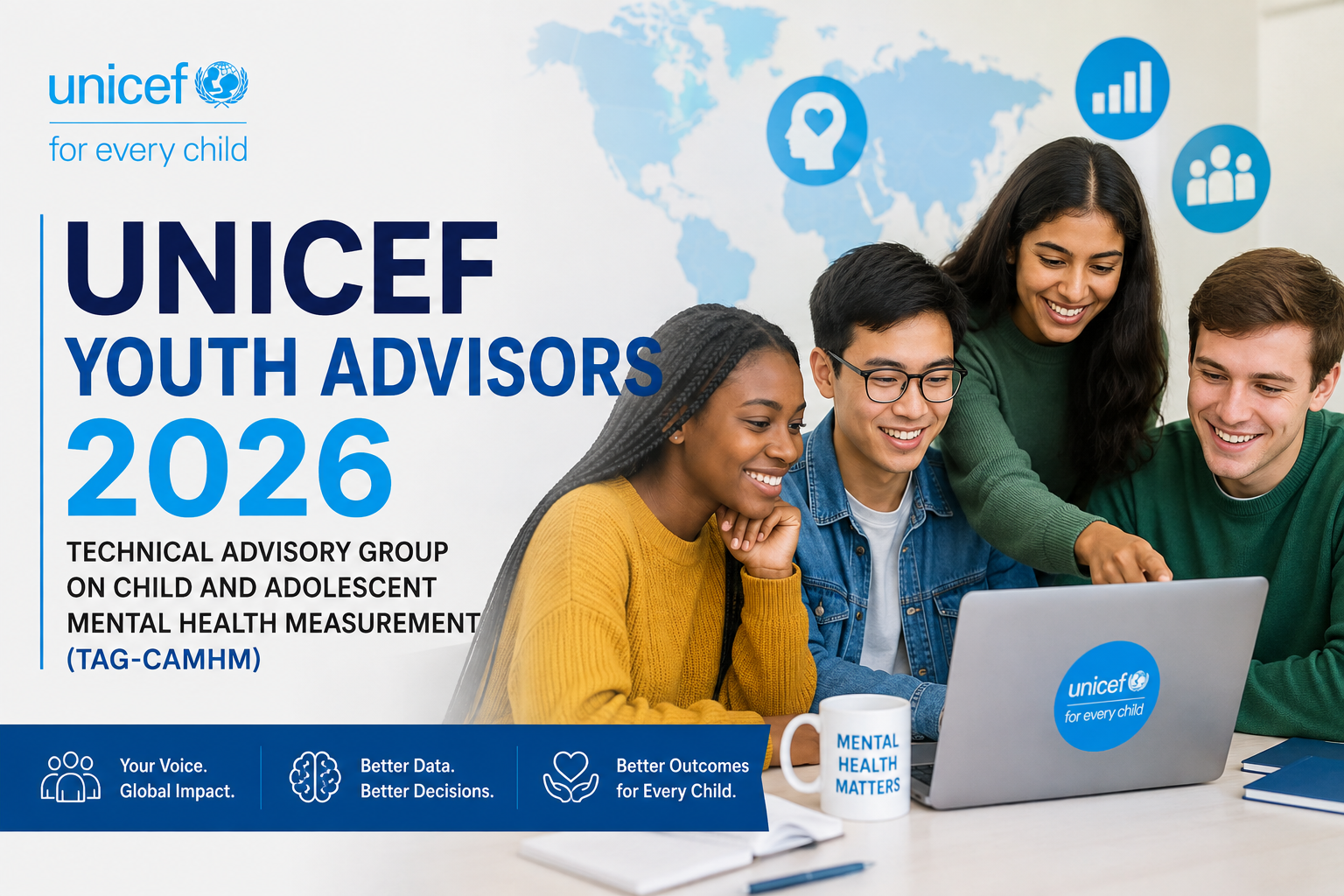







Discover how you can help shape global mental health research, represent youth voices, and contribute to evidence-based policies that improve the lives of children and adolescents worldwide.
Quick Facts
| Opportunity | Details |
|---|---|
| Organization | UNICEF (United Nations Children’s Fund) |
| Programme | Youth Advisors – Technical Advisory Group on Child and Adolescent Mental Health Measurement (TAG-CAMHM) |
| Category | Youth Advisory / Global Health / Research |
| Eligible Applicants | Young people who meet the eligibility requirements outlined in the official recruitment notice |
| Location | Global (primarily virtual unless otherwise stated by UNICEF) |
| Application Fee | None |
| Official Source | UNICEF’s official youth engagement and careers platforms |
| Application Status | Check UNICEF’s official announcements for current deadlines and eligibility requirements |
Important: Recruitment timelines, eligibility criteria, meeting schedules, and participation arrangements may change between application cycles. Always rely on the official UNICEF announcement for the most current information before submitting an application.
Why This Opportunity Matters
Young people today are navigating a rapidly changing world. From the lasting effects of the COVID-19 pandemic and economic uncertainty to climate-related challenges, conflict, digital pressures, and changing social expectations, many children and adolescents face circumstances that can affect their mental well-being.
Recognizing these realities, governments, researchers, educators, and international organizations are placing greater emphasis on understanding children’s mental health so they can develop programmes that genuinely respond to young people’s needs.
However, creating effective policies begins with one essential ingredient: reliable evidence.
Without accurate and culturally appropriate data, it becomes difficult to understand the mental health challenges affecting young people, identify those most in need of support, or evaluate whether existing programmes are making a positive difference.
This is why UNICEF’s Technical Advisory Group on Child and Adolescent Mental Health Measurement (TAG-CAMHM) is an important global initiative.
For the 2026 recruitment cycle, UNICEF is seeking youth advisors who can contribute fresh perspectives, lived experiences, and thoughtful insights to improve how mental health is measured among children and adolescents across different countries and cultures.
If you are passionate about youth leadership, public health, education, psychology, advocacy, research, or community development, this opportunity offers a meaningful way to contribute to work that could influence policies and programmes affecting millions of young people worldwide.
Understanding TAG-CAMHM
The Technical Advisory Group on Child and Adolescent Mental Health Measurement (TAG-CAMHM) is a UNICEF initiative that brings together researchers, technical experts, practitioners, and young people to strengthen the measurement of child and adolescent mental health.
At first glance, measuring mental health might appear straightforward. In reality, it is one of the most complex areas of public health research.
Unlike physical health, mental well-being cannot usually be measured using a single laboratory test or medical scan. Instead, researchers rely on carefully developed assessment tools, surveys, interviews, and scientifically validated questionnaires to understand emotional, behavioural, psychological, and social well-being.
These tools must be tested extensively to ensure they are:
- Reliable
- Valid
- Age-appropriate
- Culturally sensitive
- Ethically administered
- Suitable for different languages and communities
A questionnaire that accurately measures emotional well-being among adolescents in one country may not perform the same way in another because of differences in language, cultural beliefs, educational systems, family structures, or social norms.
For this reason, mental health researchers often adapt and validate assessment tools before using them in different populations rather than simply translating the questions.
TAG-CAMHM supports this important work by providing expert guidance on developing and improving approaches that can produce meaningful, reliable, and internationally comparable data.
Why Measuring Mental Health Is More Challenging Than Many People Realize
Mental health involves a wide range of emotional, psychological, behavioural, and social experiences.
Researchers must consider questions such as:
- How should anxiety be measured among children of different ages?
- How do cultural beliefs influence the way young people describe emotional distress?
- Can a survey developed in one country accurately reflect experiences elsewhere?
- Are assessment questions easy for children to understand?
- Do the tools identify genuine mental health concerns rather than temporary emotions?
Answering these questions requires collaboration among psychologists, statisticians, epidemiologists, educators, child development specialists, public health professionals, and importantly, young people themselves.
Youth advisors provide insights that technical experts alone may not recognize.
For example, they may identify language that feels confusing, outdated, culturally inappropriate, or difficult for young respondents to interpret accurately.
Their contributions help improve both the quality of research and the experiences of young participants.
Why Reliable Mental Health Data Matters
The phrase “good decisions depend on good information” is especially relevant in public health.
Governments, schools, healthcare providers, and development organizations rely on trustworthy data to understand what challenges children and adolescents are facing and where support is needed most.
Reliable mental health measurement helps decision-makers:
- Estimate how common different mental health conditions are among young people.
- Identify groups that may require additional support.
- Understand differences across age groups, communities, and regions.
- Evaluate whether interventions and programmes are achieving their intended outcomes.
- Allocate funding and resources more effectively.
- Monitor changes over time, including during humanitarian crises or public health emergencies.
When data are incomplete or inaccurate, policies and investments may fail to address the issues that matter most to young people.
This is one reason why organizations such as UNICEF continue investing in stronger approaches to child and adolescent mental health measurement.
Why UNICEF Includes Young People in Technical Advisory Work
One of UNICEF’s guiding principles is that children and young people should have meaningful opportunities to participate in decisions affecting their lives.
Rather than designing research exclusively through academic or institutional perspectives, UNICEF recognizes that young people possess valuable knowledge gained through their daily experiences at school, within families, online, and in their communities.
While technical experts contribute scientific knowledge, youth advisors help ensure that research remains grounded in real-world experiences.
This collaborative approach improves both the quality and relevance of research.
After reviewing previous UNICEF youth engagement initiatives, one consistent theme becomes clear: the organization values authentic participation rather than symbolic consultation. Youth advisors are encouraged to share thoughtful opinions, question assumptions respectfully, and contribute ideas that reflect the realities of their communities.
This emphasis on genuine youth engagement helps create research that is more inclusive, practical, and responsive to diverse experiences.
What Youth Advisors May Contribute
Depending on the scope of the advisory group’s activities, youth advisors may have opportunities to provide feedback on areas such as:
- Research priorities
- Survey questions
- Questionnaire language
- Cultural appropriateness
- Ethical considerations involving children and adolescents
- Communication materials
- Youth engagement strategies
- Accessibility of research tools
- Inclusivity across different communities
Their perspectives can help researchers identify potential challenges before studies are implemented, improving both participant experience and data quality.
Importantly, youth advisors do not replace technical experts. Instead, they complement scientific expertise by contributing perspectives that only young people with lived experiences can provide.
Who Can Apply?
Although specific eligibility requirements vary depending on each recruitment cycle, UNICEF generally seeks applicants who demonstrate a genuine commitment to improving the lives of children and young people.
Successful applicants often come from diverse educational, cultural, and professional backgrounds.
Rather than focusing solely on academic qualifications, UNICEF frequently values applicants who demonstrate meaningful engagement within their communities and a willingness to collaborate respectfully with people from different backgrounds.
Some qualities that may strengthen an application include:
A Genuine Interest in Child and Adolescent Mental Health
Applicants should be able to explain why mental health matters to them and how their interests align with the objectives of the advisory group.
This interest might have developed through volunteer work, advocacy, academic studies, youth leadership programmes, school initiatives, or community engagement.
Having a sincere motivation is often more compelling than attempting to present an overly polished application.
Youth Leadership and Community Engagement
Leadership does not always involve holding an official title.
Many young people demonstrate leadership by organizing community initiatives, mentoring peers, volunteering with local organizations, leading school clubs, participating in awareness campaigns, or supporting projects that improve the well-being of others.
UNICEF often values these practical experiences because they demonstrate initiative, collaboration, and commitment to positive social impact.
Strong Communication and Collaboration Skills
As a Youth Advisor, you may work with researchers, public health professionals, youth representatives, and other stakeholders from different parts of the world. While technical expertise is valuable, UNICEF also values applicants who can communicate thoughtfully, listen respectfully, and collaborate effectively in diverse environments.
Strong communication skills include the ability to:
- Express ideas clearly in written and spoken English (or any language specified in the call for applications).
- Respectfully consider perspectives that differ from your own.
- Participate constructively in group discussions.
- Ask thoughtful questions when clarification is needed.
- Provide honest feedback in a professional and respectful manner.
International advisory groups often bring together participants with different cultural backgrounds and lived experiences. Being open-minded and willing to learn from others is just as important as sharing your own perspective.
A Global Perspective and Respect for Diversity
One of UNICEF’s greatest strengths is its global reach. The organization works with children and young people in countries with different cultures, languages, education systems, and social realities.
Youth Advisors are expected to appreciate this diversity and understand that there is rarely a one-size-fits-all solution to improving child and adolescent mental health.
Applicants who demonstrate cultural sensitivity, empathy, and a willingness to consider multiple viewpoints often bring significant value to international advisory discussions.
Whether you come from a rural community in Nigeria, a bustling city in Kenya, a small island nation in the Pacific, or a metropolitan area in Europe, your experiences can help researchers better understand how children’s mental health is influenced by different environments.
Benefits of Becoming a UNICEF Youth Advisor
Serving as a Youth Advisor is more than adding an impressive line to your résumé. It is an opportunity to contribute meaningfully to research that may influence future policies, programmes, and services supporting children and adolescents around the world.
While the exact experience may differ depending on the advisory group’s activities, participants often gain valuable personal and professional development opportunities.
1. Contribute to Work with Global Impact
Perhaps the greatest reward is knowing that your ideas could help improve how child and adolescent mental health is understood across different countries.
Better measurement leads to better evidence. Better evidence supports better decisions. Those decisions can influence educational programmes, healthcare services, social protection initiatives, and youth-focused policies.
Although Youth Advisors do not make policy decisions themselves, their perspectives can help researchers design studies that more accurately reflect the realities experienced by young people.
2. Develop Valuable Leadership Skills
Participating in an international advisory group can strengthen transferable skills that remain useful long after the programme ends.
These include:
- Critical thinking
- Collaborative problem-solving
- Public speaking
- Professional communication
- Cross-cultural teamwork
- Ethical decision-making
- Research literacy
- Leadership and advocacy
These competencies are valuable across many career fields, including public health, education, psychology, medicine, social work, law, development, communications, and public policy.
3. Learn How International Research Works
Many young people are interested in research but have limited opportunities to observe how large international studies are designed.
Depending on the scope of the programme, Youth Advisors may gain insight into topics such as:
- Research planning
- Survey development
- Ethical considerations
- Stakeholder consultation
- Data quality
- Cross-cultural adaptation
- Youth participation in research
Understanding these processes can be particularly valuable for students considering careers in academia, healthcare, international development, or evidence-based policymaking.
4. Build an International Professional Network
International programmes often bring together participants from different countries and professional backgrounds.
Depending on the nature of the advisory activities, participants may have opportunities to interact with:
- Researchers
- Mental health specialists
- Public health professionals
- Youth advocates
- UNICEF staff
- Policy experts
- Fellow Youth Advisors from around the world
Building relationships with individuals who share similar interests can lead to future learning opportunities and long-term professional connections.
Why African Youth Should Consider Applying
Africa is home to one of the youngest populations in the world, making the perspectives of African young people especially important in global conversations about child and adolescent well-being.
Young people across the continent experience diverse realities shaped by factors such as:
- Education systems
- Urbanization
- Rural livelihoods
- Economic opportunities
- Healthcare access
- Digital transformation
- Climate change
- Migration
- Conflict and displacement
- Cultural traditions
- Family and community support structures
These experiences provide valuable insights that cannot always be captured through statistical reports alone.
For example, discussions around mental health may differ significantly between communities where traditional support systems remain strong and communities where young people primarily seek help through schools, healthcare providers, or digital platforms.
Including diverse African voices helps ensure that mental health measurement tools are culturally appropriate and relevant across different settings rather than reflecting only one regional perspective.
How Your Experiences Can Strengthen Your Application
Many applicants mistakenly believe they need an impressive list of awards or international achievements to be considered.
In reality, meaningful community involvement often carries significant weight.
Consider highlighting experiences such as:
- Organizing community awareness campaigns.
- Volunteering with youth-focused organizations.
- Serving in student leadership positions.
- Mentoring younger students.
- Participating in peer support initiatives.
- Contributing to school improvement projects.
- Advocating for inclusion and equality.
- Working with local NGOs or community groups.
- Supporting initiatives related to education, health, or child protection.
- Participating in youth consultations or civic engagement programmes.
The key is not the size of the project but the impact you made and what you learned from the experience.
Admissions reviewers are often more interested in authentic contributions than in lengthy lists of achievements.
Preparing a Competitive Application
Submitting a strong application involves more than completing an online form.
The most compelling applications usually demonstrate authenticity, reflection, and a clear understanding of the programme’s objectives.
1. Understand UNICEF’s Mission
Before applying, spend time learning about UNICEF’s work in child protection, education, health, nutrition, youth engagement, and mental health.
Understanding the organization’s priorities allows you to explain how your experiences align with its mission.
Avoid simply repeating information from UNICEF’s website. Instead, connect your own experiences to the values UNICEF promotes.
2. Reflect on Your Personal Journey
One common mistake applicants make is trying to sound overly formal or writing what they think reviewers want to hear.
Instead, focus on your genuine experiences.
Ask yourself:
- What inspired your interest in youth development?
- Have you witnessed challenges affecting young people’s well-being?
- What community issues have motivated you to become involved?
- What lessons have you learned through volunteering or leadership?
Specific examples often create a stronger impression than broad statements.
For instance, instead of writing:
“I am passionate about helping young people.”
You could explain a real experience that sparked your interest, such as mentoring classmates, organizing a school awareness programme, or volunteering with a community organization.
3. Demonstrate Curiosity and a Willingness to Learn
You are not expected to be an expert in mental health research before applying.
What matters is showing that you are eager to learn, collaborate, and contribute thoughtfully.
Reviewers often appreciate applicants who ask insightful questions, remain open to feedback, and demonstrate intellectual curiosity.
4. Highlight Teamwork
Research is rarely conducted by individuals working alone.
Think about examples where you successfully:
- Collaborated on a school project.
- Led a volunteer team.
- Worked with people from different backgrounds.
- Resolved disagreements constructively.
- Supported others in achieving a common goal.
These experiences demonstrate qualities that are highly relevant to advisory work.
5. Proofread Every Response Carefully
Before submitting your application:
- Check grammar and spelling.
- Ensure each answer directly addresses the question.
- Stay within the required word limits.
- Remove unnecessary repetition.
- Ask a trusted teacher, mentor, or colleague to review your application if possible.
A carefully edited application demonstrates professionalism and attention to detail.
Common Mistakes Applicants Should Avoid
Even strong candidates sometimes weaken their applications by making avoidable mistakes.
Some of the most common include:
Exaggerating Achievements
Reviewers are more interested in genuine contributions than inflated accomplishments.
Be honest about your experiences and clearly describe the role you personally played.
Writing Generic Responses
Avoid statements that could apply to almost anyone.
Instead of saying:
“I like helping people.”
Explain how you have helped others and what you learned from those experiences.
Ignoring the Organization’s Priorities
Tailor your application to the specific opportunity.
Demonstrate that you understand the purpose of TAG-CAMHM and why youth participation is important in improving child and adolescent mental health research.
Waiting Until the Last Minute
Preparing a thoughtful application takes time.
Starting early gives you enough opportunity to review eligibility requirements, gather supporting information, refine your responses, and avoid unnecessary errors.
Overlooking the Instructions
Read the official application guidance carefully.
Missing required information, exceeding word limits, or failing to answer all questions can reduce the overall quality of an otherwise strong application.
How to Apply for the UNICEF Youth Advisors 2026 Opportunity
If UNICEF opens applications for the 2026 Technical Advisory Group on Child and Adolescent Mental Health Measurement (TAG-CAMHM), prospective applicants should carefully review the official announcement before beginning the application process.
Although recruitment procedures may vary between application cycles, the process typically includes the following steps:
1. Visit UNICEF’s Official Platforms
Always begin by checking UNICEF’s official careers and youth engagement pages. These platforms provide the most accurate information about:
- Eligibility requirements
- Application deadlines
- Required documents
- Selection criteria
- Programme expectations
Avoid relying solely on information shared on social media or unofficial websites.
2. Confirm Your Eligibility
Before investing time in your application, ensure that you meet all published eligibility requirements. Pay close attention to factors such as:
- Age requirements
- Country or regional eligibility (if applicable)
- Language requirements
- Previous experience, where required
- Availability to participate in advisory meetings or activities
3. Prepare Your Supporting Information
Depending on the recruitment cycle, applicants may be asked to provide:
- Personal information
- Educational background
- Volunteer or leadership experience
- Responses to application questions
- A motivation statement
- A curriculum vitae (CV) or résumé
- References, if requested
Always provide accurate information and ensure your responses reflect your own experiences.
4. Write a Strong Motivation Statement
Your motivation statement is often one of the most important parts of the application.
Rather than listing achievements, explain:
- Why child and adolescent mental health matters to you.
- How your experiences have shaped your interest.
- What unique perspective you can bring.
- Why you are interested in contributing to UNICEF’s work.
- What you hope to learn from the experience.
Specific examples are generally more persuasive than broad statements.
5. Submit Before the Deadline
Avoid submitting your application at the last minute.
Applying early gives you time to resolve technical issues, review your responses, and ensure all required documents have been uploaded successfully.
Why Authenticity Matters
One lesson that consistently emerges from youth engagement programmes is that authenticity is more valuable than perfection.
Many applicants worry that they have not won enough awards or participated in enough international conferences. In reality, meaningful local experiences—such as volunteering in your community, mentoring younger students, leading a school club, or participating in awareness campaigns—can demonstrate qualities that advisory groups value highly.
Instead of trying to sound like an expert, focus on communicating honestly about your experiences, your willingness to learn, and your commitment to improving the well-being of children and young people.
Frequently Asked Questions (FAQs)
Is the UNICEF Youth Advisor position paid?
The terms of participation vary depending on the specific programme. Always refer to the official UNICEF opportunity announcement to determine whether the role is voluntary, paid, or includes reimbursement for eligible expenses.
Do I need a degree in psychology to apply?
Not necessarily. While an interest in child and adolescent mental health is important, UNICEF often values diverse educational backgrounds and meaningful youth engagement. Always check the eligibility requirements for the specific recruitment cycle.
Can students apply?
If students meet the published eligibility requirements, they may be eligible to apply. The official announcement will specify any age, education, or experience requirements.
Can applicants from African countries apply?
UNICEF encourages participation from diverse regions around the world. If the opportunity is open globally, eligible applicants from African countries are generally encouraged to apply. Always confirm eligibility in the official announcement.
Do I need previous international experience?
International experience is not always required. Community involvement, youth leadership, volunteering, advocacy, and other meaningful experiences may also strengthen an application.
Final Thoughts
The UNICEF Youth Advisors 2026 opportunity for the Technical Advisory Group on Child and Adolescent Mental Health Measurement (TAG-CAMHM) represents more than a volunteer role—it is an opportunity to contribute to work that could improve how the world understands and supports the mental well-being of children and adolescents.
By bringing together researchers, technical experts, and young people, UNICEF aims to develop measurement approaches that are scientifically robust, culturally appropriate, and responsive to the diverse realities of children across different countries and communities.
If you are passionate about youth leadership, research, education, psychology, public health, or community development, this programme offers an opportunity to share your perspective while learning from professionals and peers committed to improving children’s lives.
Before applying, take time to review the official guidance, prepare thoughtful responses, and reflect on the experiences that have shaped your commitment to youth well-being. A genuine application grounded in real experiences will always be stronger than one built on exaggerated achievements.
Whether or not you are selected, preparing an application can be a valuable opportunity to reflect on your leadership journey, strengthen your communication skills, and identify new ways to contribute to your community.