










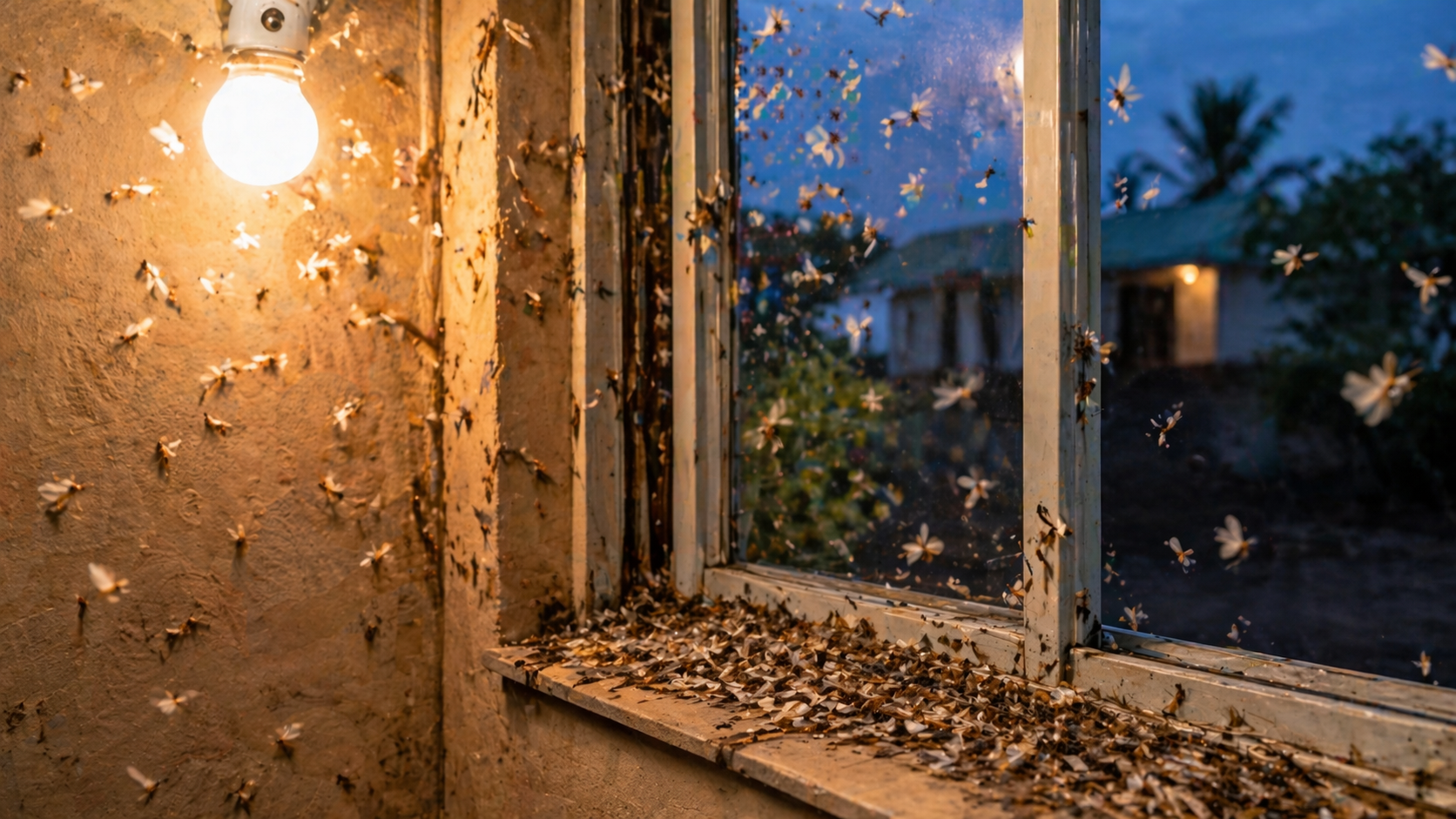
Spotting a sudden swarm of flying insects inside your home can feel unsettling. Many homeowners initially assume they’re harmless ants—until they realize they’re termites.
From real inspection cases, one of the most common mistakes people make is ignoring a swarm because it “disappears quickly.” Unfortunately, by the time swarmers appear, a termite colony may already be well established nearby—or even inside your home.
This guide explains exactly what a termite swarm means, what you should do immediately, and how to protect your home from costly structural damage.
What Is a Termite Swarm? (And Why It Happens)
A termite swarm occurs when reproductive termites—called alates—leave their colony to form new ones. This typically happens when environmental conditions are ideal, especially:
- Warm temperatures
- High humidity
- Recent rainfall
In many regions, subterranean termites (the most destructive type) swarm during the rainy season because moist soil helps new colonies survive.
Swarming is a natural part of the termite life cycle—but for homeowners, it’s often the first visible warning sign of hidden activity.
Why a Termite Swarm Should Never Be Ignored
A common misconception is that a swarm is harmless if it only happens once. In practice, that’s risky.
From field observations and pest control reports:
- Outdoor swarm → termites are active nearby
- Indoor swarm → high likelihood of an active infestation inside
Termites feed on cellulose (found in wood), and over time they can silently damage:
- Structural beams
- Flooring systems
- Roofing supports
- Doors and window frames
Because this damage often occurs behind walls or under floors, homeowners usually don’t notice until repairs become expensive.
How to Identify a Termite Swarm (Avoid Costly Confusion)
Many people confuse termite swarmers with flying ants. Correct identification is critical.
Key Differences: Termites vs Flying Ants
Termite swarmers:
- Straight antennae
- Thick, uniform body (no narrow waist)
- Two pairs of wings of equal length
- Wings shed easily and pile up near windows
Flying ants:
- Bent antennae
- Narrow “pinched” waist
- Unequal wing sizes
Common Signs Around Your Home
Watch for:
- Piles of discarded wings near windows or light sources
- Swarmers clustering around bulbs at night
- Mud tubes along walls or foundations
- Wood that sounds hollow when tapped
If you notice multiple signs together, act quickly.
Immediate Steps to Take If You See a Termite Swarm
1. Stay Calm—but Take It Seriously
A swarm may last only 30–60 minutes, but the colony behind it does not disappear.
If possible, note:
- Where the termites are coming from
- Whether they are indoors or outdoors
This information is extremely useful during inspection.
2. Close Off Entry Points
If termites are entering from outside:
- Shut windows and doors immediately
- Turn off outdoor lights (they attract swarmers)
- Temporarily seal visible cracks or gaps
This reduces further entry but does not solve the infestation.
3. Clean Up Evidence (Don’t Skip This)
After the swarm:
- Vacuum or sweep dead termites and wings
- Dispose of them in a sealed bag
Pro tip from inspections:
Leave a small sample or take clear photos—this helps professionals confirm species quickly.
4. Avoid DIY Sprays (They Can Backfire)
Many homeowners try insect sprays. While these kill visible termites, they do not eliminate the colony.
In some cases, surface spraying can:
- Scatter termites deeper into walls
- Make infestations harder to track
When You Should Be Seriously Concerned
Indoor Swarms = High Risk
If termites appear:
- In bedrooms
- From ceilings or walls
- Far from windows or doors
…it often indicates an active internal colony.
Repeated Swarms
Seeing swarmers more than once (especially within weeks) suggests:
- A mature colony nearby
- Ongoing reproduction
Structural Warning Signs
Combine swarms with:
- Soft or crumbling wood
- Bubbling or peeling paint
- Warped surfaces
…and the risk of structural damage increases significantly.
Why Professional Inspection Is Essential
Termites are not easy to locate without proper tools and training.
In a typical inspection, professionals may use:
- Moisture meters
- Probing tools to test wood integrity
- Infrared or thermal detection (in advanced cases)
A proper inspection will:
- Identify the termite species
- Locate the colony source
- Assess the extent of damage
- Recommend targeted treatment
In many cases, early inspection can prevent thousands in repair costs.
Common Treatment Methods (What Experts Actually Use)
Depending on severity, professionals may recommend:
1. Soil (Barrier) Treatments
Liquid termiticides are applied around the foundation to block termite entry.
2. Baiting Systems
Stations placed in the ground attract termites, which carry bait back to destroy the colony.
3. Wood Treatments
Direct applications protect vulnerable wood and stop further feeding.
Each method is chosen based on:
- Infestation size
- Location
- Termite species
How to Prevent Future Termite Problems
Prevention is far cheaper than treatment. Here’s what consistently works:
Control Moisture (Critical Factor)
Termites thrive in damp conditions.
- Fix leaking pipes and faucets
- Improve drainage around your home
- Use ventilation or dehumidifiers in damp areas
Eliminate Wood-to-Soil Contact
Avoid direct contact between wood and ground:
- Raise deck posts
- Keep fences from touching soil directly
- Store firewood off the ground
Store Wood Properly
- Keep firewood at least 20 feet away from your home
- Elevate it above ground level
Seal Entry Points
Regularly inspect and seal:
- Foundation cracks
- Gaps around pipes and cables
- Window and door openings
Schedule Annual Inspections
Experts widely recommend yearly termite inspections, especially in warm or humid climates.
A typical inspection:
- Takes 1–2 hours
- May cost between $50–$150 depending on location
Common Mistakes Homeowners Make
Avoid these costly errors:
- Ignoring a swarm because it disappears
- Relying only on DIY sprays
- Waiting until visible damage appears
- Skipping routine inspections
From real cases, delays are one of the biggest reasons minor issues turn into major repairs.
What a Termite Swarm Really Means for Your Home
A termite swarm is not just a temporary nuisance—it’s a signal.
Even if no damage is visible:
- Termites are active nearby
- Conditions may support infestation
- Your home could be at risk
The earlier you respond, the easier and cheaper it is to manage.
Conclusion: Act Early, Save Your Home
Seeing a termite swarm can be alarming—but it’s also an opportunity to act before serious damage occurs.
The smartest approach is simple:
- Identify the insects correctly.
- Prevent further entry.
- Document what you see.
- Arrange a professional inspection quickly.
With early action and proper prevention, you can protect your home, avoid costly repairs, and stay ahead of termite problems.