









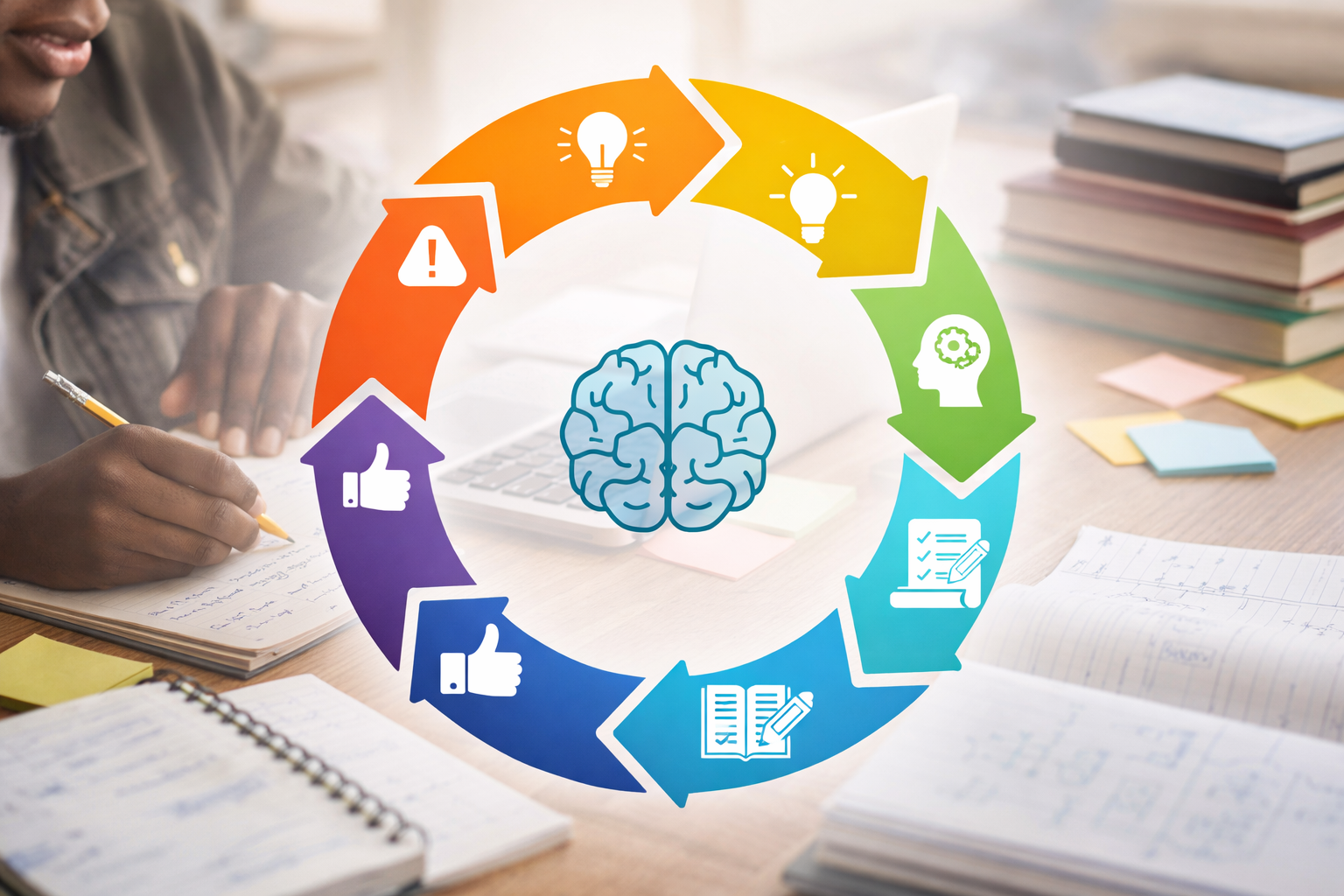
Learning is not a mysterious talent reserved for a few gifted individuals. It is a structured cognitive process that follows identifiable psychological and neurological principles. When those principles are understood and applied deliberately, learning becomes faster, deeper, and more durable.
As someone who has worked with students preparing for exams and professionals developing new skills, I’ve repeatedly observed that poor results are rarely caused by low intelligence. Instead, they stem from missing one or more foundational elements of effective learning.
This guide presents the 7 essential elements of learning, grounded in cognitive science, educational psychology, and classroom practice. You’ll not only understand what they are — but also how to apply them systematically.
Why Understanding the Elements of Learning Matters
Modern research in cognitive psychology shows that learning depends on how information moves through:
- Attention
- Working memory
- Long-term memory
Educational researcher John Sweller’s Cognitive Load Theory explains that when mental overload occurs, learning breaks down. Similarly, research on memory consolidation shows that repeated, effortful retrieval strengthens retention.
When learners understand these mechanisms, they can design study strategies that align with how the brain actually works.
The 7 Elements of Learning (Research-Based)
1. Attention and Focus
Learning begins with attention. Without it, information never reaches working memory.
Neuroscience research shows that attention acts as a gatekeeper. Distractions — especially digital interruptions — fragment working memory capacity, which is limited by nature.
In classroom observations, students who study in uninterrupted 25–40 minute blocks consistently outperform those who multitask.
Evidence Base
Research on divided attention demonstrates that multitasking reduces encoding efficiency and memory retention.
Practical Implementation
- Study in distraction-free blocks (e.g., Pomodoro method)
- Silence notifications
- Work on one cognitively demanding task at a time
Key Insight: You cannot learn what you do not attend to.
2. Motivation (Intrinsic and Extrinsic)
Motivation fuels persistence and effort.
According to Self-Determination Theory (Deci & Ryan), intrinsic motivation — driven by curiosity and personal meaning — leads to deeper processing and stronger retention than purely external rewards.
In practice, I’ve seen students dramatically improve once they connect material to real-world relevance rather than grades alone.
Evidence Base
Research in educational psychology shows intrinsic motivation correlates with deeper learning strategies and improved conceptual understanding.
Practical Implementation
- Connect topics to long-term goals
- Set mastery-based goals (improve skill, not just score)
- Track visible progress
Key Insight: Motivation determines whether learning efforts are sustained long enough to succeed.
3. Prior Knowledge and Schema Activation
Learning is cumulative. New knowledge attaches to existing mental frameworks, known as schemas.
If foundational knowledge is weak, advanced concepts feel overwhelming. This explains why students struggle in algebra without arithmetic fluency.
Cognitive science confirms that comprehension improves when learners activate prior knowledge before encountering new material.
Evidence Base
Schema theory demonstrates that background knowledge strongly predicts comprehension and retention.
Practical Implementation
- Review prerequisite concepts
- Ask: “What do I already know about this?”
- Use concept maps to connect ideas
Key Insight: Learning builds — it does not stack randomly.
4. Active Engagement (Active Learning)
Passive exposure does not equal learning.
A landmark 2014 meta-analysis published in the Proceedings of the National Academy of Sciences found that students in active learning environments performed significantly better than those in traditional lectures.
Active engagement forces retrieval, elaboration, and application — processes that strengthen neural pathways.
What Active Learning Looks Like
- Teaching concepts aloud
- Solving problems without notes
- Writing summaries from memory
- Participating in discussions
In exam preparation settings, students who self-tested regularly retained information far longer than those who reread notes.
Key Insight: The brain strengthens what it actively reconstructs.
5. Practice and Spaced Repetition
Learning fades quickly without reinforcement. Hermann Ebbinghaus’s research on the “forgetting curve” showed that memory declines rapidly unless reviewed.
Spaced repetition interrupts this forgetting process by reviewing material at increasing intervals.
Evidence Base
Research on retrieval practice shows that testing oneself improves long-term retention more effectively than passive review.
Practical Implementation
- Use flashcards spaced over days or weeks
- Take practice exams
- Review errors deliberately
- Break complex skills into components
Key Insight: Durable learning requires repeated, effortful recall over time.
6. Feedback and Reflection
Practice alone is insufficient. Without feedback, learners may reinforce errors.
Effective feedback is:
- Specific
- Timely
- Actionable
In both classrooms and skill development programs, I’ve observed that students who receive detailed corrective feedback improve significantly faster than those who receive generic praise.
Reflection strengthens metacognition — awareness of one’s own thinking.
Reflection Questions
- What mistakes did I make?
- Why did I make them?
- What strategy will I adjust next time?
Key Insight: Feedback accelerates improvement; reflection solidifies it.
7. Application and Transfer
True learning is demonstrated through transfer — applying knowledge in new contexts.
Research in cognitive psychology shows that transfer strengthens when learners practice applying concepts in varied scenarios.
For example:
- Applying math skills to budgeting
- Using scientific reasoning to evaluate news claims
- Applying communication skills in professional settings
When knowledge is used flexibly, it becomes functional rather than theoretical.
Key Insight: Learning is complete when it can be used.
How the 7 Elements Work as a System
These elements are interconnected:
- Attention enables encoding.
- Motivation sustains effort.
- Prior knowledge enables integration.
- Active engagement strengthens processing.
- Practice consolidates memory.
- Feedback corrects errors.
- Application ensures transfer.
If one element is weak, learning efficiency drops. For example:
- Practice without feedback reinforces mistakes.
- Motivation without focus leads to distraction.
- Engagement without prior knowledge leads to confusion.
High-performing learners optimize all seven simultaneously.
A Practical 30-Day Learning Upgrade Plan
To translate theory into action:
Week 1: Optimize Attention
- Create distraction-free study sessions.
- Track focused time daily.
Week 2: Implement Retrieval Practice
- Replace rereading with self-testing.
- Use spaced repetition.
Week 3: Strengthen Feedback Loops
- Analyze mistakes deeply.
- Seek corrective input from teachers or peers.
Week 4: Apply and Transfer
- Use knowledge in real-world scenarios.
- Teach concepts to someone else.
This structured approach aligns directly with research-backed principles.
Common Misconceptions About Learning (Corrected by Research)
Myth 1: Learning happens through exposure.
Reality: Retrieval and effortful practice drive retention.
Myth 2: Intelligence determines academic success.
Reality: Strategy, consistency, and deliberate practice matter more.
Myth 3: Multitasking improves productivity.
Reality: Divided attention reduces encoding quality and increases cognitive load.
Conclusion: A Science-Based Blueprint for Lifelong Learning
The 7 elements of learning — attention, motivation, prior knowledge, active engagement, practice, feedback and reflection, and application — are not theoretical abstractions. They are evidence-backed principles grounded in cognitive science and educational research.
When intentionally combined, they create:
- Faster comprehension
- Stronger retention
- Greater adaptability
- Improved performance
Learning is not about working harder. It is about aligning your methods with how the brain actually processes and stores information.
Master these seven elements, and you build not just academic success — but the foundation for lifelong growth.