



The Future of Learning Is Already Here
What if students could travel back to ancient civilizations, perform virtual surgeries, or explore space without leaving the classroom? That’s the power of Virtual Reality (VR) in education. As the demand for innovative learning methods grows, VR is emerging as a strong alternative—potentially even a replacement—for traditional teaching.
This article explores how VR can transform learning, why it might replace traditional education models, and—most importantly—how to maximize its effectiveness for real results.
What Is Virtual Reality in Education?
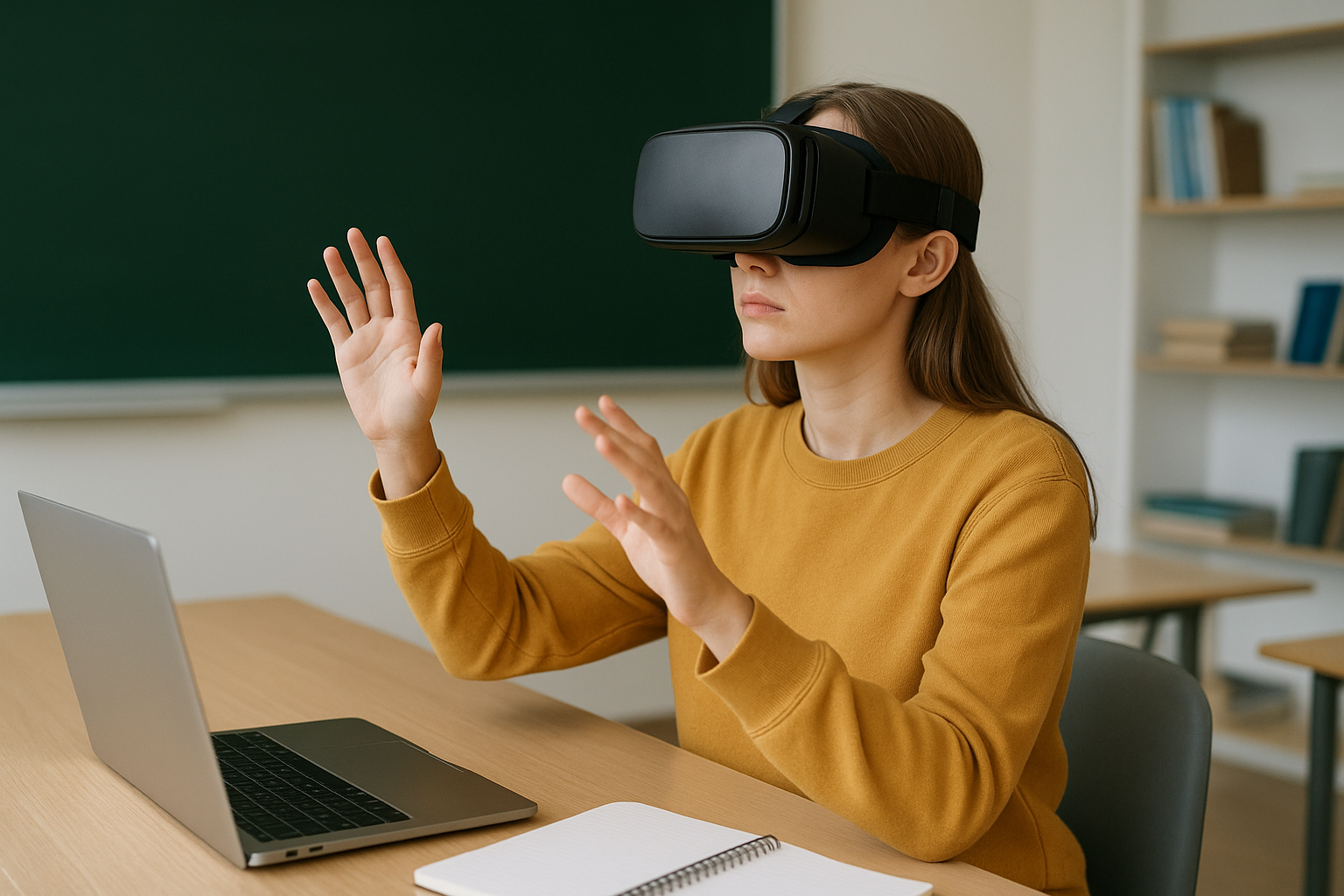
Virtual Reality is a technology that immerses learners in a 3D, interactive digital environment. In education, it’s used to simulate real-world scenarios, enhance understanding of complex concepts, and create engaging, hands-on learning experiences.
According to research, virtual reality leads to better knowledge retention, stronger engagement, and improved problem-solving skills when compared to standard methods of teaching.
(victoryxr.com)
Why Virtual Reality Could Replace Traditional Teaching
VR Creates Immersive & Focused Learning Environments
One of VR’s biggest advantages is how it eliminates distractions. Students learning through VR are less likely to drift off or become disengaged. This immersive format captures their full attention and boosts participation, especially in subjects often considered “boring.”
Studies also show that VR helps students retain information longer, especially when learning involves visual or spatial content.
(sciencedirect.com)
Real-World Examples of VR Transforming Education
Mindflight7 in Australia – Proven Results
An Australian startup, Mindflight7, introduced VR into schools and recorded a 60% increase in comprehension in math classes. Educators reported higher engagement and improved long-term memory.
(theguardian.com)
Morehouse College – VR Courses in Higher Education
Morehouse College launched a VR-based Black History course, providing students the chance to “step into history.” Feedback revealed higher attendance, improved retention, and reduced dropout rates.
(axios.com)
VR for Building Empathy
At UNSW in Australia, students use VR to experience life from others’ perspectives, especially those living with disabilities. This unique approach has been praised for developing empathy and emotional intelligence.
(ft.com)
Benefits of VR in Education
Enhanced Knowledge Retention
Unlike textbooks and lectures, VR uses multi-sensory learning, which creates stronger memory paths in the brain.
(files.eric.ed.gov)
Safe, Risk-Free Learning
Students can perform experiments or simulations without real-world consequences—perfect for fields like medicine, aviation, chemistry, and engineering.
Boosts Empathy and Emotional Intelligence
VR can place students in realistic social scenarios, helping them understand different cultures, challenges, or perspectives. This capability is unmatched in traditional education.
Limitations of Traditional Teaching (And Why VR Solves Them)
| Traditional Method Problem | How VR Solves It |
|---|---|
| Passive learning (lectures) | Active, immersive learning |
| Low student engagement | High interaction & participation |
| Limited resources | Infinite virtual environments |
| Risky experiments | Safe simulations |
| One-size-fits-all approach | Personalized learning |
How VR Aligns With Educational Theories
Supports Constructivist Learning
VR enables learning by doing, which is central to constructivist teaching.
Encourages Collaborative Learning
Group VR environments allow students to explore and solve problems together.
Enhances Experiential Learning
Students can experience situations instead of just reading about them—leading to deeper understanding.
(pmc.ncbi.nlm.nih.gov)
Can VR Replace Teachers?
The answer is No—but it can change their role.
VR does not eliminate teachers—it elevates them from lecturers to facilitators and learning designers. Educators will shift toward guiding, personalizing, and supporting learning experiences, while VR handles simulations, demos, and practical applications.
(online.lsu.edu)
Challenges of Implementing VR in Education
Hardware Costs & Infrastructure
High-quality VR headsets and software can be expensive—especially in developing regions.
Limited VR Educational Content
There is still a shortage of high-quality academic VR content, especially for specialized subjects.
Health Concerns
Studies show that long VR sessions may cause motion sickness or “reality confusion”. That’s why experts advise VR sessions of 20–30 minutes followed by breaks.
(newyorker.com)
Lack of Social Interaction
VR cannot fully replace the human connection and social growth that happen in physical classrooms.
How to Maximize the Effectiveness of VR in Education
1. Start with Clear Learning Objectives
Define your goals:
- Do you want to improve retention?
- Teach complex scientific concepts?
- Develop empathy or problem-solving skills?
VR should support specific outcomes, not just be used because it’s “techy” or trendy.
(managexr.com)
2. Use VR as a Supplement, Not a Replacement
Blended learning—where VR supports traditional teaching—works best. VR should enhance, not replace, classroom teaching.
(soeonline.american.edu)
3. Start Small: Run Pilot Programs
Test small VR modules before implementing school-wide strategies. Gather feedback from teachers and students to improve adoption.
(managexr.com)
4. Ensure Safe Physical Spaces
Set up VR Zones with:
- Soft flooring
- Clear movement space
- Supervision for younger students
(synergyxr.com)
5. Limit VR Session Time
Stick to 20–30 minute sessions to prevent dizziness or fatigue.
(newyorker.com)
6. Use VR to Teach Empathy & Soft Skills
VR enables social-emotional learning by placing students in real-life social situations. This is especially useful for leadership, psychology, and human rights education.
(ft.com)
Sample Structure: A VR Lesson Plan for STEM Education
| Phase | Activity | Purpose |
|---|---|---|
| 1. Introduction | Explain topic and VR tools | Prepare learners |
| 2. VR Experience | Hands-on simulation | Immersive learning |
| 3. Reflection | Group discussion or worksheet | Retain information |
| 4. Practice | Traditional exercise | Reinforce understanding |
| 5. Assessment | Quiz or evaluation | Track effectiveness |
The Future of Education: Will VR Become the Norm?
Increasing Adoption
Companies like Avantis and Google are driving rapid growth in VR adoption across schools.
(thetimes.co.uk)
Global Expansion in Progress
Mindflight7 aims to bring VR education across Australia and beyond.
(theguardian.com)
Growing Recognition
Educational VR programs are increasingly winning awards for innovation in empathy-based education, social learning, and sustainability.
(ft.com)
Final Thoughts: Is VR the Future of Learning?
Virtual Reality will not eliminate teachers—but it will transform education. VR can take learning beyond textbooks, beyond classrooms, and even beyond reality itself.
The future of learning isn’t coming.
It has already arrived.
🎓 Budget-Friendly & Entry-Level VR (Best for large classrooms / low budget)
- Google Cardboard — A simple, cardboard VR viewer that uses a smartphone as display. It’s extremely cheap (often $10–$20 per unit) and works with many free/low-cost educational VR apps and 360° videos. Perfect for large classes, virtual field trips, history tours, basic science visualizations. (edtechmate.com)
- Merge EDU (e.g. Merge Cube with smartphone/tablet) — Merge Cube + a basic VR viewer lets students hold and interact with virtual 3D objects (planets, cells, historical artifacts, etc.). Great for STEM, anatomy, history, or interactive lessons — and more immersive than just 360° video. (edtechmate.com)
- Affordable smartphone-based VR/viewers like “DIY VR kits / Homido / B-next / similar viewers” — These are low-cost headsets compatible with many phones, useful for introducing VR across many students without major investment. (edtechmate.com)
✅ Best for: Large classrooms, early experiments, history/geography virtual field-trips, introductory VR lessons for younger students or many students at once.
⚠️ Limitations: Lower fidelity graphics, simpler interactivity (often only 3-DoF), limited motion tracking or advanced simulations.
🎯 Mid-Range / Standalone VR Headsets (Balanced price & capability)
These are more powerful than smartphone-based viewers — often standalone (no phone or PC needed) — and good for small groups, STEM labs, advanced classes, or long-term VR integration.
- Meta Quest 2 (sometimes called Oculus Quest 2) — A popular standalone headset, wireless, with a growing library of educational apps and VR experiences. It’s often cited as a “budget-friendly but capable” option for high-school or advanced STEM/humanities classes. (edtechmate.com)
- Pico G2 4K (education-focused version) — A standalone headset designed with classrooms in mind, offering durable build, decent graphics, and manageable cost compared to high-end headsets. Good for middle/high schools, shared labs or libraries. (edtechmate.com)
- ClassVR — A turnkey VR system built for education: headsets + a teacher-friendly management portal + curriculum-aligned VR content. More expensive than Cardboard but often more practical if you plan a sustained VR program. (edtechmate.com)
✅ Best for: STEM labs, small-group lessons, high-school/university classes, repeated use over time, mixed subject teaching (science, history, vocational, art).
⚠️ Considerations: Still a moderate cost per unit; if you have many students, you may need multiple headsets to avoid bottlenecks.
💡 How to Choose — Matching VR Tool to Classroom Needs
| Classroom / School Need | Recommended VR Tool Type |
|---|---|
| Many students, limited budget, occasional VR lessons (history tours, geography, basic science) | Google Cardboard + smartphones OR Merge EDU + basic viewers |
| A few VR sessions per week, small groups, STEM / science labs | Pico G2 4K, Meta Quest 2, or Merge EDU + smartphone |
| Plans to integrate VR regularly across subjects, need management & content | ClassVR or standalone headsets in a managed set-up |
| Combining traditional teaching with VR (blended learning) | Any mid-range or entry-level solution, depending on budget & subject |
📈 Tips for Implementing Affordable VR in Classrooms
- Start small. Begin with one or two inexpensive headsets (like Cardboard or Merge) to pilot VR experiences before scaling. (edtechmate.com)
- Use existing devices — If students or school already own smartphones/tablets, you can leverage them with low-cost VR viewers to minimize additional expense.
- Blend VR with traditional teaching — Use VR to introduce or illustrate concepts (e.g. virtual labs, field trips, 3D models), then follow-up with discussions or assignments to deepen understanding.
- Rotate students in small groups — Even a few headsets can serve many students if you organize sessions properly (e.g. rotating groups, scheduled sessions).
- Opt for durable, easy-to-clean gear (especially with younger students), to ensure longevity and hygiene in a classroom setting.