







Chemical reactions are part of everyday life. From cooking food and lighting a candle to rust forming on metal, chemical changes are constantly happening around us. In basic science classes and simple laboratory experiments, students are taught to look for specific clues that indicate when a chemical reaction has occurred.
Although chemical reactions happen at the atomic level, many of their effects are visible. By learning the seven common signs of a chemical reaction, you can better understand what you observe in school experiments, household activities, and natural processes.
This article explains each sign clearly, using examples commonly demonstrated in classrooms and introductory chemistry experiments.
Understanding Chemical Reactions
A chemical reaction occurs when one or more substances, known as reactants, are transformed into new substances called products. During this process, atoms rearrange, chemical bonds break, and new bonds form. Because the atoms are rearranged into new combinations, the resulting substances usually have different physical and chemical properties from the original materials.
This is different from a physical change, such as melting ice or dissolving sugar in water, where no new substance is formed and the original material remains chemically the same.
In introductory chemistry education, recognizing whether a change is chemical or physical is a foundational skill.
The 7 Common Signs of a Chemical Reaction
Not every chemical reaction shows all of the signs listed below. However, observing one or more of these indicators is often enough to suggest that a chemical change has taken place.
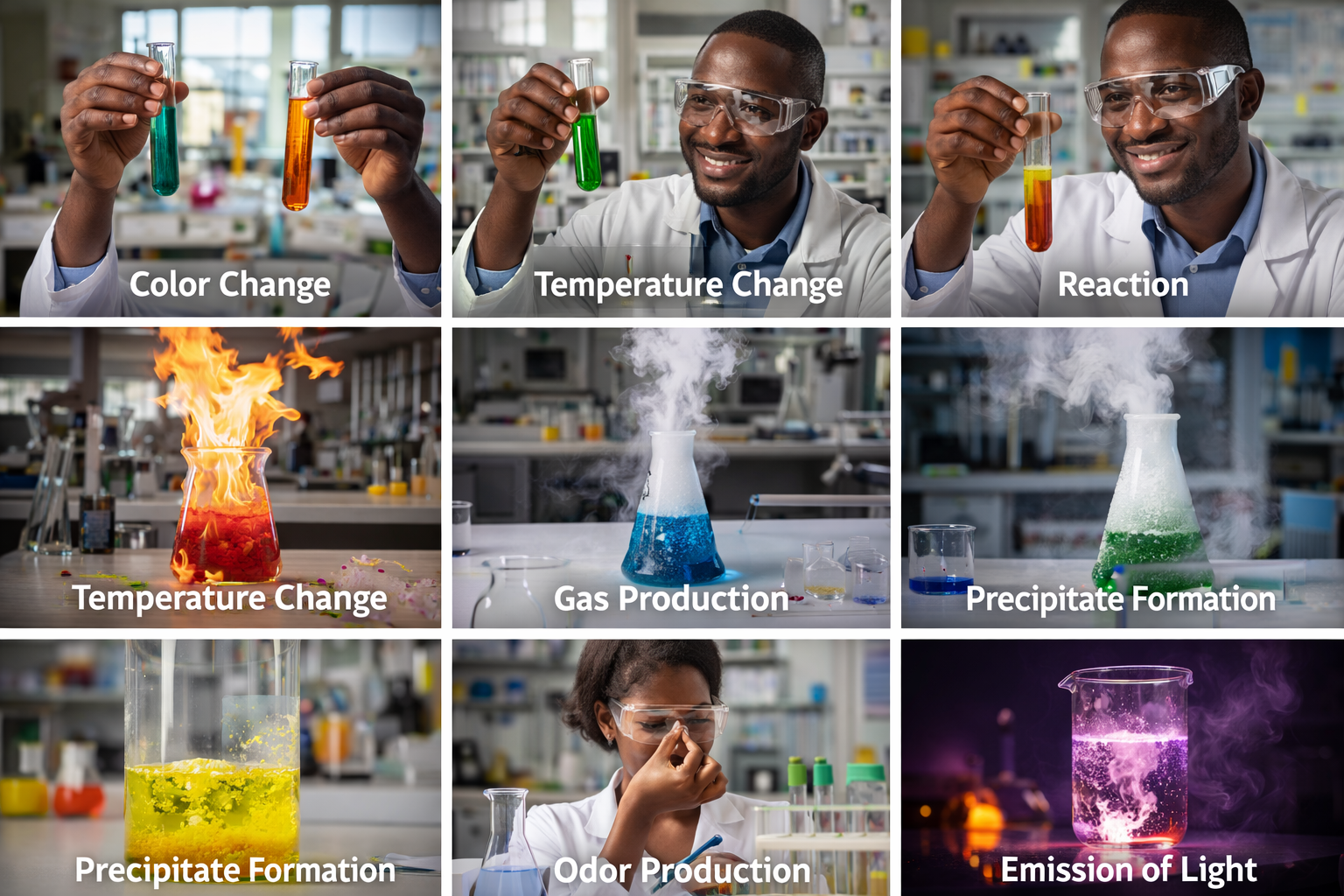
1. Color Change
What It Means
A color change can indicate that a new substance has formed. When chemical reactions occur, the products may absorb and reflect light differently than the reactants, resulting in a visible color change.
Common Examples
- Iron gradually turning reddish-brown as it rusts
- Food browning as it cooks or bakes
- A clear solution turning cloudy or colored after two substances are mixed in a lab
Important Clarification
Not all color changes are chemical reactions. For example, adding food coloring to water changes the color but does not create a new substance. In chemistry education, color change is considered meaningful only when it occurs alongside other chemical evidence.
2. Temperature Change (Heat Absorbed or Released)
What It Means
Many chemical reactions involve changes in energy.
- Exothermic reactions release heat
- Endothermic reactions absorb heat
These temperature changes happen because energy is either released or absorbed when chemical bonds form or break.
Common Examples
- Heat released when fuels burn
- A cold pack becoming cold when activated
- Heat produced when quicklime reacts with water
Why It Matters
In laboratory demonstrations, a temperature change that occurs without external heating or cooling is a strong indicator of a chemical reaction.
3. Formation of a Gas (Bubbling or Fizzing)
What It Means
Gas formation is one of the clearest observable signs of a chemical reaction. It often appears as bubbling, fizzing, or foaming as a new gaseous product is released.
Common Examples
- Vinegar reacting with baking soda to produce carbon dioxide
- Effervescent tablets releasing gas in water
- Carbon dioxide released during fermentation
Important Distinction
Boiling is a physical change caused by heat. In chemistry lessons, students are taught to distinguish between boiling and chemical gas production by observing whether heat is applied.
4. Formation of a Precipitate
What It Means
A precipitate is a solid that forms when two liquid solutions react and produce an insoluble substance. This solid usually settles at the bottom of the container or makes the solution cloudy.
Common Examples
- Solid particles appearing when certain salt solutions are mixed
- Insoluble solids forming during water treatment processes
- Laboratory reactions involving ionic compounds
Scientific Insight
In basic chemistry, precipitate formation often occurs during double-displacement reactions, where ions exchange partners and form an insoluble compound.
5. Change in Odor
What It Means
Some chemical reactions produce new substances that have distinct smells. A noticeable odor change can signal that a reaction has taken place.
Common Examples
- The sulfur-like smell from spoiled eggs
- Strong odors released when certain chemicals react
- New aromas produced during cooking or burning food
Safety Note
In both classrooms and everyday settings, unfamiliar or strong odors may indicate harmful gases. Proper ventilation is always recommended.
6. Emission of Light
What It Means
Some chemical reactions release energy in the form of light. This may occur with or without noticeable heat.
Common Examples
- Flames from candles or matches
- Fireworks producing bright colors
- Glow sticks emitting light
Scientific Term
Reactions that produce light are called chemiluminescent reactions. These reactions are commonly discussed in educational science and are used in emergency lighting and laboratory applications.
7. Change in Sound
What It Means
In rare cases, chemical reactions produce sound due to rapid energy release or gas expansion.
Common Examples
- Popping sounds during small combustion reactions
- Crackling sounds from fireworks
- Fizzing noises during rapid gas-producing reactions
Key Insight
In science education, sound alone is not considered sufficient proof of a chemical reaction. It is typically used only as supporting evidence alongside other signs.
Chemical Changes vs. Physical Changes
Understanding the difference between chemical and physical changes is essential in basic chemistry.
Chemical Changes
- New substances are formed
- Usually difficult or impossible to reverse
- Often show one or more of the seven signs
Physical Changes
- No new substance is formed
- Often reversible
- Examples include melting, freezing, tearing, and dissolving
For example, melting ice is a physical change, while burning hydrogen (producing water) is a chemical reaction.
Why Knowing the Signs of Chemical Reactions Matters
Recognizing chemical reactions is useful in many real-world situations:
- Education: Helps students correctly identify reactions in exams and experiments
- Safety: Allows early detection of potentially dangerous reactions
- Cooking: Improves understanding of how heat and ingredients interact
- Scientific literacy: Builds critical thinking and observational skills
These signs are widely taught in schools because they form the foundation of observational chemistry.
Common Misconceptions About Chemical Reactions
- “All color changes are chemical reactions.”
Some color changes are purely physical. - “Bubbles always mean boiling.”
Bubbles can also indicate gas production from a chemical reaction. - “Heat must be released.”
Some reactions absorb heat instead of releasing it.
Clarifying these misconceptions leads to more accurate scientific observations.
Conclusion
Chemical reactions may occur at the atomic level, but their effects are often easy to observe. The seven signs of a chemical reaction—color change, temperature change, gas formation, precipitate formation, odor change, light emission, and sound—provide reliable clues that a chemical change has taken place.
These indicators are commonly used in classrooms, laboratories, and everyday life to distinguish chemical changes from physical ones. By learning to recognize them, you develop stronger scientific awareness and a deeper understanding of the processes happening around you.