









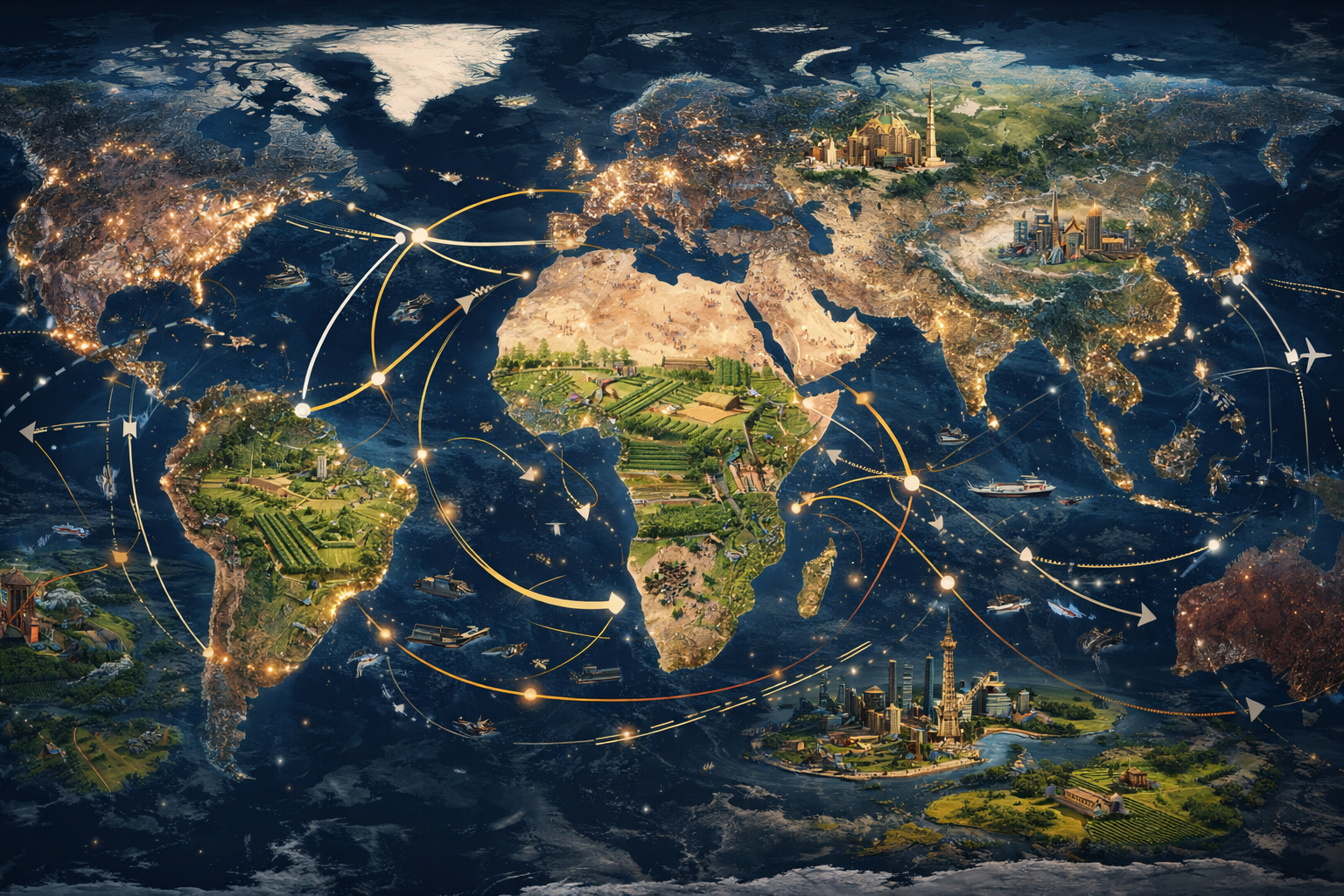
Human geography is the study of how people interact with the spaces and environments where they live. It explores how human activities—such as migration, economic development, culture, and urban growth—shape the Earth’s landscapes.
From the design of cities to the spread of cultures and the movement of populations, human geography helps explain why people live where they do and how their choices transform the world around them.
Today, the field is increasingly important because global challenges such as rapid urbanization, climate change, migration, and economic inequality all have strong geographic dimensions. Organizations like the United Nations and the World Bank rely on geographic data to guide decisions about sustainable development, infrastructure planning, and resource management.
This article explains the meaning of human geography, its key concepts, practical examples, and how it is used to solve real-world problems.
What Is Human Geography?
Human geography is a branch of geography that studies the spatial relationships between people, culture, economies, and the environment.
In simple terms, it examines how humans organize space and how places influence human behavior.
Human geography focuses on questions such as:
- Why are some regions densely populated while others are nearly empty?
- Why do cities grow in certain locations?
- How do cultures shape landscapes?
- What factors influence migration and economic activity?
While physical geography studies natural features like mountains, rivers, and climate systems, human geography focuses on human activities and their impact on landscapes and societies.
Researchers in this field use maps, demographic data, and spatial analysis to understand patterns of settlement, economic activity, and cultural development.
Key Concepts in Human Geography
Understanding human geography requires familiarity with several core concepts that geographers use to analyze human activity across space.
1. Population Distribution
Population distribution refers to how people are spread across the Earth’s surface.
Some regions have extremely high population densities, while others remain sparsely populated.
For example:
- Fertile river valleys such as those near the Nile historically attracted large populations.
- Coastal areas often grow rapidly because of trade opportunities.
- Harsh environments like deserts and polar regions typically support fewer people.
According to the United Nations, more than half of the world’s population now lives in urban areas, highlighting the growing concentration of people in cities.
Human geographers analyze population distribution to understand how factors such as climate, economic opportunity, transportation networks, and political stability influence where people live.
2. Migration
Migration is the movement of people from one location to another, either temporarily or permanently.
Migration occurs for many reasons, including:
- Employment opportunities
- Education
- Political stability
- Environmental conditions
- Family reunification
Human geographers analyze migration patterns to understand how populations change over time and how societies adapt to new demographic realities.
For example, economic migration has significantly shaped the development of major cities around the world. Large urban centers often grow as workers move from rural areas seeking jobs and better living conditions.
3. Cultural Landscapes
A cultural landscape is a physical area that reflects the cultural practices, beliefs, and traditions of the people who live there.
These landscapes provide visible evidence of how human culture shapes the environment.
Examples include:
- Historic architecture and city design
- Religious buildings and monuments
- Agricultural landscapes created through traditional farming practices
For instance, terraced farming in mountainous regions shows how communities adapt agricultural methods to challenging terrain.
4. Urbanization
Urbanization refers to the growth of cities and the increasing concentration of populations in urban areas.
This trend has accelerated dramatically in the last century.
According to the World Bank, urban areas now generate over 80% of global economic output.
Human geographers study urbanization to understand:
- housing patterns
- transportation systems
- infrastructure development
- environmental impacts
These insights help urban planners design cities that are more efficient, sustainable, and livable.
5. Human–Environment Interaction
Human geography also studies how people interact with their natural environment.
This includes how societies:
- use natural resources
- adapt to climate conditions
- modify landscapes through development
Examples include irrigation systems used in agriculture, the construction of dams for energy production, and conservation programs designed to protect ecosystems.
Balancing development with environmental sustainability is one of the most important challenges studied in modern human geography.
Real-World Examples of Human Geography
Human geography is not just an academic subject—it is visible in everyday life.
Here are some examples of how human geographic processes shape communities.
City Development and Transportation Hubs
Many cities grow around transportation routes, trade centers, or natural resources.
Ports, railway intersections, and highways often attract businesses, industries, and housing developments.
Over time, these areas become major economic centers because transportation makes it easier for people and goods to move.
Human geographers study these patterns to understand how economic opportunities influence urban growth.
Agricultural Patterns
Agricultural practices vary widely across regions because of differences in climate, soil quality, and cultural traditions.
Examples include:
- Rice farming in regions with abundant rainfall
- Wheat production in temperate climates
- Livestock grazing in grassland regions
These agricultural patterns demonstrate how societies adapt food production systems to environmental conditions.
Cultural Diversity Across Regions
Human geography also explains why different regions develop unique cultural identities.
Examples include:
- Language differences across countries
- Traditional clothing shaped by climate
- Local cuisine influenced by available ingredients
These cultural characteristics create regional identities and influence how communities interact with their environment.
Major Branches of Human Geography
Human geography is a broad discipline that includes several specialized areas of study.
Cultural Geography
Cultural geography examines how cultural beliefs, traditions, languages, and religions are distributed across space.
Researchers explore how cultural practices influence landscapes, architecture, and social structures.
Economic Geography
Economic geography studies how industries, businesses, and trade networks are distributed across regions.
This field helps explain why certain industries cluster in specific areas, such as technology hubs or manufacturing regions.
Political Geography
Political geography focuses on the relationship between geography and political systems.
Topics include:
- national borders
- territorial disputes
- geopolitical strategy
- regional governance
Urban Geography
Urban geography studies cities and metropolitan areas.
Researchers analyze issues such as housing shortages, transportation congestion, infrastructure development, and population density.
Urban geographers often work with city planners and policymakers to improve urban living conditions.
Real-World Applications of Human Geography
Human geography plays a crucial role in addressing many modern challenges.
Urban Planning
City planners rely on geographic data to determine where to build housing, roads, schools, and hospitals.
By analyzing population density and migration trends, planners can design cities that are more efficient and sustainable.
Environmental Management
Human geography helps governments balance economic development with environmental protection.
Geographic studies help identify areas where deforestation, pollution, or resource depletion may threaten ecosystems.
Disaster Preparedness
Human geography is also essential for disaster planning.
By studying settlement patterns and population distribution, emergency planners can design evacuation routes and determine the best locations for emergency shelters.
Organizations such as the World Health Organization and disaster response agencies often rely on geographic data to coordinate responses during crises.
Economic Development
Governments and businesses use human geographic analysis to identify regions with strong economic potential.
For example, analyzing transportation access, population trends, and natural resources helps determine where new industries and infrastructure projects should be developed.
Public Health Planning
Human geography plays an important role in understanding how diseases spread across populations.
Population density, travel networks, and urbanization patterns all influence the transmission of infectious diseases.
Geographic analysis helps public health officials plan vaccination campaigns, locate healthcare facilities, and track outbreaks.
Why Human Geography Matters Today
Human geography helps us understand how societies evolve and interact with the spaces they occupy.
It provides insights into major global challenges, including:
- rapid urbanization
- migration crises
- climate-related displacement
- economic inequality
- sustainable development
By analyzing spatial patterns and human behavior, geographers help governments, businesses, and communities make better decisions about resource management, infrastructure development, and environmental protection.
Conclusion
Human geography is the study of how people interact with the places where they live. It explores population patterns, migration, culture, economic activity, and urban development to better understand the relationship between humans and the environment.
Through its applications in urban planning, environmental management, disaster preparedness, and public health, human geography plays a vital role in shaping modern societies.
By understanding how human activities influence geographic spaces, communities can make more informed decisions that promote sustainable development, cultural preservation, and improved quality of life.