








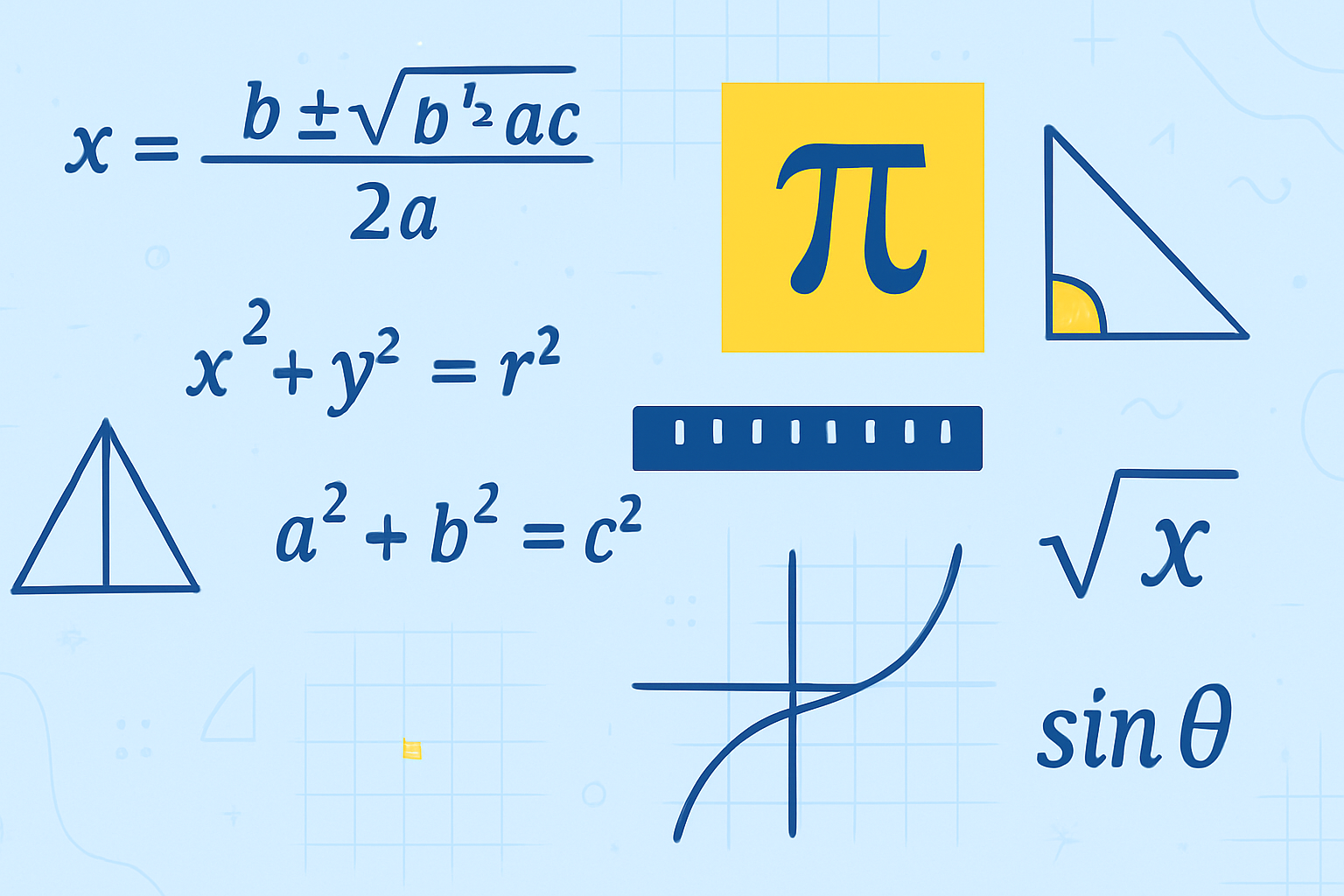
Mathematics is often described as the language of logic, problem-solving, and scientific thinking. Whether you’re a student, professional, or lifelong learner, understanding key formulas can strengthen your ability to solve real-world problems. But with thousands of mathematical formulas across algebra, geometry, calculus, trigonometry, and statistics, which ones matter most?
In this guide, we break down 20 of the most essential formulas in Mathematics, explain what they mean, and show how they apply in everyday life. These formulas are the foundation of higher-level math and appear in school exams, standardized tests, engineering, finance, data science, and even computer programming.
Let’s dive into the 20 foundational formulas everyone should know.
1. Pythagorean Theorem
Formula:
[
a^2 + b^2 = c^2
]
Use: Determines the length of the hypotenuse in right-angled triangles.
Why it matters: Used in construction, navigation, physics, and computer graphics.
2. Quadratic Formula
Formula:
[
x = \frac{-b \pm \sqrt{b^2 – 4ac}}{2a}
]
Use: Solves any quadratic equation.
Why it matters: Essential for algebra, calculus, engineering, and motion physics.
3. Area of a Circle
Formula:
[
A = \pi r^2
]
Use: Calculates circular areas.
Why it matters: Used in architecture, landscaping, engineering, and design.
4. Circumference of a Circle
Formula:
[
C = 2\pi r
]
Use: Measures the distance around a circle.
Why it matters: Useful in manufacturing mechanical parts and circular structures.
5. Slope of a Line
Formula:
[
m = \frac{y_2 – y_1}{x_2 – x_1}
]
Use: Measures steepness of a line.
Why it matters: Applied in data analytics, economics (rate of change), and physics.
6. Distance Formula
Formula:
[
d = \sqrt{(x_2 – x_1)^2 + (y_2 – y_1)^2}
]
Use: Finds distance between two points.
Why it matters: Used in mapping, navigation, and geometry.
7. Simple Interest
Formula:
[SI = \frac{P \times R \times T}{100}]
Use: Calculates basic interest over time.
Why it matters: Used in banking, savings, and investing.
Formula:
[A = P\left(1 + \frac{r}{n}\right)^{nt}]
8. Compound Interest
Use: Calculates interest compounded over time.
Why it matters: Vital for financial planning and investment growth.
9. Area of a Triangle
Formula:
[A = \frac{1}{2} bh]
Use: Calculates triangular regions.
Why it matters: Applied in architecture, construction, and geometry.
10. Volume of a Cylinder
Formula:
[V = \pi r^2 h]
Use: Finds the volume of cylindrical shapes.
Why it matters: Used in engineering, manufacturing, and liquid capacity calculations.
11. Sine Rule
Formula:
[\frac{a}{\sin A} = \frac{b}{\sin B} = \frac{c}{\sin C}]
Use: Solves non-right triangles.
Why it matters: Applied in astronomy, navigation, and surveying.
12. Cosine Rule
Formula:
[c^2 = a^2 + b^2 – 2ab\cos C]
Use: Finds sides or angles in any triangle.
Why it matters: Crucial for physics, 3D modeling, and engineering.
13. Perimeter of a Rectangle
Formula:
[P = 2(l + w)]
Use: Finds the boundary length of rectangles.
Why it matters: Used in fencing, carpeting, and layout planning.
14. Area of a Rectangle
Formula:
[A = lw]
Use: Measures rectangular surfaces.
Why it matters: Common in construction, tiling, room measurements, and land assessment.
15. Arithmetic Mean (Average)
Formula:
[\text{Mean} = \frac{\text{Sum of values}}{\text{Number of values}}]
Use: Central value in statistics.
Why it matters: Used in data analysis, business, finance, and research.
16. Standard Deviation
Formula:
[\sigma = \sqrt{\frac{\sum (x – \mu)^2}{N}}]
Use: Measures variability of data.
Why it matters: Essential for statistical research, quality control, and AI algorithms.
17. Derivative (Basic)
Formula:
[\frac{d}{dx}(x^n) = nx^{n-1}]
Use: Measures the rate of change.
Why it matters: Used in calculus, physics, machine learning, and optimization.
18. Integration (Basic)
Formula:
[\int x^n dx = \frac{x^{n+1}}{n+1} + C]
Use: Finds area under curves.
Why it matters: Foundational in economics, engineering, and probability.
19. Probability Formula
Formula:
[P(E) = \frac{\text{Number of favorable outcomes}}{\text{Total outcomes}}]
Use: Measures likelihood of events.
Why it matters: Used in risk analysis, finance, gaming, and AI.
20. Euler’s Formula (Complex Numbers)
Formula:
[e^{i\theta} = \cos\theta + i\sin\theta]
Use: Connects exponential and trigonometric functions.
Why it matters: Used in quantum physics, engineering, and computer science.
Why These 20 Mathematics Formulas Matter
These formulas form the backbone of many disciplines:
1. In School and Examinations
The formulas above appear in:
- WAEC
- NECO
- SAT
- GMAT
- GRE
- College algebra and calculus courses
2. In Career Fields
These formulas are used in:
- Engineering
- Data science
- Architecture
- Finance
- Computer programming
- Robotics
- Artificial intelligence
3. In Daily Life
Mathematics helps solve real-world problems such as:
- Calculating mortgage interest
- Estimating travel distances
- Measuring room sizes
- Determining investment growth
Mathematics is not just theory — it is a practical tool for life.
How to Memorize Mathematical Formulas Easily
To master these formulas:
Use repetition
Practice applying the formulas in different problems.
Create flashcards
Great for quick study sessions.
Understand, don’t memorize
Knowing why a formula works improves long-term memory.
Practice real-world examples
Apply formulas to finance, measurements, and everyday tasks.
Use visual aids
Diagrams make formulas easier to understand.
Conclusion
Mathematics is built on patterns, logic, and precision — and these 20 essential formulas form the foundation of many topics. By learning them, students and professionals gain a deeper understanding of how numbers shape the physical world, digital systems, and financial decisions.
Whether you’re preparing for exams, revising core concepts, or looking to refresh your knowledge, mastering these formulas strengthens your problem-solving skills and boosts your confidence.
FAQ Section
1. What are the most important formulas in Mathematics?
The most important formulas in Mathematics include algebraic formulas (a² + b² = (a + b)² − 2ab), geometry formulas (Area = πr²), trigonometric identities (sin²θ + cos²θ = 1), and calculus formulas (derivative of xⁿ = n·xⁿ⁻¹). These formulas form the foundation of most mathematical operations and problem-solving.
2. Why is it important to learn basic math formulas?
Learning basic math formulas improves accuracy, speeds up problem-solving, and strengthens logical thinking. These formulas are essential for school exams, higher education, technical fields, budgeting, engineering, and real-life decision-making.
3. How can I memorize Mathematics formulas easily?
You can memorize formulas by practicing daily, using flashcards, grouping similar formulas together, applying formulas to real-world examples, and solving practice problems. Repetition and visualization also improve long-term recall.
4. Are these formulas useful for competitive exams?
Yes. The 20 formulas listed are frequently seen in exams such as SAT, GRE, WAEC, JAMB, A-Level, NECO, and university entrance tests. Mastering them boosts speed and accuracy in quantitative reasoning sections.
5. Can beginners understand these formulas?
Absolutely. These formulas are explained in simple terms and include examples. They are suitable for beginners, high school students, and anyone strengthening their mathematical foundation.
6. Do these formulas apply in real life?
Yes. Mathematics formulas help in cooking, construction, banking, budgeting, engineering, navigation, technology development, architecture, design, and data analysis. Many daily tasks rely on mathematical calculations.