








why a national safe school standard matters
Every child deserves a learning environment where they can learn without fear. In Nigeria — a country that has faced episodes of targeted attacks on schools, communal violence, and the everyday hazards of inadequate infrastructure — establishing a clear, practical, and enforceable Safe School standard is no longer optional. Over the last five years the Federal Government, with development partners and civil society, has moved from ad-hoc responses to a nationally coordinated framework that defines what a safe school must look like, how to measure it, and how to finance it. (PolicyVault.Africa)
What is Nigeria’s Safe School Framework?
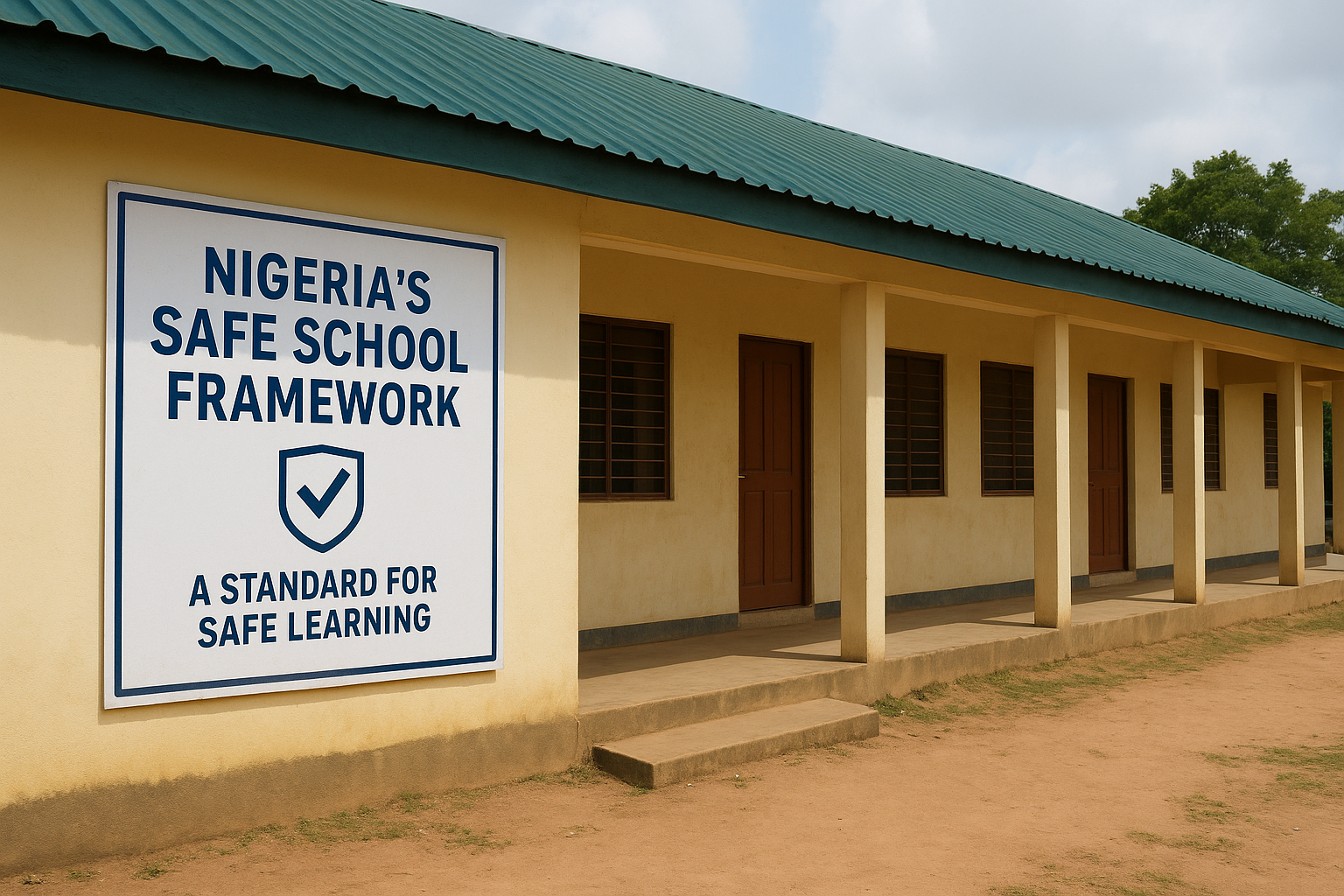
Nigeria’s Safe School Framework is a set of policies, standards and tools designed to protect students, teachers and school buildings from threats — whether those are violent attacks, health emergencies, structural hazards, or protection risks that inhibit learning. The framework is anchored in two complementary documents: the National Policy on Safety, Security and Violence-Free Schools (and its implementation guidelines) and the Minimum Standards for Safe Schools, which together set out roles, minimum physical and psychosocial requirements, and monitoring mechanisms. (PolicyVault.Africa)
Key components of the framework include:
- Physical safety: secure perimeters, safe drinking water, gender-sensitive sanitation, and retrofitted classrooms.
- Psychological safety: child protection policies, referral pathways, and mental health support.
- Disaster preparedness and response: emergency plans, drills, and continuity arrangements.
- Community and security partnerships: local security fora, parent–teacher collaboration, and school-community early warning systems.
- Data and monitoring: regular school safety audits and an EMIS-linked reporting system. (FEDERAL MINISTRY OF EDUCATION)
Why the framework is evidence-based (and who helped write it)
The safe school standards draw on international norms — notably the Safe Schools Declaration — and on global minimum standards for school safety developed by UNESCO, UNICEF and partners. Nigeria’s version was developed with inputs from ministries, state education boards, UN agencies, civil society and practitioners working in conflict-affected zones to ensure it is contextually appropriate. The result is a policy that blends global best practice with local realities. (ssd.protectingeducation.org)
What “minimum standards” mean in practice
The Minimum Standards for Safe Schools document is intentionally practical. Instead of vague aspirations, it lists measurable conditions for schools to deserve the label safe school. Examples include:
- A documented school safety plan and a trained safety focal person.
- Functional, sex-segregated toilets with handwashing facilities.
- Regular maintenance checks and records for roofs, doors and exits.
- An emergency communication protocol that links the school to local authorities.
- Reporting and referral pathways for child protection incidents. (FEDERAL MINISTRY OF EDUCATION)
These are not cosmetic checklists: evidence from monitoring pilots shows that schools which comply with the standards see improvements in attendance, teacher retention and the ability to reopen quickly after disturbances. UNICEF and partners have developed monitoring tools to track compliance and to support state-level roll-out. (UNICEF)
Financing safe schools — the national investment plan
Policy without investment fails. Nigeria’s National Plan on Financing Safe Schools maps costs and funding options to scale up safety measures — from structural retrofits to training and security equipment. The plan recommends a blended financing approach: federal and state budget lines, local government contributions, private-sector partnerships, and targeted donor financing (including pooled funds and multi-partner trust funds). This financing strategy seeks to ensure that ‘safe school’ budgeting becomes part of routine education planning rather than a one-off project. (protectingeducation.org)
Monitoring and accountability — how we know it’s working
Monitoring is built into the framework. UNICEF and federal partners have produced monitoring checklists and piloted school safety assessments that link to the national EMIS. These tools track key indicators such as the presence of a safety plan, water and sanitation status, perimeter security, and incidents of violence. Regular monitoring enables states to prioritise the highest-risk schools for upgrades and to measure the impact of interventions on attendance and learning continuity. (UNICEF)
A transparent, public reporting mechanism also strengthens accountability: when communities and parents can see school safety scores, they can advocate to local governments and hold officials responsible for gaps.
Implementation challenges and how they are being addressed
Designing an ambitious framework is easier than implementing it across 36 states and the Federal Capital Territory. Common challenges include:
- Resource gaps — many schools lack funds for basic repairs or sanitation. The financing plan aims to close that gap but will require sustained political will. (protectingeducation.org)
- Data gaps — EMIS coverage and real-time reporting of attacks or hazards remains incomplete; strengthening data systems is a near-term priority. (UNICEF)
- Capacity constraints — teachers and school managers need training on safety planning, psychosocial first aid, and monitoring tools. UNICEF and CSOs have been delivering capacity-building but scale-up is needed. (UNICEF)
- Contextual insecurity — in areas affected by armed groups or communal violence, physical upgrades alone are insufficient; safe schools must be part of broader security and social cohesion strategies. (wvi.org)
Addressing these challenges requires coordination across ministries (education, interior, health), donors, community leaders and security agencies — exactly the kind of multi-stakeholder approach the framework prescribes.
Real-world impact: examples from states and partners
Several Nigerian states and local programmes illustrate progress:
- Community-led security committees in some northern states have reduced incidents of school vandalism and enabled faster re-opening after attacks. Civil society groups report measurable increases in girls’ attendance where sanitation and safety improvements were made. (drpcngr.org)
- Safe School Initiative sites supported by UNDP, UNICEF and partners have used the minimum standards to guide retrofits (fence repairs, water points), train teachers in emergency response, and establish referral pathways for survivors of violence. Early monitoring shows improved perceptions of safety among students and teachers. (MPTF Office Gateway)
These pilots matter: they show that the framework is not just policy text but a practical roadmap that, when funded and implemented, changes school life.
What parents, teachers and communities can do now
A national framework succeeds only when local actors own it. Practical actions parents, teachers and community leaders can take include:
- Insist on a visible school safety plan and ask about recent safety audits.
- Support simple, high-impact upgrades (repair doors, install LED lighting, provide soap).
- Participate in school-community safety committees and school-based emergency drills.
- Promote psychosocial support and reduce stigma for learners affected by violence.
- Hold duty-bearers accountable for budget allocations for school safety.
Community involvement is often the most cost-effective route to safer schools: local volunteers and parent groups can monitor, report, and even co-finance small but critical repairs.
The next steps: scaling from pilots to a resilient national system
To make the Safe School Framework the standard in every learning environment, Nigeria should pursue three priorities:
- Budget mainstreaming: establish dedicated school-safety lines in federal and state education budgets and enforce ring-fencing for maintenance and protection. (protectingeducation.org)
- Data and digital reporting: expand the EMIS to include real-time incident reporting and public dashboards so hotspots can be identified fast. (UNICEF)
- Integrated security and education planning: coordinate with security agencies, disaster management authorities and health services so responses are holistic and child-centred. (wvi.org)
If these steps are taken consistently, the framework can move from compliance pilots into national scale and durability.
Conclusion — safe schools as the foundation of learning continuity
Nigeria’s Safe School Framework successfully converts international commitments into national law, measurable standards and financing plans. It recognises that a safe school is not just a locked gate or a fence — it is a set of practices, services and relationships that together protect learners and enable education to continue in times of crisis and peace. The policy and minimum standards provide a clear standard; the next task is to fund, monitor and scale those standards so every child in Nigeria can learn without fear. (PolicyVault.Africa)