







Math doesn’t have to be a battle — especially at home! Whether your child is struggling with arithmetic or already a numbers whiz, Math Games can transform learning into something joyful, curiosity-fueling, and highly effective. In this detailed, research-backed guide, we’ll explore why math games work, how they benefit children’s cognitive development, and share a collection of the best games and activities you can play at home — with and without screens.
Why Math Games Matter: Research & Benefits
Before we jump into the games, let’s explore why Math Games are one of the most effective tools for supporting children’s learning.
1. Games Build Real Math Skills
Multiple studies show that math games aren’t just fun — they work. A systematic review of research on math learning found that games played at home or in school contribute significantly to early math learning and engagement in young children. This includes numeracy, counting, problem-solving, and even higher-order thinking skills when the games are well-designed. (ERIC)
2. Board Games Boost Mathematical Ability
A comprehensive research review found that traditional board games like Chutes and Ladders and number-based activities helped children (ages 3–9) improve counting, addition skills, and number sense. Board games also promote strategic thinking and turn-taking — critical skills for academic success. (ScienceDaily)
3. Games Reduce Math Anxiety
A published educational study noted that creative, game-like environments help lessen math anxiety by making learning feel safe and enjoyable rather than test-like. This invites learners to experiment, take risks, and build confidence — essential for long-term success. (ERIC)
4. Multi-Skill Development
Beyond arithmetic, Math Games can boost logic, spatial reasoning, and even collaboration skills when played in groups. Games often challenge kids to find multiple solutions to a problem, encouraging flexible thinking and creative strategies. (ERIC)
In short: Math Games make learning active, engaging, and effective, turning abstract concepts into concrete experiences that kids remember.
Screen-Free Math Games for Home
Not all math play needs a tablet or phone! These screen-free ideas are simple, hands-on, and packed with learning.
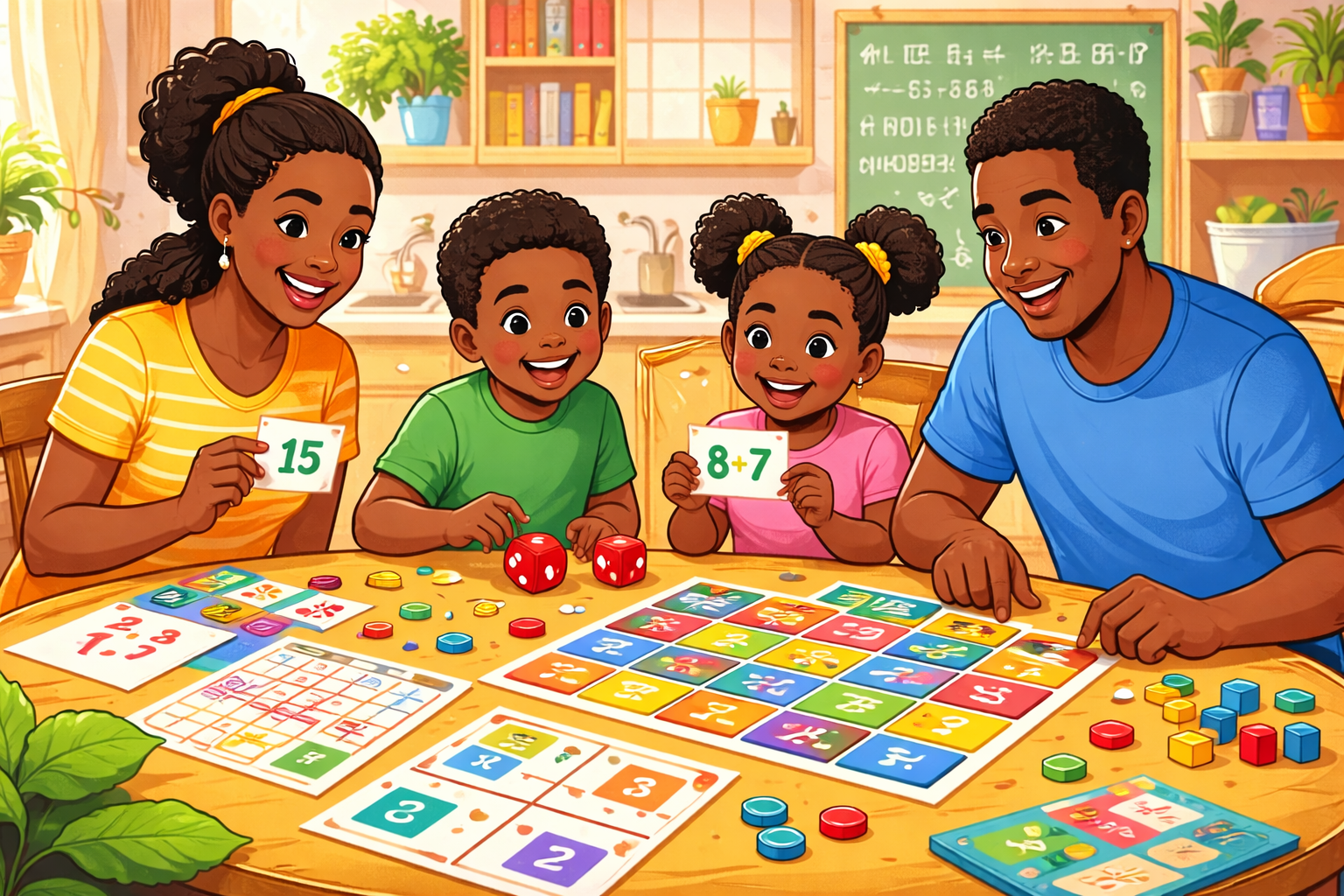
1. Math Bingo
Classic bingo gets an academic twist:
- Create bingo cards with math problems instead of numbers.
- Kids solve problems (e.g., 6 + 3) and cover answers on their cards.
- First to complete a row yells “Bingo!”
This boosts mental math fluency and speeds recall — perfect for group play or solo practice. (deekshastemschools.com)
2. Pattern Block Puzzles
Pattern blocks — colorful geometric shapes — help kids explore:
- Geometry
- Shape relationships
- Fractions
Kids fill outlines or design their own patterns, improving spatial reasoning and introducing early fraction concepts. (Mathnasium)
3. Target Number Challenge
A simple do-it-yourself game using dice or number cards:
- Roll dice
- Use operations (add, subtract, multiply) to reach a target number
This game adapts for all ages and strengthens flexible thinking. (Mathnasium)
4. Card Games Like “Math War”
With a standard card deck:
- Flip two cards
- Perform a math operation
- Highest correct answer wins
This game sharpens quick calculation and comparison skills — plus it’s fun for siblings! (JetLearn)
5. Flashcard Memory Match
Create math flashcards and play memory match:
- Turn cards face down
- Match problems with correct answers
This enhances number recognition and strengthens recall under less pressure than traditional drills. (PW Live)
6. Board Game Numbers
Popular tabletop games naturally build math skills:
- Snakes & Ladders: sequencing & counting
- Monopoly Jr.: money management
- Yahtzee: probability & addition
You can even customize these games with extra math questions to reinforce specific concepts. (Twinkl)
Digital & App-Based Math Games
When used intentionally and in moderation, digital Math Games can deepen understanding and make abstract topics more tangible.
1. Prodigy Math
A fantasy-style RPG where math answers fuel progress — the perfect blend of adventure and arithmetic. Players solve math problems to battle monsters, keeping engagement high for learners in elementary grades. (Maths Karma)
2. DragonBox Algebra
This award-winning app teaches basic algebra concepts in a game environment by first using symbols and then transitioning to numbers. It was designed to make abstract algebra intuitive and fun. (Wikipedia)
3. Math Jeopardy (DIY or Online)
Turn your living room into a game show! Create categories like:
- Addition
- Fractions
- Word problems
Kids choose questions and earn points — great for reinforcing learned skills in a fun way. (PW Live)
4. Puzzle Apps (Sudoku, Logic Mazes)
Games like Sudoku promote:
- Logical thinking
- Pattern recognition
- Strategic planning
They make excellent screen-time alternatives when balanced with physical play. (PW Live)
Making the Most of Math Game Play
Here are parent-tested strategies to help Math Games really boost kids’ skills:
1. Play Regularly — Without Pressure
Short, fun sessions outperform long, forced ones. Try 15–20 minutes a day instead of marathon sessions.
2. Talk About Thinking
Ask questions like:
- “How did you solve that?”
- “Can you think of another way?”
This builds meta-cognitive skills — thinking about thinking — which deepens learning.
3. Match Games to Learning Goals
Choose games that align with what your child is learning in school. For example:
- Fun with numbers → bingo, dice games
- Fractions & geometry → pattern blocks
- Logic & problem-solving → puzzles & strategy games
4. Play Together
Shared play increases motivation and helps you spot where a child may need support — and when they’re ready to be challenged.
5. Celebrate Effort, Not Just Correctness
Games should encourage persistence and resilience. Even when answers are wrong, praise the thinking process.
Testimonials from Real Parents & Educators
Parents and educators consistently report that incorporating Math Games at home:
- Makes math less intimidating
- Encourages strategic thinking
- Helps kids associate math with fun, not fear
- Boosts confidence before school assessments
One homeschooling parent shared ideas like using everyday games (Uno, Yahtzee) to reinforce math without it feeling like “homework” — evidence that playful learning sticks. (Reddit)
Final Thoughts: Math Can Be Fun!
If math has ever felt boring, overwhelming, or stressful for your child, Math Games offer a powerful alternative. They harness curiosity, play, and challenge in ways that make math naturally engaging — and backed by science, they work too. From screen-free classics like Math Bingo and board games to rich digital experiences like Prodigy and DragonBox, there’s a game for every age and learning style.
So bring out the dice, shuffle those cards, fire up a math app, and see how much your child can blossom when learning feels more like play.