







Geography is far more than memorizing maps, countries, or capital cities. It is the study of how the Earth works and how people interact with the environment around them. Geography helps us understand patterns in nature, human settlements, trade, climate, and cultural development.
In schools and geography education, teachers often explain the subject using four key concepts that help students analyze the world in a structured way. These concepts make geography easier to understand because they break complex global systems into simple questions.
As someone who has studied and explained geography concepts in educational settings, one of the most effective ways to help students understand geography is to focus on these four core ideas.
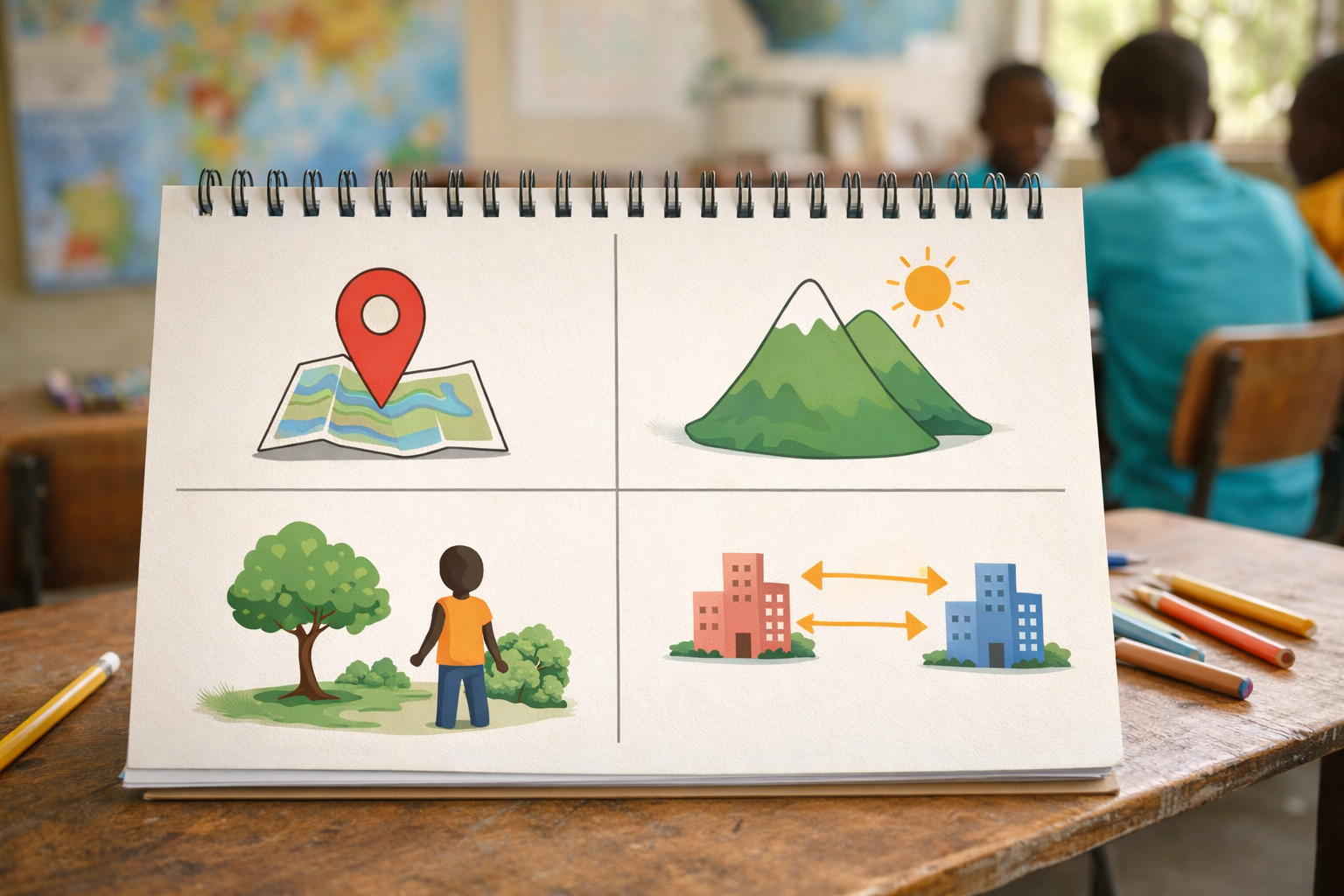
The four concepts of geography are:
- Location
- Place
- Human–Environment Interaction
- Movement
These concepts help geographers and students answer important questions such as:
- Where is something located?
- What makes that place unique?
- How do humans interact with the environment?
- How do people, goods, and ideas move around the world?
According to the National Geographic Society, these geographic ideas help people analyze spatial relationships and understand how human and natural systems connect across the planet.
The Four Core Concepts of Geography
The four geographic concepts provide a framework for studying the Earth. Each concept focuses on a different aspect of how places function and how people interact with them.
| Concept | Key Question | Example |
|---|---|---|
| Location | Where is it? | Coordinates of Lagos |
| Place | What is it like? | Sahara Desert climate |
| Human–Environment Interaction | How do humans affect nature? | Farming, dams |
| Movement | How do things travel? | Migration and trade |
Let’s examine each concept in detail.
1. Location: Where Something Is
The concept of location refers to the position of a place on the Earth’s surface. It answers one of the most basic geographic questions:
“Where is it?”
Geographers describe location in two main ways.
Absolute Location
Absolute location refers to the exact position of a place using latitude and longitude coordinates.
Latitude and longitude form a global grid system that allows geographers, scientists, pilots, and sailors to identify precise locations anywhere on Earth.
For example:
- Lagos, Nigeria: approximately 6.5244° N latitude and 3.3792° E longitude
- The Equator: 0° latitude
- The North Pole: 90° N latitude
Absolute location is essential for:
- Navigation
- Aviation
- Mapping
- Geographic research
- Satellite technology
Modern GPS systems rely on this coordinate system to determine locations accurately.
Relative Location
Relative location explains where a place is in relation to other places.
Instead of exact coordinates, it uses reference points people recognize.
Examples include:
- Abuja is located in the central region of Nigeria.
- Canada lies north of the United States.
- A hospital may be located next to a major road or opposite a school.
Relative location helps people understand how places connect geographically, socially, and economically.
For instance, a city located near a coastline often becomes an important trade port.
2. Place: What Makes a Location Unique
While location tells us where something is, the concept of place explains what a location is like.
Place describes the characteristics that distinguish one area from another.
Geographers usually describe places using two types of characteristics:
- Physical characteristics
- Human characteristics
Physical Characteristics
Physical characteristics are natural features formed by nature.
Examples include:
- Mountains
- Rivers
- Climate
- Soil types
- Vegetation
- Wildlife
For example, the Sahara Desert is known for:
- Extremely dry climate
- Sand dunes and rocky plateaus
- Very little rainfall
These natural features influence how people live in that region.
Human Characteristics
Human characteristics are features created by people.
These include:
- Language
- Culture
- Religion
- Architecture
- Population density
- Economic activities
- Transportation systems
For example, Tokyo, Japan is known for:
- Very high population density
- Advanced technology
- Extensive public transportation
Together, physical and human characteristics create the identity of a place.
3. Human–Environment Interaction
The third geographic concept is human–environment interaction.
This concept explores how humans depend on, adapt to, and modify the natural environment.
Geographers study this relationship because human actions can significantly affect ecosystems and natural resources.
How Humans Depend on the Environment
Humans rely on nature for essential resources, including:
- Water
- Food
- Energy
- Raw materials
For example:
- Farmers depend on fertile soil and rainfall to grow crops.
- Fishing communities depend on oceans and rivers for food and income.
Natural resources shape economies and settlement patterns around the world.
How Humans Modify the Environment
Humans also change their environment to meet their needs.
Examples include:
- Building cities and roads
- Clearing forests for agriculture
- Constructing dams for hydroelectric power
- Mining minerals and fossil fuels
While these activities support economic development, they can also lead to environmental challenges such as deforestation, pollution, and climate change.
How Humans Adapt to the Environment
People often adapt their lifestyles and infrastructure to environmental conditions.
Examples include:
- Houses built on stilts in flood-prone areas
- Irrigation systems used in dry regions
- Lightweight clothing worn in hot climates
Understanding human–environment interaction helps policymakers make more sustainable environmental decisions.
4. Movement: How People, Goods, and Ideas Travel
The fourth concept of geography is movement.
Movement examines how people, products, information, and cultural ideas travel between places.
This concept helps explain globalization and the interconnected nature of the modern world.
Movement of People
People migrate for many reasons, including:
- Job opportunities
- Education
- Family reunification
- Safety from conflict or disasters
Migration can influence population growth, cultural diversity, and economic development.
Movement of Goods
Trade allows countries to exchange goods and services.
For example:
- Oil may be exported from oil-producing countries.
- Agricultural products may be transported across continents.
According to the World Trade Organization, most global trade is transported through international shipping networks.
Modern transportation systems include:
- Cargo ships
- Air freight
- Trucks
- Rail systems
Movement of Ideas and Culture
Ideas and cultural practices also spread between regions.
Examples include:
- Music styles
- Fashion trends
- Languages
- Technology innovations
The internet has dramatically accelerated the global movement of information.
Why the Four Concepts of Geography Are Important
The four concepts of geography are widely used in education, research, urban planning, and environmental science.
They help people analyze how the world works and how societies develop.
Understanding these concepts helps individuals:
- Analyze environmental problems
- Plan sustainable cities
- Understand cultural diversity
- Improve transportation systems
- Respond to natural disasters
Geographers often use these concepts to study spatial patterns and relationships between places.
Real-World Example of the Four Concepts Working Together
To see how these concepts interact, consider a coastal city.
Location
The city lies along the Atlantic Ocean.
Place
It has sandy beaches, a warm climate, and a busy harbor.
Human–Environment Interaction
Residents build sea walls and drainage systems to reduce coastal flooding.
Movement
Ships transport goods through the harbor to international markets.
By analyzing these four elements together, geographers can better understand how cities develop and how they might change in the future.
Simple Way to Remember the Four Concepts
Students often remember the four concepts using a simple sequence of questions:
- Location: Where is it?
- Place: What is it like?
- Human–Environment Interaction: How do people and nature affect each other?
- Movement: How do people, goods, and ideas travel?
This framework helps students analyze any place in the world.
Conclusion
Geography helps us understand how the Earth functions and how human societies interact with their environments. The four key concepts—location, place, human–environment interaction, and movement—provide a clear structure for studying the world.
Location identifies where things are. Place describes the features that make each location unique. Human–environment interaction explains how people depend on and influence nature. Movement reveals how people, goods, and ideas connect different regions of the world.
Together, these concepts allow geographers, students, and policymakers to better understand global patterns and make informed decisions about environmental management, urban development, and international connections.
By learning these geographic principles, readers gain a deeper understanding of how natural systems and human activities shape the world around us.