





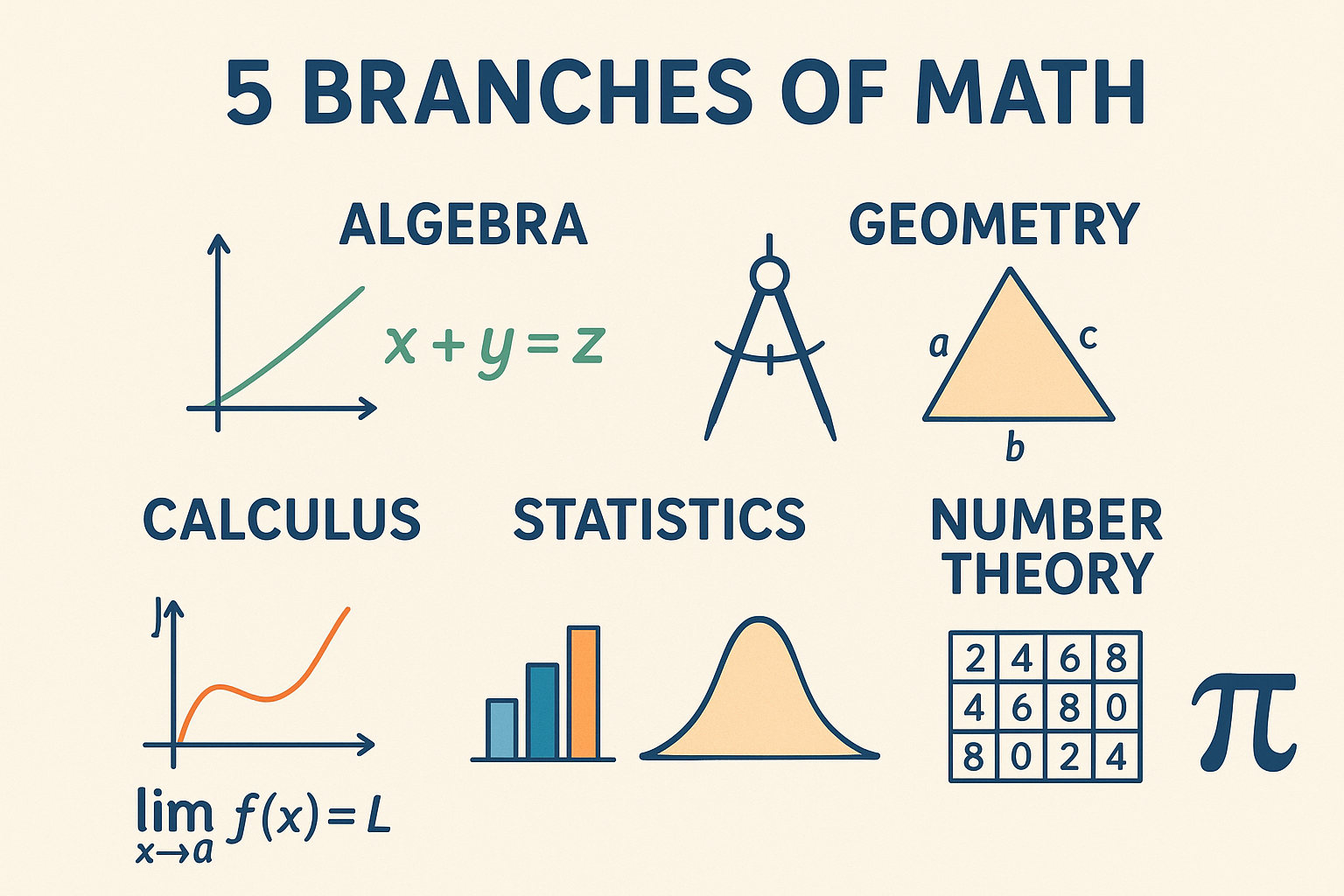
Mathematics is one of the oldest and most essential fields of human knowledge. From architecture and engineering to computer science and finance, math forms the foundation of nearly every aspect of modern life.
As someone who has taught mathematics for over five years, I’ve seen firsthand how understanding the main branches of math not only builds problem-solving skills but also shapes critical thinking, creativity, and career potential.
Many people wonder:
“What are the 5 main branches of math — and why do they matter?”
This guide answers that question comprehensively, drawing on educational research, academic standards, and real-world applications. By the end, you’ll understand each branch deeply and know how to apply it practically.
Why Understanding the Branches of Math Matters
Knowing the branches of mathematics is more than memorizing definitions. Understanding them helps you:
- Build structured knowledge: Each branch connects to others in predictable ways.
- Choose a career path: Engineers, data scientists, and economists rely on specific branches.
- Solve real-world problems: From budgeting to AI algorithms, math shapes outcomes.
- Develop analytical skills: Logical thinking and pattern recognition improve across branches.
According to the U.S. Department of Education’s National Mathematics Advisory Panel Report (2008), students who master foundational branches early perform better in higher-level STEM courses. UNESCO’s educational reports also emphasize these branches as core for global curricula.
The 5 Branches of Mathematics
1. Arithmetic: The Foundation of All Math
Arithmetic is the branch of mathematics dealing with numbers and basic operations: addition, subtraction, multiplication, and division.
Experience Insight: In my experience teaching younger students, mastering arithmetic early leads to faster success in algebra and calculus, because they spend less time struggling with basic calculations.
Key Concepts:
- Natural numbers and integers
- Fractions, decimals, and percentages
- Ratios and proportions
Real-World Applications:
- Budgeting and personal finance
- Cooking and measuring ingredients
- Everyday decision-making (shopping, comparisons)
Research from NCES (2023) shows strong arithmetic skills in early childhood correlate with improved logical reasoning and problem-solving later in life.
2. Algebra: The Language of Patterns
Algebra introduces symbols and variables to represent unknown quantities and generalize arithmetic. It forms the backbone of higher mathematics.
Experience Insight: When teaching algebra, students often struggle with abstract variables. I’ve found that linking equations to real-world scenarios, like calculating loan interest or tracking savings, helps students understand patterns and relationships.
Key Concepts:
- Variables, expressions, and equations
- Linear and quadratic equations
- Polynomials, inequalities, and functions
Applications in Real Life:
- Programming and algorithm design
- Machine learning models
- Business forecasting
- Engineering calculations
According to the National Mathematics Advisory Panel, algebra proficiency strongly predicts success in STEM careers and standardized testing outcomes.
3. Geometry: Understanding Space and Shape
Geometry studies the properties and relationships of shapes, lines, angles, and solids. It also develops spatial reasoning skills, which are critical in science, engineering, and design.
Experience Insight: I often guide students through hands-on activities—like building models or using CAD software—to make abstract geometric concepts tangible.
Key Concepts:
- Points, lines, angles, and planes
- Triangles, polygons, and circles
- Area, volume, and perimeter
- Symmetry and transformations
Applications:
- Architecture and interior design
- Robotics and 3D modeling
- Navigation, GPS, and mapping
A 2024 MIT study demonstrated that strong geometric skills improve problem-solving performance in engineering and architecture tasks.
4. Trigonometry: Measuring Angles and Waves
Trigonometry focuses on angles, triangles, and trigonometric functions like sine, cosine, and tangent.
Experience Insight: In tutoring trigonometry, I’ve observed that students grasp concepts faster when we relate them to real-world applications, such as calculating the height of a building or analyzing sound waves.
Key Concepts:
- Right triangles and angle measurement
- Trigonometric ratios and identities
- Unit circle and periodic functions
Applications:
- Satellite communications and astronomy
- Engineering and construction
- Wave and sound analysis
- Computer graphics and animation
According to a 2022 Applied Mathematics Review, trigonometry is crucial for climate modeling, aviation navigation, and medical imaging.
5. Calculus: The Math of Change
Calculus studies change, motion, and rates of growth or decay. Developed by Isaac Newton and Gottfried Wilhelm Leibniz, it underpins modern science and technology.
Experience Insight: Students often find calculus intimidating, but once they understand the connection between algebra, geometry, and real-life change, the concepts become intuitive.
Key Concepts:
- Limits, derivatives, and integrals
- Optimization problems
- Multivariable calculus
Applications:
- Engineering design and simulations
- Predictive modeling in economics
- Artificial intelligence algorithms
- Medicine (drug dosage calculations)
- Space exploration and orbital physics
A 2024 ScienceDirect analysis highlights calculus as foundational in AI modeling, pharmacology, and economic forecasting.
Beyond the Five Branches
While arithmetic, algebra, geometry, trigonometry, and calculus form the core, modern mathematics includes specialized fields like:
- Statistics and probability
- Number theory
- Linear algebra
- Topology
- Game theory
- Mathematical logic
These fields often stem from the primary five branches, expanding their applications in research and technology.
How to Learn the Five Branches Effectively
- Start with arithmetic to build a strong foundation.
- Progress to algebra, linking variables to real-life examples.
- Learn geometry with visual and hands-on methods.
- Understand trigonometry through practical problems in physics and navigation.
- Tackle calculus after mastering algebra and geometry, applying it to real-world change.
Tip: Combine theory with practice. Use apps, worksheets, and small projects to apply concepts in everyday life.
Conclusion: Math as the Blueprint of Progress
The five primary branches of mathematics—arithmetic, algebra, geometry, trigonometry, and calculus—form the foundation for all mathematical knowledge. Each branch has unique applications, and together they empower problem-solving, innovation, and logical thinking.
By understanding and practicing these branches, you gain skills that extend far beyond the classroom: from designing software to planning cities, predicting markets, and exploring the universe.
Mathematics is not just a subject—it’s a tool for understanding and shaping the world.