







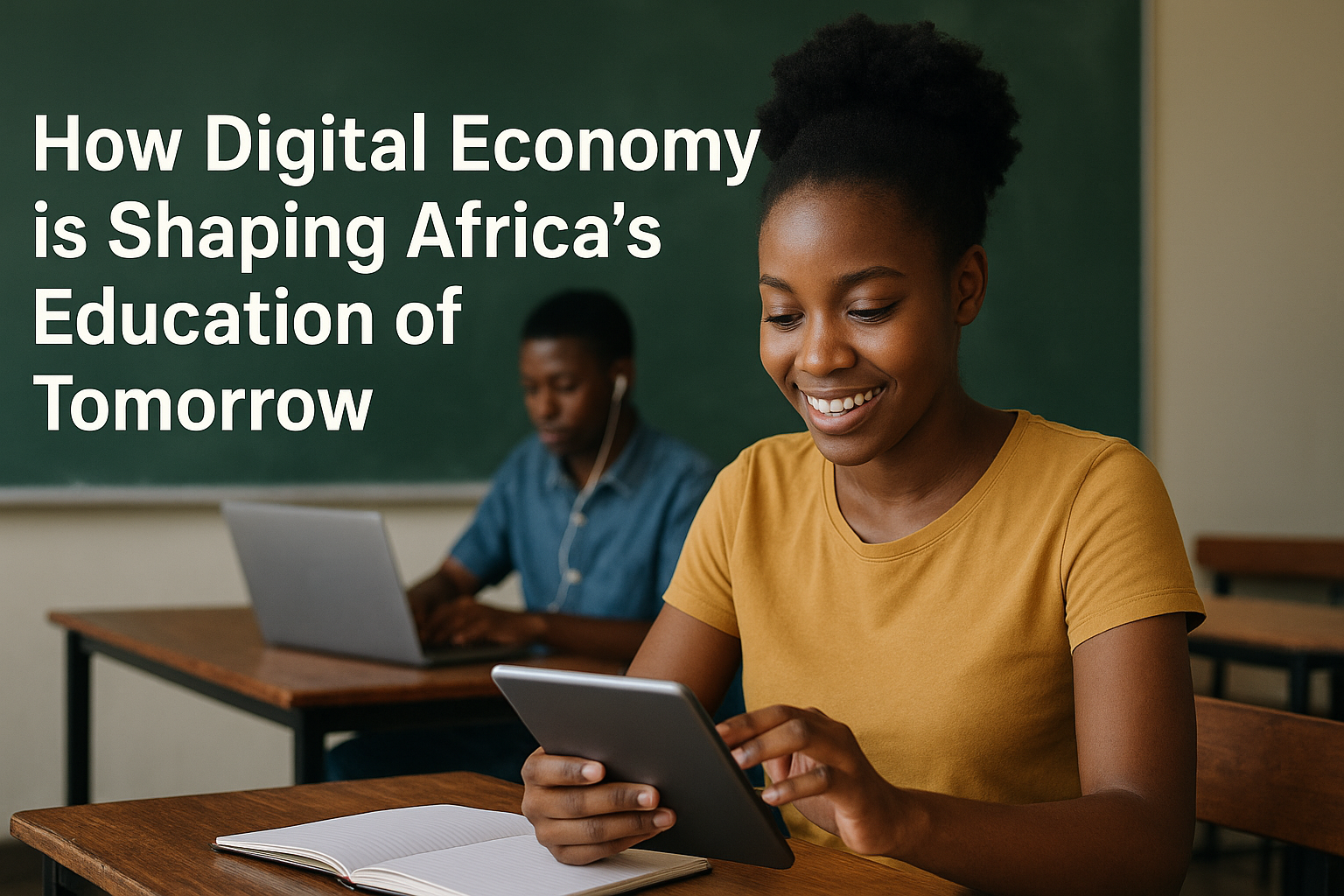
The phrase “The Role of the Digital Economy in Shaping Africa’s Education of Tomorrow” is more than a headline — it is a roadmap. As Africa builds digital infrastructure, expands mobile access, and grows vibrant tech ecosystems, the digital economy is changing how students learn, how teachers teach, and how governments design education systems. Done well, digitalization offers a way to expand access, personalise instruction, and close skills gaps. Done poorly, it risks widening inequality and wasting scarce public resources. This article explores the opportunities, evidence, policy levers, and practical models that show how the digital economy is shaping Africa’s education of tomorrow.
Why the digital economy matters for Africa’s education
The digital economy — meaning connectivity, mobile services, cloud and data infrastructure, digital platforms, and the businesses built on them — is a major driver of economic growth across Africa. Mobile technologies alone contributed roughly $220 billion to Africa’s GDP in 2024 (about 7.7% of GDP), and the sector is expected to expand further as 4G/5G adoption grows and local data hosting improves. These infrastructure and market trends shape what is possible for education: faster, lower-cost content delivery, scalable teacher training, and wider use of adaptive learning platforms. (GSMA)
The World Bank’s Digital Economy for Africa (DE4A) initiative underscores this connection: countries that build digital ecosystems are better positioned to deploy large-scale digital education solutions and link learning to growing sectors such as fintech, agritech, and health tech. (World Bank)
Four ways the digital economy is reshaping education
1. Expanding access through connectivity and affordable devices
Connectivity is the entry point. As mobile broadband and smartphone affordability improve, more learners—especially in peri-urban and rural areas—can access online lessons, radio/TV/online hybrid programs, and teacher resources. Public and private investments in local data centers and the expansion of mobile networks reduce latency and costs, making interactive learning viable at larger scale. For example, recent investments that expand African data-centre capacity reduce reliance on foreign hosting and improve service reliability, a practical boost for EdTech services. (Reuters)
2. Growing demand for digital skills and aligning curricula to jobs
The digital economy creates new types of jobs and raises demand for skills such as digital literacy, data handling, basic coding, and online entrepreneurship. Governments and institutions that integrate digital skills into primary, secondary and TVET curricula help align graduate supply with labour market demand. Targeted bootcamps, apprenticeships with tech firms, and micro-credentials are growing methods to rapidly equip learners with job-relevant skills. (World Bank)
3. Scaling teacher professional development
Digital platforms enable low-cost, scalable teacher training: video coaching, micro-credentials, and AI-assisted lesson planning allow continuous professional development even in remote areas. When teachers become digitally fluent, they can mediate technological tools effectively, select or adapt materials in local languages, and use formative assessment dashboards to track learners’ progress. Agencies such as UNESCO stress the centrality of teacher capacity in digital education strategies. (UNESCO)
4. Personalising learning with data and adaptive platforms
Adaptive learning systems and data dashboards can personalise instruction — offering remediation to learners who fall behind and enrichment to high performers. The promise is real: adaptive interventions have produced learning gains in trial settings, but evidence shows they work best when combined with in-person mentorship, localized content, and reliable connectivity. Tech is a tool, not a substitute for good pedagogy. (UNESCO Documents)
What the evidence says — promising, uneven, conditional
A growing body of research and reports points to gains when digital interventions are packaged sensibly. The UNESCO Global Education Monitoring (GEM) Report (2023) cautions that technology can improve access and learning — but only if deployment is evidence-based, equitable, and accompanied by governance. (UNESCO)
GSMA data shows the mobile industry’s economic footprint continues to grow; this economic muscle supports affordability initiatives (e.g., device financing and zero-rated education content) that can lower barriers for learners. Still, GSMA and other observers note the “usage gap”: access alone doesn’t guarantee meaningful learning. (GSMA)
UNCTAD and UN partners highlight a third dimension: sustainability and inclusion. The Digital Economy Report 2024 stresses that digital expansion must be environmentally sustainable (device lifecycle, energy use) and socially inclusive, or the benefits will be uneven. (UN Trade and Development (UNCTAD))
Key policy levers to maximise impact
Policy choices determine whether the digital economy helps education equitably or deepens exclusion. High-leverage actions include:
Invest in resilient, affordable connectivity
Public–private finance for last-mile connectivity, subsidies for data in education, and local data-centre investments reduce delivery costs and improve service quality for EdTech providers. The World Bank and IFC recently supported major data-centre projects to expand local hosting capacity — a direct infrastructure win for digital learning scalability. (Reuters)
Make digital skills core to curricula and TVET
Integrate digital literacy, computational thinking, and data skills across grade levels and TVET programs to meet employer demand. Link curricula updates directly to regional industry needs so schools feed growing local sectors.
Fund teacher development and open educational resources (OER)
Prioritise continuous teacher training in digital pedagogy and create OER in local languages. Teacher readiness is the single most important factor in whether technologies improve classroom outcomes. (ReliefWeb)
Target equity through device programs and blended delivery
Use targeted subsidies, community learning hubs, and blended radio/TV/online models to reach learners without reliable home internet. Public policies should explicitly prioritise rural learners, girls, and low-income households to avoid widening the digital divide. (Reuters)
Support local EdTech ecosystems
Encourage incubation, procurement pathways for public systems, and impact investment to scale context-appropriate solutions. Local innovators better understand language, cultural norms, and practical constraints.
Practical models that work
Several scalable models are proving effective in African contexts:
- Blended radio and online programs: combine low-bandwidth channels with online tutoring for redundancy and reach.
- Community solar hubs: shared study spaces with devices and off-grid power for rural learners.
- Teacher micro-credentials: stackable training that upgrades pedagogical and digital skills incrementally.
- Industry-linked bootcamps and apprenticeships: short programs that lead to direct placements in local tech, agritech, and fintech firms.
Each succeeds when infrastructure, teacher capacity, and employer demand converge.
Risks and safeguards
Rapid digitalisation brings risks: data privacy for children, low-quality content proliferating, environmental costs of device scale-up, and the risk that investments favour urban over rural areas. Policymakers must prioritize child data protection, set procurement standards for quality, and design device programs with recycling and energy considerations in mind. UN reports urge a balanced, sustainable approach. (UN Trade and Development (UNCTAD))
Conclusion — a conditional but hopeful vision
“The Role of the Digital Economy in Shaping Africa’s Education of Tomorrow” is both transformative and conditional. The digital economy offers Africa powerful tools to expand access, personalise learning, and link education to jobs — but its benefits are not automatic. Real success depends on deliberate investments in connectivity, teacher capacity, localized content, equitable device access, and sustainable policies.
If African governments, donors, EdTech innovators, and educators align infrastructure investments with inclusive policies and teacher development, the digital economy will be a major force in building an educated, employable, and resilient generation ready for tomorrow’s jobs.