







Prime numbers may look simple, but they sit at the heart of mathematics. From classroom problem-solving to modern encryption systems like RSA, primes play a foundational role in number theory and computer security.
If you’ve ever needed to determine whether a number is prime — especially in an exam setting without a calculator — this guide will walk you through reliable, practical methods that actually work.
Over the years, I’ve noticed that students who master just three key principles — elimination, divisibility rules, and the square root limit — can test primes quickly and confidently. Let’s break those down clearly and logically.
What Exactly Is a Prime Number?
A prime number is a whole number greater than 1 that has exactly two positive factors:
- 1
- Itself
Examples of prime numbers:
2, 3, 5, 7, 11, 13, 17, 19, 23, 29
Examples of non-prime (composite) numbers:
- 4 (1, 2, 4)
- 6 (1, 2, 3, 6)
- 9 (1, 3, 9)
Important clarification:
1 is not prime because it has only one factor.
Why Learning This Without a Calculator Matters
When calculators are not allowed — such as in many standardized exams — manual prime testing becomes essential.
But beyond exams, testing primes by hand strengthens:
- Logical reasoning
- Pattern recognition
- Mental arithmetic
- Understanding of factor relationships
Students who rely only on technology often struggle with number sense. Learning these methods builds deeper mathematical intuition.
The Proven Manual Method (Trial Division Strategy)
The formal name for the process you’re about to learn is trial division. It works efficiently for moderately sized numbers.
Here’s the structured approach.
Step 1: Immediately Eliminate Even Numbers
Every even number greater than 2 is composite.
If a number ends in:
0, 2, 4, 6, 8 → it is divisible by 2.
Exception: 2 itself is prime.
This step alone eliminates half of all numbers instantly.
In timed exams, this is the fastest first filter.
Step 2: Apply the Divisibility Rule for 5
If a number ends in:
0 or 5 → it is divisible by 5.
Exception: 5 itself is prime.
Another quick elimination step.
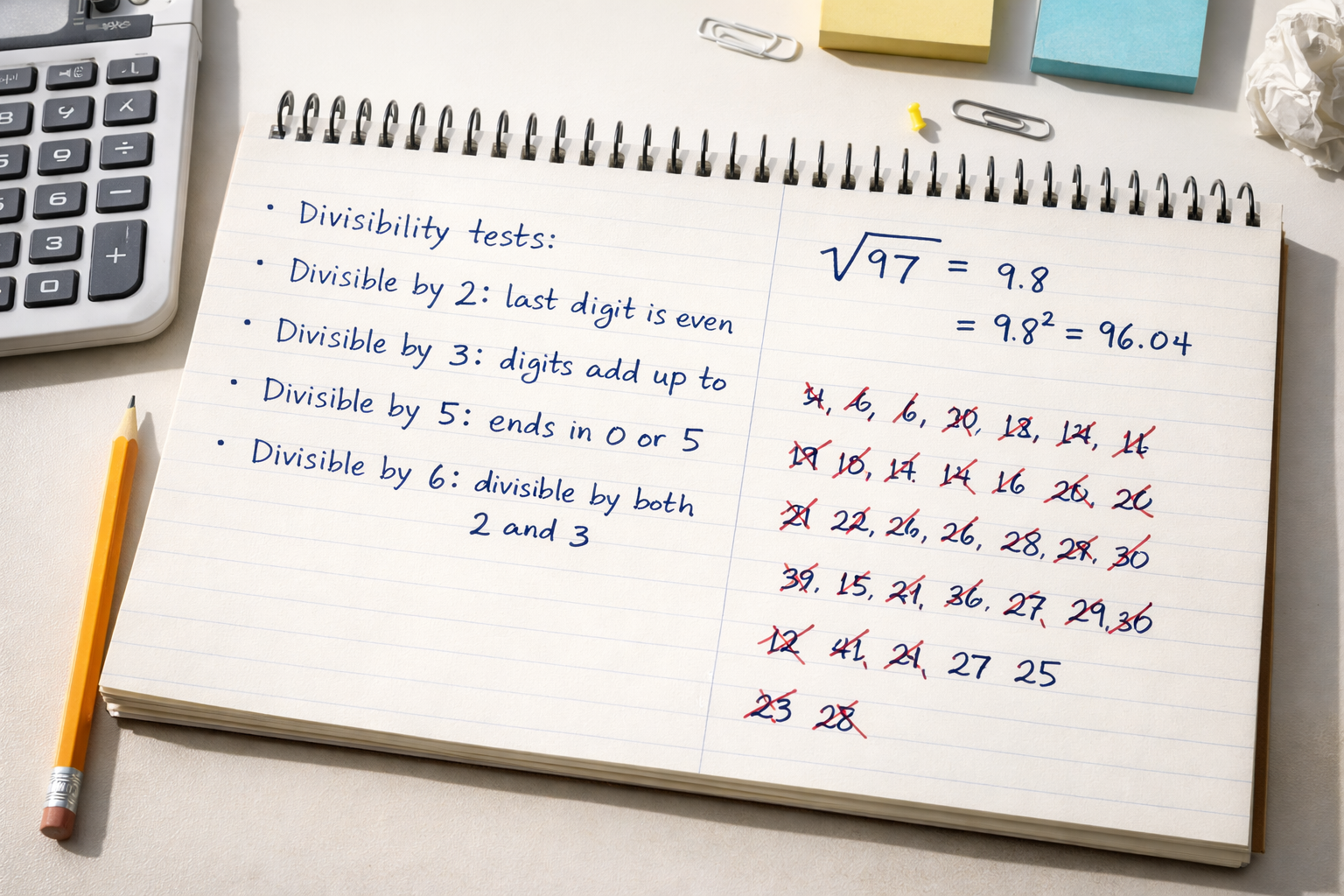
Step 3: Test Divisibility by 3
Add the digits together.
If the sum is divisible by 3, the number is divisible by 3.
Example:
123
1 + 2 + 3 = 6
6 is divisible by 3 → 123 is composite.
This rule works because of how our base-10 number system distributes multiples of 3 across digit places.
The Most Important Principle: Stop at the Square Root
This is the step many learners misunderstand.
To determine if a number n is prime, you only need to test divisibility up to √n.
Why This Works
Factors come in pairs.
If:
a × b = n
Then one factor must be less than or equal to √n.
If both were larger than √n, their product would exceed n.
Therefore:
If no factor less than or equal to √n divides n, the number must be prime.
This dramatically reduces the work required.
Full Example: Is 97 Prime?
Step 1: Is it even?
No.
Step 2: Sum of digits
9 + 7 = 16 → not divisible by 3.
Step 3: Ends in 0 or 5?
No.
Now apply the square root limit.
√97 is slightly less than 10.
So we only test prime numbers less than or equal to 10:
2, 3, 5, 7
We’ve ruled out 2, 3, and 5.
Test 7:
97 ÷ 7 = 13 remainder 6
Not divisible.
No primes up to √97 divide it.
Conclusion: 97 is prime.
Another Example: Is 121 Prime?
Not even.
Digit sum = 4 → not divisible by 3.
Does not end in 0 or 5.
√121 = 11.
Test primes up to 11:
2, 3, 5, 7, 11
121 ÷ 11 = 11 exactly.
Therefore, 121 is composite.
The Sieve Method (Finding Many Primes at Once)
If you need to list many primes in a range, use the Sieve of Eratosthenes, developed in ancient Greece.
How it works:
- Write numbers starting from 2.
- Circle 2.
- Cross out all multiples of 2.
- Move to the next uncrossed number (3).
- Cross out all multiples of 3.
- Repeat.
This method systematically eliminates composite numbers.
It is one of the earliest known prime-generating algorithms and remains foundational in computational number theory.
Why Prime Numbers Matter Beyond the Classroom
Prime numbers are not just academic exercises.
Modern encryption systems such as RSA rely on the mathematical difficulty of factoring very large composite numbers made from two large primes.
The security of online banking, messaging, and digital signatures depends on this principle.
While the primes used in encryption are extremely large, the logic behind identifying them begins with the same trial division principles you’ve learned here.
When Manual Prime Testing Becomes Impractical
Trial division works well for:
- Classroom problems
- Numbers under a few hundred
- Exam settings
It becomes inefficient for very large numbers.
For advanced mathematics or computing, more sophisticated algorithms are used — but understanding the manual method is essential before learning those.
Common Mistakes to Avoid
- Assuming 1 is prime
- Testing divisors beyond the square root
- Forgetting to test 7 and 11 for mid-sized numbers
- Not checking all relevant primes below √n
In exam situations, the most common error I see is students stopping too early — especially forgetting to test 7.
Quick Divisibility Reference
Divisible by 2 → Last digit even
Divisible by 3 → Sum of digits divisible by 3
Divisible by 5 → Ends in 0 or 5
Divisible by 9 → Sum of digits divisible by 9
These rules significantly reduce workload.
How to Get Faster at Prime Testing
To build speed and confidence:
- Memorize prime numbers up to 50
- Practice estimating square roots mentally
- Strengthen multiplication tables up to 12 × 12
- Randomly test numbers under 150
With practice, you’ll begin to recognize likely primes instantly.
Final Summary: The Efficient Prime-Testing Framework
To determine if a number is prime without a calculator:
- Eliminate even numbers
- Apply divisibility rules for 3 and 5
- Test remaining prime divisors
- Stop at the square root
This structured approach minimizes effort while ensuring accuracy.
Prime numbers reward patience and logical thinking. Once you understand factor pairing and the square root principle, the process becomes systematic rather than mysterious.
With consistent practice, you’ll move from guessing to confidently proving whether a number is prime.