







Choosing between a college and a university is one of the first major decisions students make after high school. But many people still ask:
Are college and university the same?
The short answer is no—but the difference depends on the country, structure, and your goals.
This guide will give you a clear, practical understanding, including:
- Key differences (with a simple table)
- Real-life examples
- How to choose the right option for your future
What Is a College?
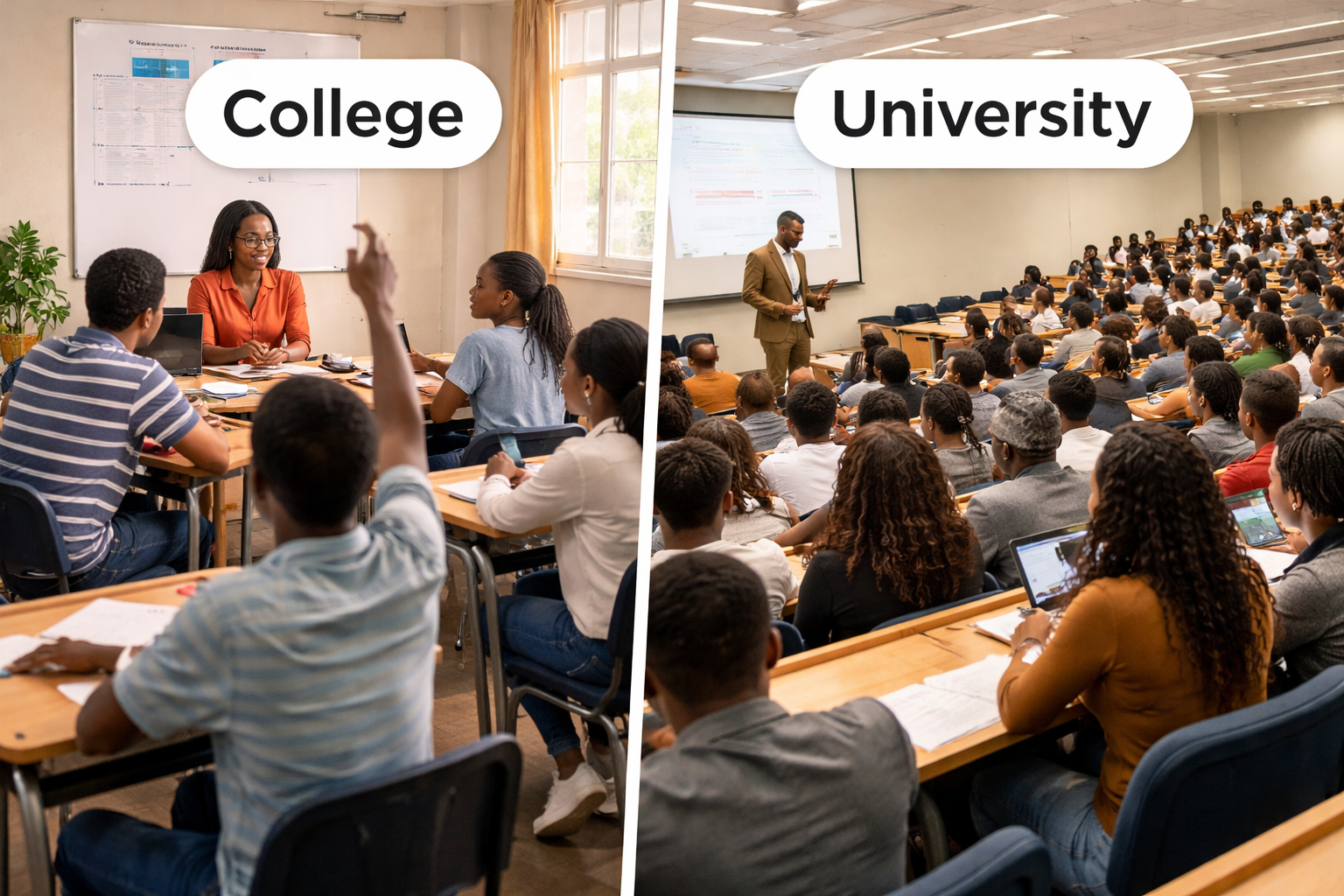
A college is generally a smaller institution that focuses mainly on undergraduate education.
In many education systems, colleges:
- Offer associate or bachelor’s degrees
- Provide smaller class sizes
- Focus more on teaching than research
Real-World Example
A student who wants to study business and enter the workforce quickly may choose a community college, complete a 2-year program, and start working—or transfer later to a university.
Types of Colleges
- Community Colleges: 2-year programs, often more affordable
- Liberal Arts Colleges: Broad education (arts, science, humanities)
- Specialized Colleges: Focused fields like nursing, tech, or business
What Is a University?
A university is a larger institution that offers both:
- Undergraduate degrees
- Postgraduate degrees (Master’s, PhD)
Universities also emphasize:
- Research
- Advanced facilities
- Diverse academic programs
Real-World Example
A student aiming to become a doctor or researcher will typically attend a university, where they can progress from a bachelor’s degree to advanced studies.
Key Differences Between College and University
Here’s a simple comparison to make things clear:
| Feature | College | University |
|---|---|---|
| Size | Smaller | Larger |
| Programs | Mostly undergraduate | Undergraduate + postgraduate |
| Class Size | Smaller, more personal | Larger, especially early years |
| Research | Limited | Strong focus |
| Structure | Single institution | Multiple faculties/colleges |
| Flexibility | Easier entry, transfer options | More structured academic paths |
Why the Terms Can Be Confusing
The meaning of “college” and “university” changes depending on the country.
🇺🇸 United States
- “College” and “university” are often used interchangeably
- Universities usually contain multiple colleges
🇬🇧 United Kingdom
- Colleges may be part of universities or refer to pre-university education
- Universities are the main degree-awarding institutions
Key takeaway:
Always look at what the institution offers—not just its name.
Real-Life Scenarios: Which One Is Better?
Scenario 1: Career-Focused Student
- Goal: Get job-ready skills quickly
- Best choice: College
Example: Studying nursing or IT at a community college
Scenario 2: Academic/Research Path
- Goal: Become a scientist, lecturer, or specialist
- Best choice: University
Example: Engineering → Master’s → PhD
Scenario 3: Flexible Path
- Start at college → transfer to university
Saves money and builds foundation
Pros and Cons of College vs University
College Pros
- Smaller class sizes
- More personal attention
- Often more affordable
- Easier admission in many cases
College Cons
- Limited advanced degree options
- Fewer research opportunities
University Pros
- Wide range of programs
- Access to postgraduate degrees
- Strong research opportunities
- Better global recognition (in some cases)
University Cons
- Larger classes
- Higher cost
- Less individual attention (especially early years)
How to Choose the Right Option (Step-by-Step)
1. Define Your Career Goals
- Do you need a postgraduate degree?
Yes → University.
No → College may be enough.
2. Consider Your Learning Style
- Prefer small classes? → College
- Comfortable with lectures? → University
3. Evaluate Your Budget
- Colleges are often more affordable
- Universities may offer more scholarships
4. Check Transfer Opportunities
Many students:
Start at college.
Transfer to university later.
5. Look Beyond the Name
Focus on:
- Course quality
- Accreditation
- Career outcomes
Common Misconceptions (Cleared Up)
“Universities are always better”
Not true—depends on your goals
“Colleges don’t offer quality education”
Many colleges provide excellent, career-focused training
“You can’t switch between them”
Many systems allow transfers
Expert Insight: What Actually Matters Most
From real student experiences and education trends:
Success depends more on:
- Your skills
- Your effort
- Your chosen field
Not just whether you attend a college or university.
Final Answer: Are College and University the Same?
No, they are not the same—but they are closely related.
- College: Smaller, focused on undergraduate education
- University: Larger, offers advanced degrees and research opportunities
The best choice depends on your goals, budget, and learning style—not the label.