








Short answer: Yes — when implemented thoughtfully, artificial intelligence (AI) can significantly improve accessibility, personalization, communication, and independence for students with disabilities.
But AI is not a magic solution. Its effectiveness depends on ethical design, educator training, accessibility standards, and proper oversight.
This guide explores:
- How AI supports students with disabilities
- Evidence-backed benefits
- Real classroom applications
- Legal and privacy considerations
- How schools and parents can evaluate AI tools responsibly
Why Inclusive Education Still Faces Barriers
According to the World Health Organization, more than 1 billion people worldwide live with some form of disability. In education systems globally, students may face barriers such as:
- Visual impairments
- Hearing impairments
- Dyslexia and other learning disabilities
- Autism spectrum conditions
- ADHD
- Physical or mobility limitations
- Speech and communication disorders
The UNESCO emphasizes that inclusive education requires removing systemic barriers — not expecting students to adapt to rigid systems.
Traditional instruction methods (lecture-heavy teaching, printed textbooks, handwritten assignments) can unintentionally exclude students with diverse needs. This is where AI-powered assistive technologies are making measurable impact.
How AI Supports Students with Disabilities (With Evidence)
1. Text-to-Speech & Speech-to-Text: Reducing Literacy Barriers
Students with dyslexia or visual impairments often struggle with decoding printed text. AI-powered reading tools such as:
- Microsoft Immersive Reader
- Google Read Along and Live Transcribe
- Kurzweil Education literacy software
use natural language processing to convert text into speech and highlight words in real time.
Research published in educational technology journals shows that text-to-speech tools can improve reading comprehension and reduce cognitive load for struggling readers.
Why it matters: Students can focus on understanding content rather than decoding mechanics.
2. Adaptive Learning Platforms: Personalization at Scale
AI-based learning platforms analyze student performance patterns and adjust content difficulty automatically.
For example:
- If a student struggles with algebraic word problems, the system provides scaffolded exercises.
- If a learner masters a concept quickly, it increases complexity.
The U.S. Department of Education has reported that adaptive learning technologies can improve engagement and mastery when integrated effectively into instruction.
This is particularly beneficial for students with ADHD or executive functioning challenges, who may require smaller instructional steps and frequent feedback.
3. Real-Time Captioning for Deaf and Hard-of-Hearing Students
AI speech recognition systems generate real-time captions in classrooms and virtual learning environments.
Tools like:
- Google Live Caption
- Microsoft Teams live transcription
allow students to follow lectures without relying solely on interpreters.
Research in accessibility studies shows captioning improves comprehension not only for deaf students but also for multilingual learners and students with auditory processing disorders.
4. AI-Powered Communication Aids
Students with speech impairments or autism spectrum conditions may use Augmentative and Alternative Communication (AAC) apps powered by predictive AI.
These systems:
- Suggest context-based words
- Convert typed text into natural speech
- Learn user-specific language patterns
Predictive language models reduce communication effort and increase participation in classroom discussions.
5. Executive Function Support for ADHD
Students with ADHD frequently struggle with:
- Time management
- Task sequencing
- Organization
AI-based digital planners and smart assistants help by:
- Breaking assignments into smaller tasks
- Sending reminders
- Tracking progress
When combined with teacher oversight, these tools support independence without replacing human guidance.
Real-World Classroom Application
In classrooms that integrate AI tools effectively:
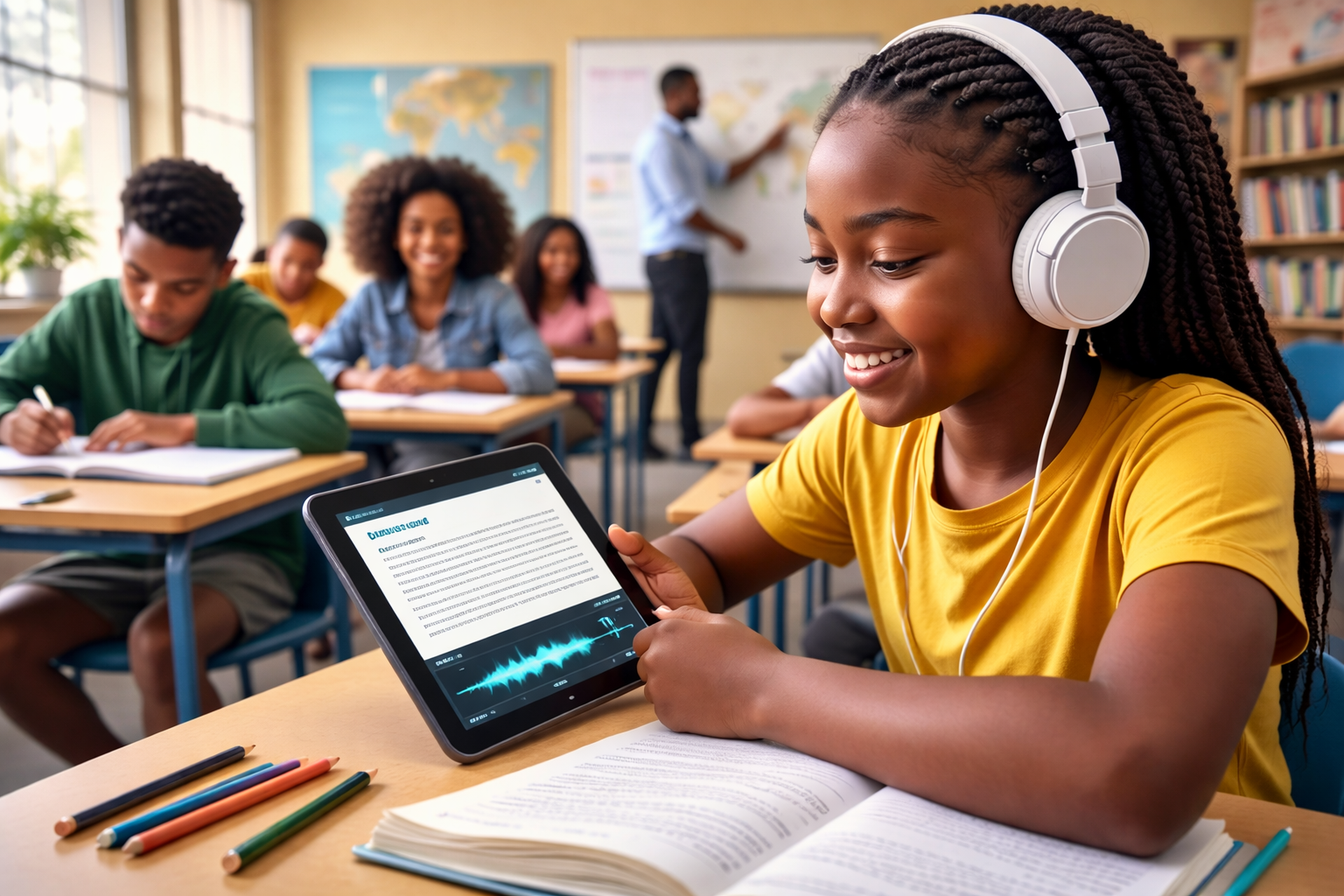
- A student with dyslexia listens to a digital textbook while following synchronized highlighted text.
- A student with limited mobility completes essays through speech dictation.
- A teacher receives dashboard insights identifying skill gaps before exams.
- A deaf student reviews automatically transcribed lectures after class.
Importantly, AI supplements teachers — it does not replace them.
As emphasized by UNESCO, inclusive education succeeds when technology is paired with trained educators and supportive environments.
Legal & Ethical Considerations Schools Must Address
AI use in education intersects with privacy and disability rights laws.
In the United States:
- FERPA protects student education records.
- IDEA ensures students with disabilities receive appropriate support.
In the European Union:
- GDPR governs personal data processing.
Schools must ensure that AI vendors:
- Store data securely
- Limit third-party data sharing
- Provide transparency on algorithmic decision-making
Privacy compliance is not optional — it directly impacts trust.
Benefits Beyond Academics
When implemented responsibly, AI can support:
Increased Independence
Students complete tasks without constant adult intervention.
Greater Confidence
Removing access barriers allows students to demonstrate their true abilities.
Improved Engagement
Interactive, adaptive systems can reduce frustration and cognitive overload.
Stronger Inclusion
Accessible technology enables students to participate in mainstream classrooms alongside peers.
The World Health Organization highlights that accessibility improves not only learning outcomes but long-term social participation.
Limitations and Responsible Use
AI in education is promising but not flawless.
1. Algorithmic Bias
AI systems trained on limited datasets may misinterpret speech patterns or learning behaviors.
2. Emotion Recognition Technology
While emerging systems claim to detect frustration or confusion, research indicates accuracy and ethical concerns remain unresolved.
3. Teacher Training Gaps
Technology is ineffective without educator training.
4. Equity Concerns
Advanced AI platforms may be costly, potentially widening socioeconomic disparities.
Google’s Search Quality Evaluator Guidelines emphasize that trustworthy content must avoid exaggerated claims. AI should be described as a tool — not a guaranteed solution.
How Parents and Educators Can Evaluate AI Tools
Before adopting an AI tool, consider:
✔ Does it comply with FERPA or GDPR?
✔ Is it aligned with accessibility standards (e.g., WCAG)?
✔ Is there peer-reviewed research supporting its claims?
✔ Can teachers customize settings?
✔ Does it enhance — not replace — human instruction?
Collaboration between families, educators, and special education professionals ensures appropriate implementation.
The Future of AI in Special Education
AI systems are improving in:
- Multilingual accessibility
- Real-time translation
- Context-aware tutoring
- Personalized learning pathways
However, ethical oversight must evolve alongside innovation.
As the U.S. Department of Education has emphasized, technology in education must prioritize equity, accessibility, and data protection.
Conclusion: A Powerful Tool — When Used Responsibly
So, can AI help students with disabilities?
Yes — when implemented ethically, supported by research, and integrated with compassionate teaching.
AI can:
- Improve accessibility
- Personalize learning
- Strengthen communication
- Promote independence
But it works best as a partner to educators, not a replacement.
Inclusive education is not simply about classroom access. It is about equitable opportunity — and when guided by research, regulation, and human care, AI can help make that opportunity real.