








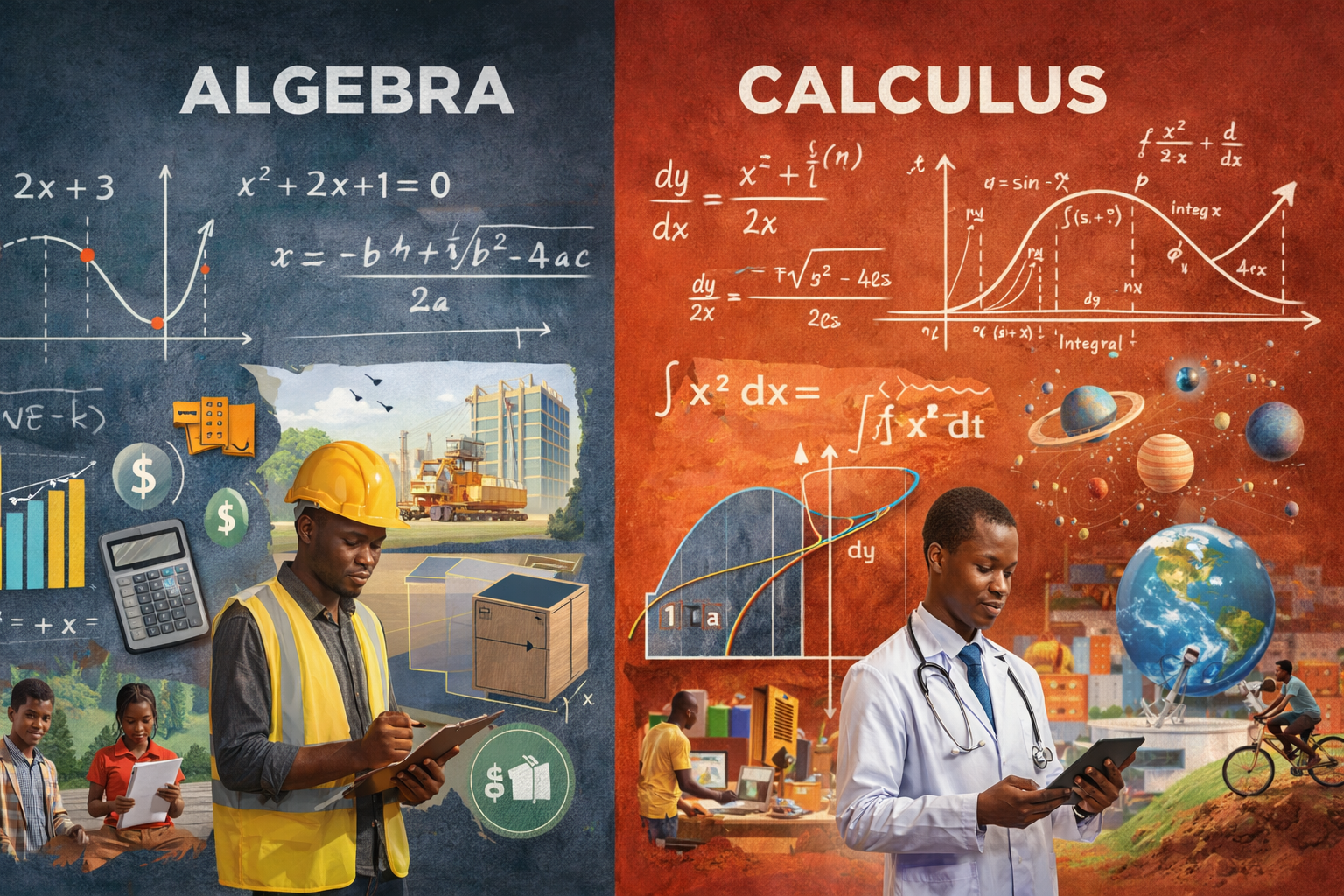
Have you ever wondered why algebra feels manageable, but calculus seems like a completely different level of math?
You’re not alone.
Many students and even professionals struggle to clearly understand the difference between algebra and calculus—and more importantly, when and why each one matters in real life.
In this guide, you’ll learn:
- What algebra and calculus really are (in simple terms)
- The key differences between them
- How they apply in real-world situations
- A clear path to mastering both
Whether you’re a student, entrepreneur, or just curious, this explanation will make things click.
What Is Algebra?
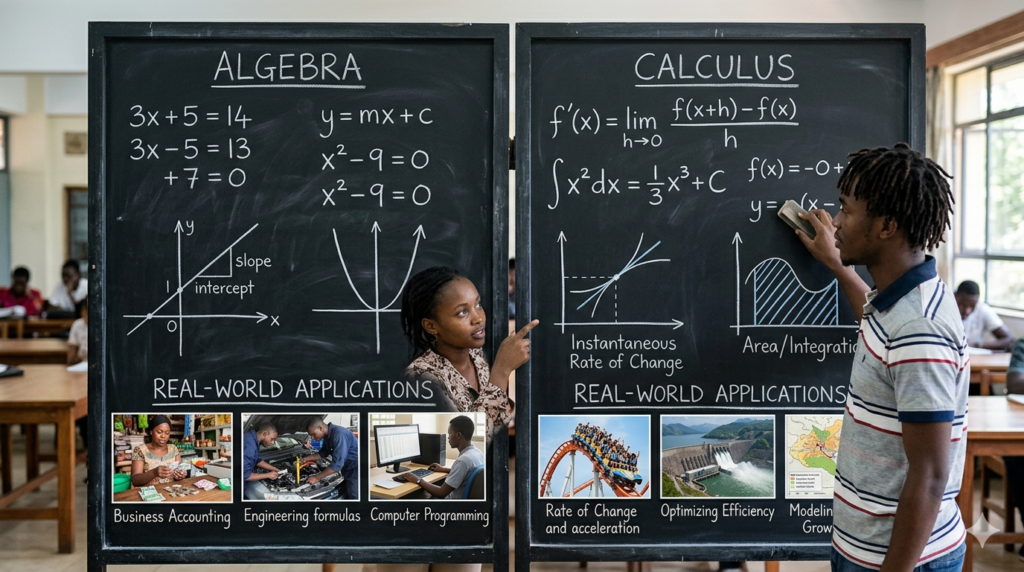
Algebra is one of the most important foundations of mathematics. It uses symbols (like x and y) to represent unknown values and helps you solve problems step by step.
Key Features of Algebra
- Variables: Letters represent unknown numbers
- Equations: Expressions like 2x + 5 = 15
- Operations: Addition, subtraction, multiplication, division
- Relationships: Understanding how quantities connect
Simple Example
3x + 6 = 12
Subtract 6 from both sides:
3x = 6
Divide by 3:
x = 2
This is algebra in action—finding the unknown using logical steps.
Real-Life Applications of Algebra
Algebra isn’t just classroom theory—it shows up in everyday decisions.
For example, when budgeting or managing expenses, you often need to solve for unknown values:
“If I spend ₦5,000 on transport and still want to save ₦10,000, how much can I spend on food?”
That’s algebra.
Other uses include:
- Budgeting and financial planning
- Business profit calculations
- Programming and data analysis
- Measuring distance, speed, and time
According to platforms like Khan Academy, algebra is a critical stepping stone for understanding higher-level math and problem-solving.
What Is Calculus?
Calculus is a more advanced branch of mathematics that focuses on change and motion.
While algebra deals with fixed values, calculus helps you understand how things change over time—which is essential in the real world.
Key Features of Calculus
- Rates of change: How fast something increases or decreases
- Accumulation: Adding up small changes to get a total
- Functions and graphs: Visualizing relationships dynamically
- Core concepts: Limits, derivatives, and integrals
The Two Main Branches of Calculus
1. Differential Calculus (Change)
This focuses on how things change at a specific moment.
For example:
- How fast is a car accelerating right now?
- How quickly is a business growing this month?
A derivative gives you that exact rate of change.
2. Integral Calculus (Accumulation)
This focuses on totals built from small pieces.
For example:
- Total distance traveled over time
- Total revenue accumulated over months
An integral helps you calculate that total.
Real-Life Applications of Calculus
Calculus powers many real-world systems.
In my experience analyzing trends (like tracking growth or changes over time), the idea of “rate of change” becomes incredibly useful—even outside formal math.
It is widely used in:
- Engineering and physics
- Economics and finance
- Medicine (e.g., modeling growth or decay)
- Artificial intelligence and machine learning
For instance, machine learning models rely heavily on calculus to optimize performance using derivatives.
Key Differences Between Algebra and Calculus
Here’s a simple breakdown:
1. Focus
- Algebra: Solving for unknown values
- Calculus: Understanding change and motion
2. Complexity
- Algebra: Foundational and introductory
- Calculus: More advanced and builds on algebra
3. Type of Problems
- Algebra: Static (fixed values)
- Calculus: Dynamic (changing values)
4. Tools Used
- Algebra: Equations and formulas
- Calculus: Limits, derivatives, integrals
5. Real-World Use
- Algebra: Everyday calculations and planning
- Calculus: Modeling complex systems and predictions
How Algebra and Calculus Work Together
Here’s something many people miss:
Calculus is impossible without algebra.
Before solving calculus problems, you must:
- Simplify expressions
- Rearrange equations
- Understand functions
Example
To find the derivative of:
f(x) = 2x² + 3x
You must already understand algebraic rules.
Without algebra, calculus quickly becomes confusing.
Common Mistakes Students Make
Understanding these can save you time and frustration:
1. Treating Calculus as “Just Hard Algebra”
Calculus introduces entirely new ideas like limits and instantaneous change—not just harder equations.
2. Weak Algebra Foundation
Many struggles with calculus come from not fully understanding algebra basics.
3. Memorizing Instead of Understanding
Formulas help, but concepts matter more—especially in calculus.
A Simple Learning Path (Step-by-Step)
If you want to master both subjects, follow this order:
- Learn basic algebra (variables, equations)
- Understand functions and graphs
- Move into limits (foundation of calculus)
- Learn derivatives (rates of change)
- Learn integrals (accumulation)
This progression is recommended by many educational institutions, including MIT OpenCourseWare.
Practical Example: Real-Life Comparison
Imagine you run a small delivery business.
Algebra Helps You:
- Calculate costs and profits
- Set pricing
- Solve expense-related equations
Calculus Helps You:
- Track growth trends over time
- Optimize delivery efficiency
- Predict future demand
Both are powerful—but they solve different types of problems.
Tips for Understanding Both Subjects
For Algebra
- Practice solving problems daily
- Break problems into smaller steps
- Focus on understanding, not memorizing
For Calculus
- Strengthen algebra first
- Use graphs to visualize concepts
- Apply ideas to real-life situations
Conclusion
Algebra and calculus are both essential—but they serve different purposes.
- Algebra helps you find unknown values
- Calculus helps you understand how those values change
Together, they form the backbone of mathematics used in everything from budgeting to advanced technology.
By mastering algebra first and then building into calculus, you unlock the ability to solve both simple and complex real-world problems with confidence.
Final Thought
Mathematics isn’t just about numbers—it’s about understanding the world.
And once you see how algebra and calculus apply to everyday life, they stop being difficult subjects… and start becoming powerful tools.