




Special education continues to evolve as educators, policymakers, and caregivers search for better ways to support children with diverse learning needs. One important framework that has become increasingly recognized in professional development conversations is the “7 G’s in Special Education.”
While the term is not yet universal in every region, it is commonly used in teacher training, educational workshops, and inclusive learning models to describe seven foundational principles that guide effective teaching and support for learners with special needs.
In a world where classrooms are becoming more diverse and inclusive, understanding these 7 G’s can help teachers deliver better instruction, strengthen emotional support systems, and promote long-term success for every child.
In this in-depth article, you’ll learn:
- What the 7 G’s in special education are
- How they improve learner outcomes
- Why they matter in inclusive classrooms
- How teachers, parents, and administrators can apply them
- The latest research supporting each principle
Let’s dive in.
What Are the 7 G’s in Special Education?
The 7 G’s refer to seven instructional and support principles used to enhance learning experiences for students with disabilities. They include:
- Guidance
- Growth
- Goals
- Grit
- Gears (Tools & Adaptations)
- Grace (Empathy & Patience)
- Grounding (Structure & Stability)
Each “G” represents a powerful pillar that helps educators create a supportive, inclusive, and effective special education environment.
Let’s explore each one in detail.
1. Guidance: Providing Direction, Support, and Individualized Instruction
Guidance refers to the intentional support given to learners with disabilities, ensuring they understand what to do, how to do it, and why it matters.
Why Guidance Matters
Students in special education often require:
- Clear directions
- Step-by-step modeling
- Visual cues
- Repetition
- Scaffolding
Studies published in the Journal of Special Education show that guided instruction improves task completion, reduces frustration, and enhances self-confidence among students with learning disabilities.
Classroom Application
Teachers can provide effective guidance by:
- Using visual schedules
- Demonstrating tasks before asking students to perform them
- Using chunking and scaffolding
- Giving prompts gradually (least to most or most to least)
- Checking for understanding frequently
Guidance lays the foundation for every other “G.”
2. Growth: Monitoring Progress and Encouraging Improvement
Growth refers to the academic, emotional, and behavioral development of learners. In special education, growth is highly individualized.
Why Growth Matters
The Individuals with Disabilities Education Act (IDEA) emphasizes measurable progress as a core principle. Growth is not just about grades — it includes:
- Communication skills
- Social skills
- Self-regulation
- Functional life skills
Research from the National Center for Special Education Research (NCSER) shows that growth-based teaching improves long-term outcomes by helping students see their personal progress, not just compare themselves to others.
Classroom Application
Teachers can encourage growth by:
- Using Individualized Education Program (IEP) tracking tools
- Celebrating small achievements
- Offering personalized feedback
- Using growth charts and visual data trackers
Growth ensures learners feel empowered, not overwhelmed.
3. Goals: Setting Clear, Attainable Objectives
In special education, goals are central. Every student has an IEP that outlines specific short-term and long-term goals.
Why Goals Matter
Goals provide:
- Direction
- Structure
- Motivation
- Accountability
A 2023 report from the American Institutes for Research found that students with clearly defined learning goals show significantly higher engagement and improved academic results.
Classroom Application
Teachers should ensure that goals are:
- SMART (Specific, Measurable, Achievable, Relevant, Time-bound)
- Written in student-friendly language
- Reviewed regularly
- Linked to daily lessons
Goals help students build confidence by knowing exactly what they are working toward.
4. Grit: Building Perseverance and Resilience
Grit is the ability to keep trying even when tasks are difficult. For many learners in special education, perseverance is essential for success.
Why Grit Matters
Research by psychologist Angela Duckworth shows that grit is one of the strongest predictors of academic success — even more than intelligence or talent.
For special education students, grit leads to:
- Improved task completion
- Higher self-esteem
- Stronger problem-solving skills
- Increased independence
Classroom Application
Teachers can nurture grit by:
- Teaching self-regulation strategies
- Providing manageable challenges
- Modeling perseverance
- Praising effort rather than perfection
- Allowing safe mistakes
Grit builds mindset — and mindset builds success.
5. Gears: Tools, Technology, and Adaptations
“Gears” refers to the tools, assistive technologies, accommodations, and modifications that support learners with disabilities.
Why Gears Matter
Gears close the gap between ability and opportunity.
Modern research shows that adaptive tools significantly improve student engagement and access.
Examples include:
- Text-to-speech devices
- Audiobooks
- Braille materials
- Adaptive seating
- Visual communication boards
- Noise-canceling headphones
- Adaptive keyboards
- Augmentative and Alternative Communication (AAC) devices
A 2022 review by the Assistive Technology Industry Association reports that assistive tools can increase reading comprehension by up to 43% and boost independence for students with autism, ADHD, and learning disabilities.
Classroom Application
Teachers should:
- Identify which tools each student needs
- Train students on how to use them
- Collaborate with occupational therapists and speech therapists
- Update classroom tools regularly
Gears ensure that students are equipped to learn effectively.
6. Grace: Empathy, Compassion, and Emotional Support
Grace represents the emotional component of teaching — patience, understanding, kindness, and empathy.
Why Grace Matters
Students in special education may face:
- Emotional regulation challenges
- Social difficulties
- Anxiety
- Low confidence
- Behavior struggles
A study published in Frontiers in Psychology (2023) shows that empathetic classroom environments improve academic outcomes, reduce behavior incidents, and increase student engagement.
Classroom Application
Teachers can show grace by:
- Using calm, encouraging language
- Practicing trauma-informed teaching
- Offering breaks without judgment
- Understanding triggers
- Supporting emotional needs as much as academic needs
Grace builds relationships — and relationships build learning.
7. Grounding: Establishing Stability and Well-Structured Routines
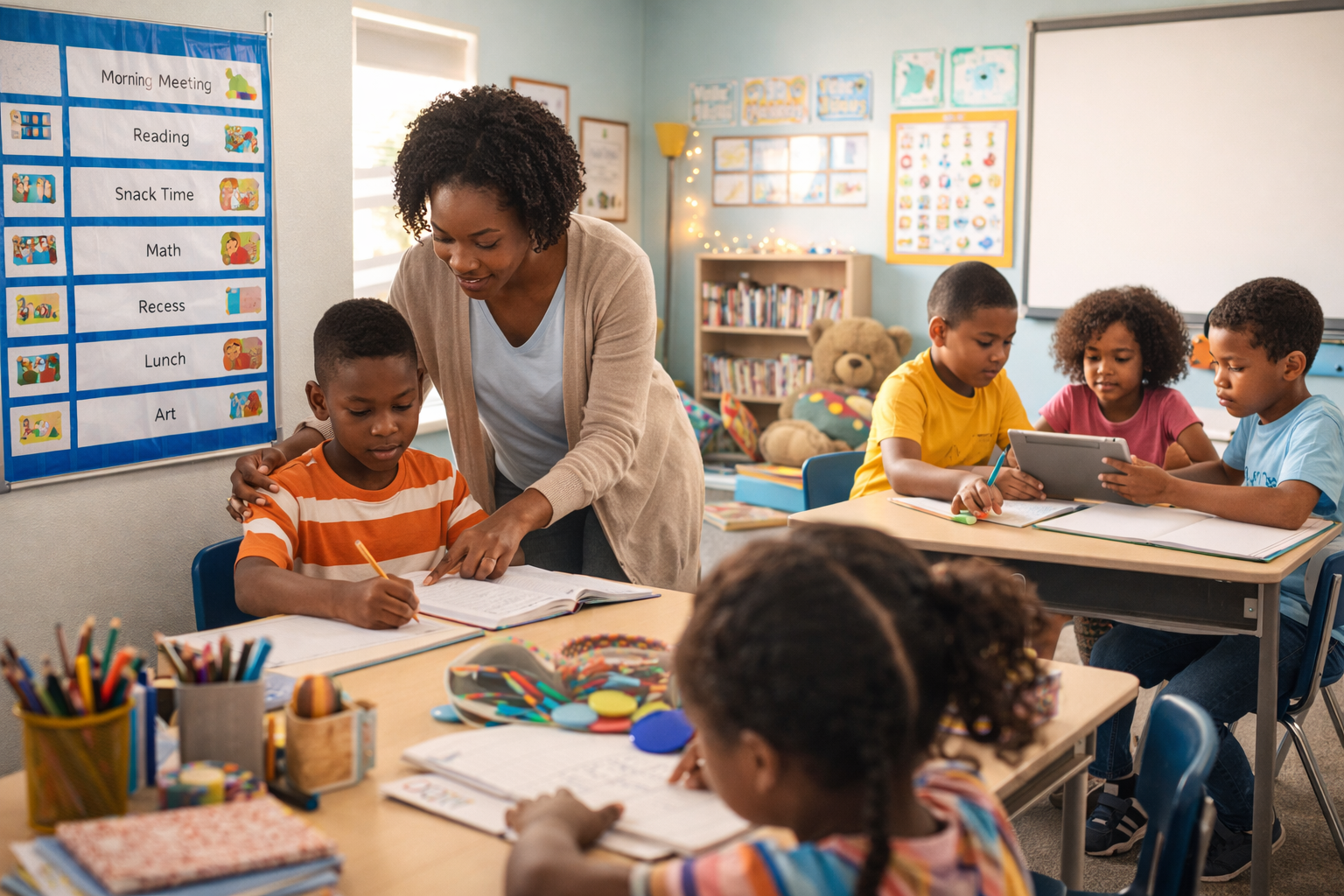
Grounding refers to providing predictability, routine, structure, and consistency.
Why Grounding Matters
Many learners in special education thrive on:
- Clear expectations
- Visual routines
- Transition warnings
- Structured learning blocks
Children with autism, ADHD, and sensory disorders especially benefit from grounding practices.
Research from the Child Mind Institute confirms that consistent routines reduce anxiety, improve attention, and enhance learning outcomes.
Classroom Application
Teachers can implement grounding by:
- Using visual schedules
- Creating predictable classroom routines
- Offering structured transitions
- Making expectations clear and simple
- Maintaining a calm learning environment
Grounding helps students feel safe, supported, and ready to learn.
Why the 7 G’s Matter Now More Than Ever
Modern special education is shifting toward inclusive classrooms, where students with diverse needs learn alongside their peers. The 7 G’s help educators:
- Build inclusive learning environments
- Support academic, emotional, and behavioral growth
- Apply differentiated instruction
- Strengthen relationships with students
- Meet IEP goals efficiently
- Integrate tools and technology
- Reduce frustration for both students and teachers
These principles align with global recommendations from organizations like UNESCO, IDEA, and the National Association of Special Education Teachers (NASET).
How Teachers and Parents Can Use the 7 G’s
| Stakeholder | Practical Applications |
|---|---|
| Teachers | Lesson planning, IEP development, behavior support, classroom routines |
| Parents | Reinforcing growth and routines at home, supporting grit, celebrating goals |
| Administrators | Training teachers, ensuring assistive technology, creating inclusive policies |
| Therapists | Aligning interventions with the 7 G structure |
The 7 G’s offer a flexible yet powerful framework that helps students thrive academically and emotionally.
Conclusion
The 7 G’s in special education — Guidance, Growth, Goals, Grit, Gears, Grace, and Grounding — form a comprehensive roadmap for supporting learners with diverse needs. Each principle plays a crucial role in helping students become confident, capable, and independent individuals.
As classrooms continue adapting to more inclusive and diverse learning environments, these seven pillars provide clarity, direction, and powerful instructional support. The goal is simple: to ensure every child receives the education, compassion, and opportunities they deserve.