








Geography is often misunderstood as just memorizing maps, capital cities, or country names. However, through years of working with geography learning materials and reviewing student misconceptions, one thing becomes clear: geography is the science of how the world actually works—physically, socially, and environmentally.
In an era shaped by climate change, global migration, urban growth, and digital mapping technologies, understanding geography is no longer optional. It is essential for informed citizenship and future careers.
This article draws on established geographic research, global datasets, and authoritative institutions to explain 20 fascinating geography facts every student should know—not just to pass exams, but to understand the planet they live on.
1. Africa Is the Only Continent in All Four Hemispheres
Africa is the only continent that lies in the Northern, Southern, Eastern, and Western Hemispheres. Both the Equator and the Prime Meridian pass through it, making Africa geographically central to the world.
Source: National Geographic Society
This positioning contributes to Africa’s wide range of climates and ecosystems, from tropical rainforests to deserts.
Student Tip: This fact often appears in questions about hemispheres and global positioning.
2. Asia Is Home to Over 60% of the World’s Population
Asia contains approximately 4.6 billion people, accounting for over 60% of the global population. China and India alone represent more than one-third of humanity.
Source: United Nations Department of Economic and Social Affairs (UN DESA)
This population concentration explains Asia’s major influence on global economics, politics, and environmental sustainability.
3. Antarctica Is the World’s Largest Desert
Although commonly associated with ice, Antarctica is the largest desert on Earth because it receives extremely low annual precipitation.
Source: National Snow and Ice Data Center (NSIDC)
Deserts are defined by dryness, not temperature.
4. Earth Has More Than One “North”
There are four recognized types of north:
- True North (geographic)
- Magnetic North
- Grid North
- Geodetic North
These distinctions are essential in navigation, aviation, cartography, and GPS technology.
Source: National Oceanic and Atmospheric Administration (NOAA)
5. Mountains Are Still Growing and Shrinking
Mountains form through tectonic plate collisions and are worn down by erosion. The Himalayas continue to rise by a few millimeters each year as the Indian Plate pushes into the Eurasian Plate.
Source: United States Geological Survey (USGS)
6. Over 70% of Earth Is Covered by Water—But Very Little Is Drinkable
About 71% of Earth’s surface is covered by water, yet only 2.5% is freshwater, and less than 1% is easily accessible.
Source: World Health Organization (WHO)
This scarcity makes water conservation a major global issue.
7. National Borders Change More Often Than You Think
Since 1990, over 30 new countries have emerged due to independence movements, political restructuring, and conflict.
Source: United Nations
Geography and political history are deeply interconnected.
8. The Amazon Rainforest Is Not the “Lungs of the Earth”
Scientific studies show that the Amazon produces roughly the same amount of oxygen it consumes. Its true importance lies in carbon storage, climate regulation, and biodiversity.
Source: NASA Earth Observatory
9. More Than Half of Humanity Lives in Cities
As of recent UN estimates, over 55% of the global population lives in urban areas, projected to reach nearly 70% by 2050.
Source: UN-Habitat
Urban geography helps students understand housing, pollution, and transportation systems.
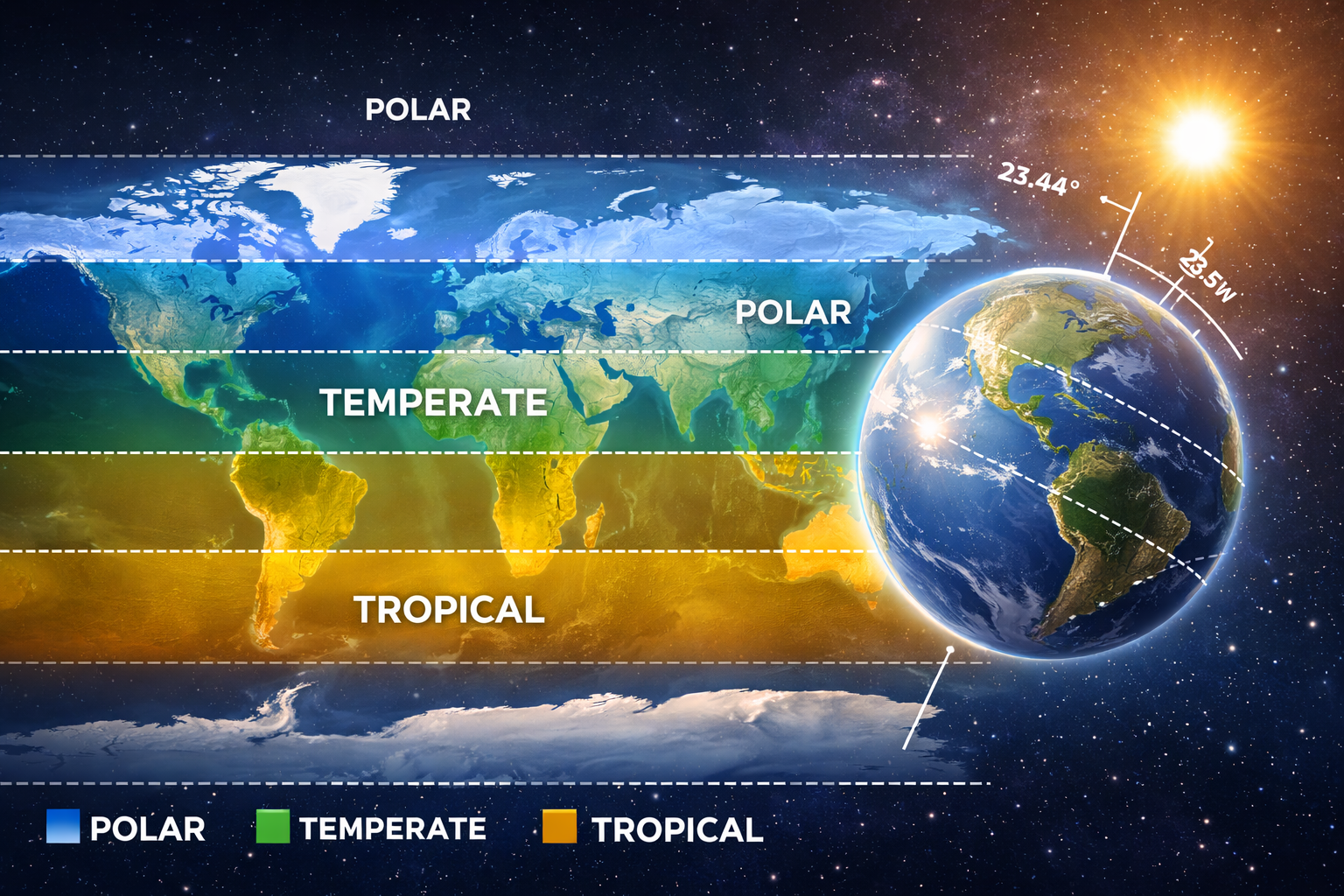
10. Climate Zones Are Shifting Toward the Poles
Global warming is causing climate zones to migrate poleward, affecting agriculture and ecosystems.
Source: Intergovernmental Panel on Climate Change (IPCC)
This is often analyzed using the Köppen–Geiger climate classification system.
11. Some Rivers Appear to Flow Uphill
Certain rivers seem to flow uphill due to optical illusions created by surrounding landscapes, not actual elevation changes.
Source: Geological Survey of Canada
12. Europe Is a Cultural, Not Geological, Continent
Geologically, Europe is part of the Eurasian landmass and is classified separately mainly for historical and cultural reasons.
Source: Encyclopaedia Britannica
13. Earth Is an Oblate Spheroid
The Earth bulges at the equator and flattens at the poles due to rotation, making it an oblate spheroid.
Source: NASA
This shape is essential for satellite systems and accurate mapping.
14. Time Zones Are Politically Determined
While Earth’s rotation influences time, time zone boundaries are shaped by political and economic decisions.
Source: International Earth Rotation Service
15. Over 7,000 Languages Are Spoken Worldwide
There are more than 7,000 living languages, with Papua New Guinea being the most linguistically diverse country.
Source: Ethnologue: Languages of the World
Language distribution is a core topic in human geography.
16. Some Islands Are Disappearing Due to Sea-Level Rise
Low-lying islands in the Pacific have already experienced coastal loss and partial submersion.
Source: IPCC, World Meteorological Organization
17. The Longest Mountain Range Is Underwater
The Mid-Ocean Ridge stretches over 65,000 kilometers, making it the longest mountain range on Earth.
Source: NOAA
18. Latitude Influences Human Lifestyle
Latitude affects daylight, climate, agriculture, architecture, and clothing.
Source: National Geographic Society
19. Continents Are Still Moving Today
Tectonic plates move at about the speed fingernails grow, causing earthquakes and volcanoes.
Source: USGS
20. Geography Is a Future-Proof Skill
Geography underpins GIS, climate science, urban planning, disaster management, and sustainability careers.
Source: Royal Geographical Society
Why Geography Facts Matter for Students
Geography builds:
- Critical thinking
- Global awareness
- Environmental responsibility
- Data literacy
- Career-ready skills
Modern geography integrates technology, real-world data, and problem-solving.
Conclusion
Geography is not just about where places are—it explains why the world functions the way it does. These 20 geography facts reveal a planet that is dynamic, interconnected, and constantly changing.
For students, mastering geography means gaining the tools to understand global challenges, make informed decisions, and thrive in an increasingly complex world.