





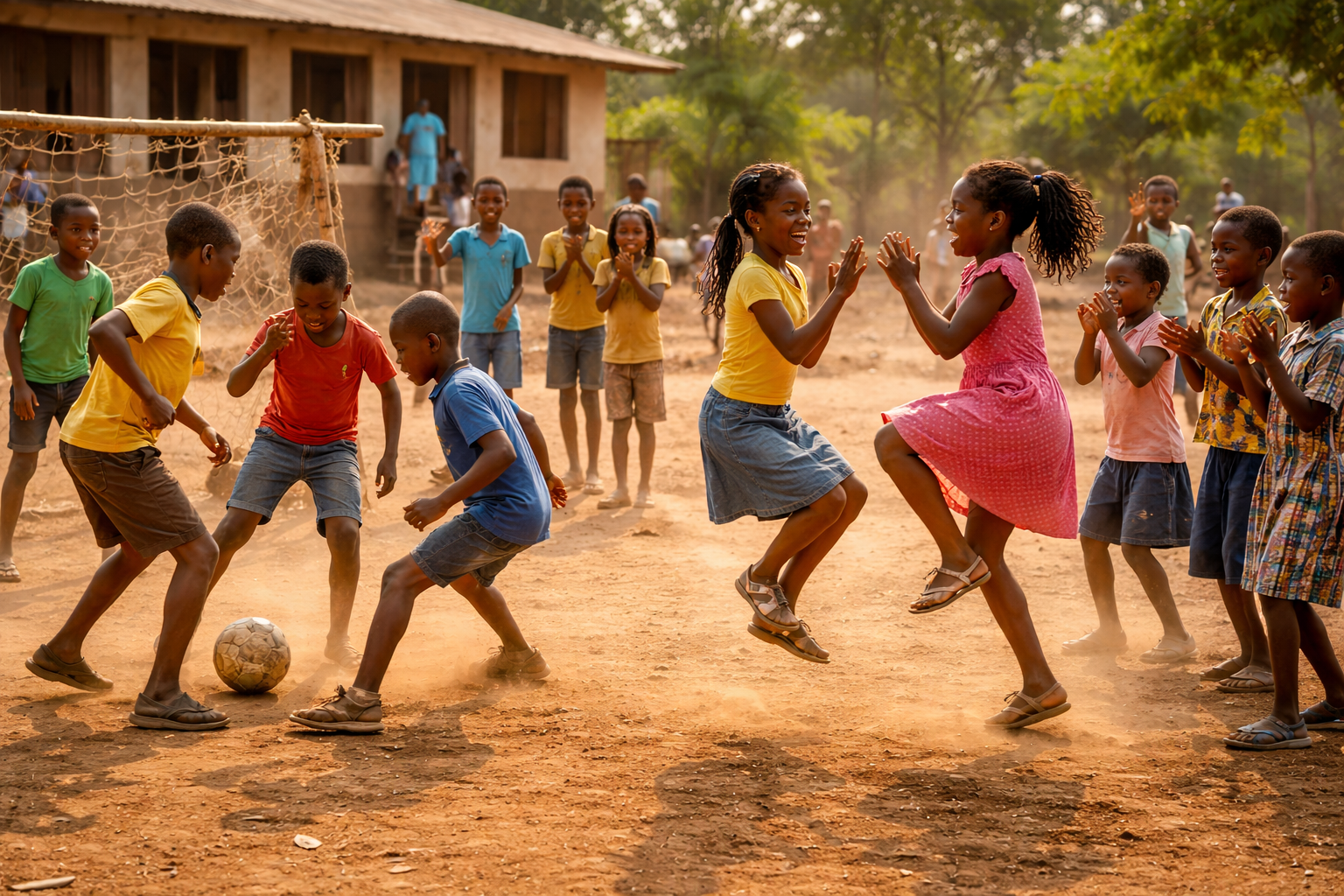
If you walk into almost any primary school playground across Africa during recess, you’ll hear the same sounds: laughter, cheering, rhythmic clapping, and the thud of a ball—sometimes handmade from tied plastic bags.
Having visited schools in both urban and rural communities in West and East Africa, one thing becomes clear very quickly: play is not just recreation—it is an essential part of childhood learning and community life.
So what games do kids actually play at school in Africa?
The answer is rich, regional, and deeply cultural. From fast-paced football matches to strategy board games carved into wooden boards, African school playgrounds reflect creativity, heritage, and social connection.
This guide explores traditional games, modern sports influences, and the developmental impact of school play—supported by educational research and child development insights.
Why School Games Matter in African Education Systems
In many African primary schools, recess is not viewed as wasted time. Educators and child development experts widely recognize that structured and unstructured play supports cognitive, emotional, and physical growth.
According to the UNICEF, play is essential for children’s social and emotional development and contributes to resilience and well-being [Citation: UNICEF Play and Child Development Report].
Similarly, the UNESCO highlights that physical education and traditional games support inclusive learning environments and cultural preservation [Citation: UNESCO Quality Physical Education Guidelines].
In many African schools—especially in rural areas—limited equipment does not prevent active play. Instead, children adapt creatively using locally available materials. This reflects both economic realities and strong community traditions.
Traditional Playground Games Kids Play in African Schools
Because Africa is home to 54 recognized countries, playground games vary by region, culture, and urbanization level. However, several games appear consistently across the continent.
1. Football (Soccer)
Football is widely considered one of the most popular schoolyard games across Africa.
During visits to primary schools in Ghana and Kenya, informal football matches often began within minutes of recess. Goalposts were sometimes marked with stones, and balls were occasionally handmade.
Why football dominates:
- Requires minimal equipment
- Easy to organize
- Encourages teamwork and leadership
Research on youth sports participation suggests that team sports can improve peer cooperation and leadership development in school-aged children [Citation: Journal of Sport & Exercise Psychology].
Football’s popularity is also influenced by continental competitions like the Africa Cup of Nations, which inspire many children to dream of professional careers.
2. Skipping Rope (Jump Rope)
Skipping rope is especially common among primary school children. In many West and Southern African schools, groups chant rhythmic songs while one child jumps in the center.
Developmental benefits:
- Improves coordination
- Enhances cardiovascular endurance
- Builds rhythm and memory
The World Health Organization recommends regular moderate-to-vigorous physical activity for children aged 5–17 to support healthy growth [Citation: WHO Physical Activity Guidelines].
Skipping rope is an accessible way to meet those activity recommendations.
3. Ampe (Common in Ghana and West Africa)
Ampe is a traditional clapping-and-jumping game widely played in Ghanaian schools.
Two players jump simultaneously and extend a foot. If both extend the same foot, one scores a point.
In schools I observed in Accra, Ampe often attracted cheering circles of classmates, reinforcing social bonding.
Why Ampe matters:
- Requires no equipment
- Encourages quick decision-making
- Strengthens balance and agility
- Preserves cultural heritage
Traditional games like Ampe also support cultural continuity, which UNESCO identifies as an important element of education in multicultural societies [Citation: UNESCO Cultural Education Framework].
4. Tag and Chasing Games
Chasing games exist worldwide, but African schools often adapt them with local twists.
Common variations:
- Freeze tag
- Chain tag
- Animal-themed tag
Unstructured chasing games help develop reflexes, endurance, and conflict negotiation skills. Studies in early childhood development show that free play enhances executive function and emotional regulation [Citation: Harvard Center on the Developing Child].
5. Mancala (Oware, Bao, Ayo Variants)
Mancala is one of the oldest known strategy games in the world and is played under different names:
- Oware (Ghana)
- Bao (East Africa)
- Ayo (Nigeria and other parts of West Africa)
The game involves moving seeds or stones between carved pits.
Cognitive benefits include:
- Strategic planning
- Numerical reasoning
- Pattern recognition
Educational researchers note that traditional counting games strengthen arithmetic foundations and logical thinking skills [Citation: African Journal of Educational Studies].
In several schools, teachers informally integrate Mancala-style games into math enrichment activities.
6. Hopscotch
Hopscotch is played in both rural and urban schools. Children draw grids with chalk or stones and hop while balancing on one foot.
Benefits:
- Improves balance
- Enhances motor control
- Builds turn-taking skills
Motor skill development is strongly associated with improved academic performance in early grades [Citation: Early Childhood Research Quarterly].
7. Tug of War
Often featured during sports days, tug of war promotes collective effort and school spirit.
These structured events frequently bring together students, teachers, and parents—reinforcing community engagement in education.
Modern Sports Influencing African School Playgrounds
Urban schools increasingly incorporate formal sports.
Basketball and Volleyball
In cities such as Lagos, Nairobi, and Johannesburg, basketball and volleyball courts are more common.
International competitions like the FIBA Basketball World Cup have increased youth interest in basketball.
Benefits include:
- Team coordination
- Communication skills
- Agility and endurance
Creative Games in Resource-Limited Schools
In rural schools with limited sports infrastructure, creativity thrives.
Children often:
- Roll bicycle tires with sticks
- Create balls from cloth or plastic
- Build goalposts from wood
These adaptations reflect resilience and problem-solving—qualities educators often aim to cultivate.
According to UNICEF, play in low-resource environments still delivers meaningful developmental outcomes when children are free to explore and collaborate [Citation].
How School Games Support Child Development
Educational and developmental research consistently shows that play supports:
Physical Development
- Cardiovascular health
- Muscle and bone strength
- Motor coordination
Social Skills
- Teamwork
- Conflict resolution
- Leadership
Emotional Growth
- Confidence building
- Coping with wins and losses
- Stress reduction
Cognitive Development
Strategy-based games like Mancala improve:
- Logical reasoning
- Planning skills
- Numerical understanding
The Harvard Center on the Developing Child notes that play-based learning supports executive functioning and long-term academic readiness [Citation].
Regional Variations Across Africa
Because Africa includes 54 countries and hundreds of cultural groups, playground games vary significantly.
- West Africa: Ampe, Ayo, football
- East Africa: Bao, running games, football
- Southern Africa: Netball, football, traditional strength games
- North Africa: Football, handball, playground chasing games
Climate, school funding, colonial history, and urbanization all influence game types.
Challenges Affecting School Play
Some schools face:
- Overcrowded classrooms
- Reduced recess due to academic pressure
- Limited sports facilities
However, community-led initiatives often preserve active play traditions despite constraints [Citation: UNESCO Education Infrastructure Report].
Conclusion
What games do kids play at school in Africa?
They play football on dusty fields. They chant while skipping rope. They clap and jump in Ampe circles. They strategize over Mancala boards carved into wood.
Across rural villages and urban cities, school playgrounds remain vibrant spaces of learning, culture, and creativity.
Research from organizations such as UNESCO, UNICEF, and the World Health Organization consistently reinforces what teachers and parents already know: play is not separate from education—it is foundational to it.
In African schools, games are more than recreation. They are lessons in teamwork, resilience, strategy, and community.
And every recess tells a story.