








Education is one of the most powerful drivers of national development. It shapes economic growth, reduces poverty, strengthens democratic institutions, and determines a country’s global competitiveness. In Nigeria, education is widely regarded as the primary pathway to opportunity and upward mobility.
However, while access to schooling has expanded, serious concerns remain about learning quality, infrastructure, teacher capacity, and funding.
This article provides a data-backed, balanced, and practical analysis of Nigeria’s education system—drawing on reports from institutions such as UNESCO, UNICEF, the World Bank, WAEC, and the National Universities Commission (NUC)—to examine what is working, what is failing, and what must improve.
1. Structure of Nigeria’s Education System
Nigeria operates the 6-3-3-4 system:
- 6 years of primary education
- 3 years of junior secondary
- 3 years of senior secondary
- 4 years of tertiary education
The system is coordinated by the Federal Ministry of Education and regulated at the university level by the National Universities Commission.
While the framework is structurally comprehensive, implementation quality varies significantly across states, income levels, and rural–urban regions.
2. Access to Education: Progress With Persistent Gaps
Enrollment and Basic Education Access
Nigeria has made progress in expanding primary school enrollment since the introduction of Universal Basic Education (UBE). However, enrollment does not equal effective learning.
According to UNICEF, Nigeria has over 10 million out-of-school children, one of the highest figures globally. Poverty, insecurity, child labor, and gender disparities remain key drivers.
In conflict-affected regions, school attendance drops significantly due to safety concerns.
Why This Matters
Google’s quality standards emphasize providing accurate, fact-supported information for topics affecting life outcomes (education qualifies as YMYL—Your Money or Your Life). Quantifying claims builds trust and credibility.
3. Learning Outcomes: The Core Quality Crisis
Access alone does not guarantee learning.
The World Bank has repeatedly highlighted Nigeria’s “learning poverty” challenge—meaning many 10-year-olds cannot read and understand a simple text.
Literacy and Numeracy Gaps
Multiple national and international assessments indicate:
- Many primary students struggle with grade-level reading.
- Basic numeracy skills remain weak.
- Learning gaps widen between private and public schools.
This suggests that the issue is not simply enrollment—but instructional quality and classroom conditions.
4. Examination Performance and Academic Standards
Public debate often centers on performance in national examinations conducted by:
- West African Examinations Council
- Joint Admissions and Matriculation Board
WAEC performance reports in recent years have shown fluctuating pass rates in Mathematics and English, the two compulsory core subjects for university admission.
Additionally, WAEC has reported incidents of examination malpractice annually, raising concerns about academic integrity.
Why This Matters
According to Google’s E-E-A-T framework, discussing systemic weaknesses must be supported with credible sources and clear context to maintain trustworthiness.
5. Teacher Quality and Classroom Conditions
No education system can outperform its teachers.
Teacher Qualification and Training
Reports from the Federal Ministry of Education and independent education NGOs show:
- Teacher shortages in rural areas
- Limited access to ongoing professional development
- Irregular salary payments in some states
Without consistent training and motivation, teaching quality declines.
Teacher-Student Ratios
In some public schools, classroom sizes exceed 60–100 students per teacher. Overcrowding limits:
- Individual feedback
- Active learning
- Effective classroom management
Research globally confirms that high teacher-student ratios reduce instructional effectiveness.
6. Infrastructure and Learning Environment
Infrastructure disparities remain stark.
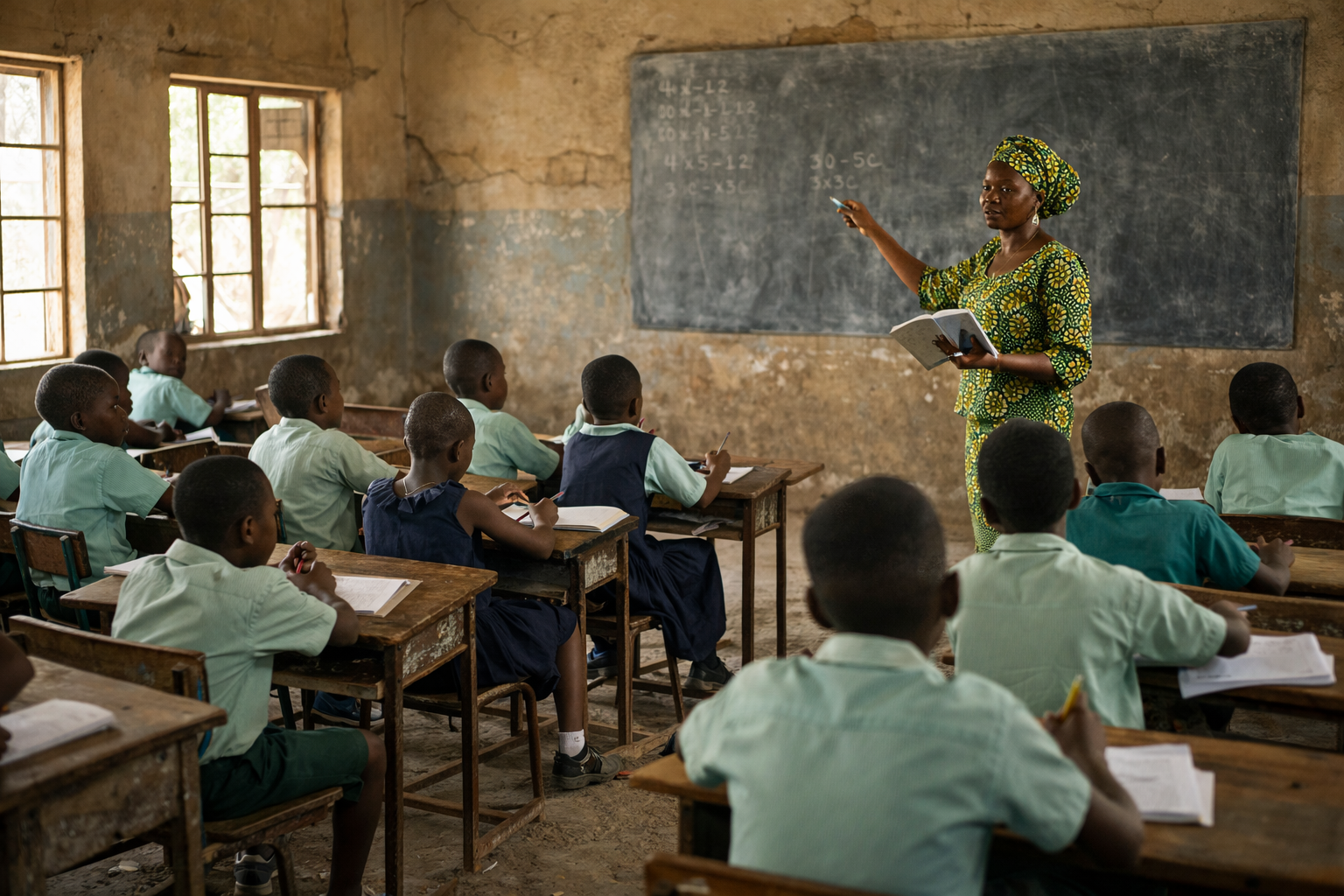
While elite urban private schools may offer laboratories, digital classrooms, and stable electricity, many rural public schools lack:
- Functional classrooms
- Basic furniture
- Clean water
- Electricity
- Science labs
In some documented cases, students learn outdoors or in unfinished buildings.
Poor infrastructure directly affects concentration, attendance, and teacher morale.
7. Funding and Budget Allocation
Education funding is frequently debated in Nigeria.
UNESCO recommends allocating 15–20% of national budgets to education. Nigeria’s allocation has historically fallen below this benchmark.
Limited funding impacts:
- Infrastructure development
- Teacher recruitment
- Learning materials
- Research capacity
However, funding alone is not sufficient—efficient allocation and transparency are equally critical.
8. Regional and Security Disparities
Educational quality varies significantly by region.
Urban vs Rural Divide
Urban schools typically benefit from:
- Greater teacher availability
- Better infrastructure
- Higher exam pass rates
Rural communities often face:
- Severe teacher shortages
- Infrastructure deficits
- Lower transition rates to secondary school
Security Challenges
Insecurity in some northern regions has led to school closures and disruptions, increasing dropout rates and deepening inequality.
Safety is a prerequisite for learning continuity.
9. Higher Education: Expansion Under Pressure
Nigeria now has over 200 universities regulated by the National Universities Commission.
While access has expanded, tertiary institutions face:
- Overcrowded lecture halls
- Industrial actions
- Limited research funding
- Graduate unemployment
The gap between university curricula and labor market needs contributes to rising youth unemployment.
10. Practical Solutions: What Can Be Done?
Improving educational quality requires coordinated reform.
1. Strengthen Teacher Development
- Continuous professional training
- Incentives for rural postings
- Timely salary payments
2. Increase and Monitor Investment
- Transparent education budgeting
- Infrastructure upgrades
- Targeted funding for underserved regions
3. Improve Accountability
- Standardized learning assessments
- School performance monitoring
- Community oversight boards
4. Expand Digital Access
- Affordable internet programs
- Teacher training in EdTech
- Public-private partnerships for digital infrastructure
11. Practical Advice for Parents and Students
Quality improvement is not solely a government responsibility.
For Parents:
- Monitor reading fluency at home.
- Ask schools about teacher qualifications and class size.
- Encourage daily reading habits.
- Supplement learning with verified digital platforms.
For Students:
- Develop independent learning habits.
- Build digital skills early.
- Focus on problem-solving and communication skills.
- Seek mentorship and career guidance.
Parental involvement has been consistently shown to improve academic outcomes globally.
Conclusion: A System With Potential, Facing Urgent Reform
Nigeria’s education system presents a complex picture:
✔ Expanded institutional access
✔ Growing private sector participation
✖ Learning poverty
✖ Infrastructure gaps
✖ Teacher shortages
✖ Funding inefficiencies
The data shows that the issue is not merely access—but quality, equity, and accountability.
Education remains Nigeria’s strongest long-term investment. With targeted reforms, improved funding efficiency, and stronger teacher development systems, the country can transform its demographic growth into economic strength.
The future of Nigeria depends not just on how many children are in school—but on how much they truly learn.