








Mathematics is often described as the language of science, technology, engineering, and finance. Yet many students experience it as a disconnected collection of topics—fractions one year, equations the next, and geometry somewhere in between.
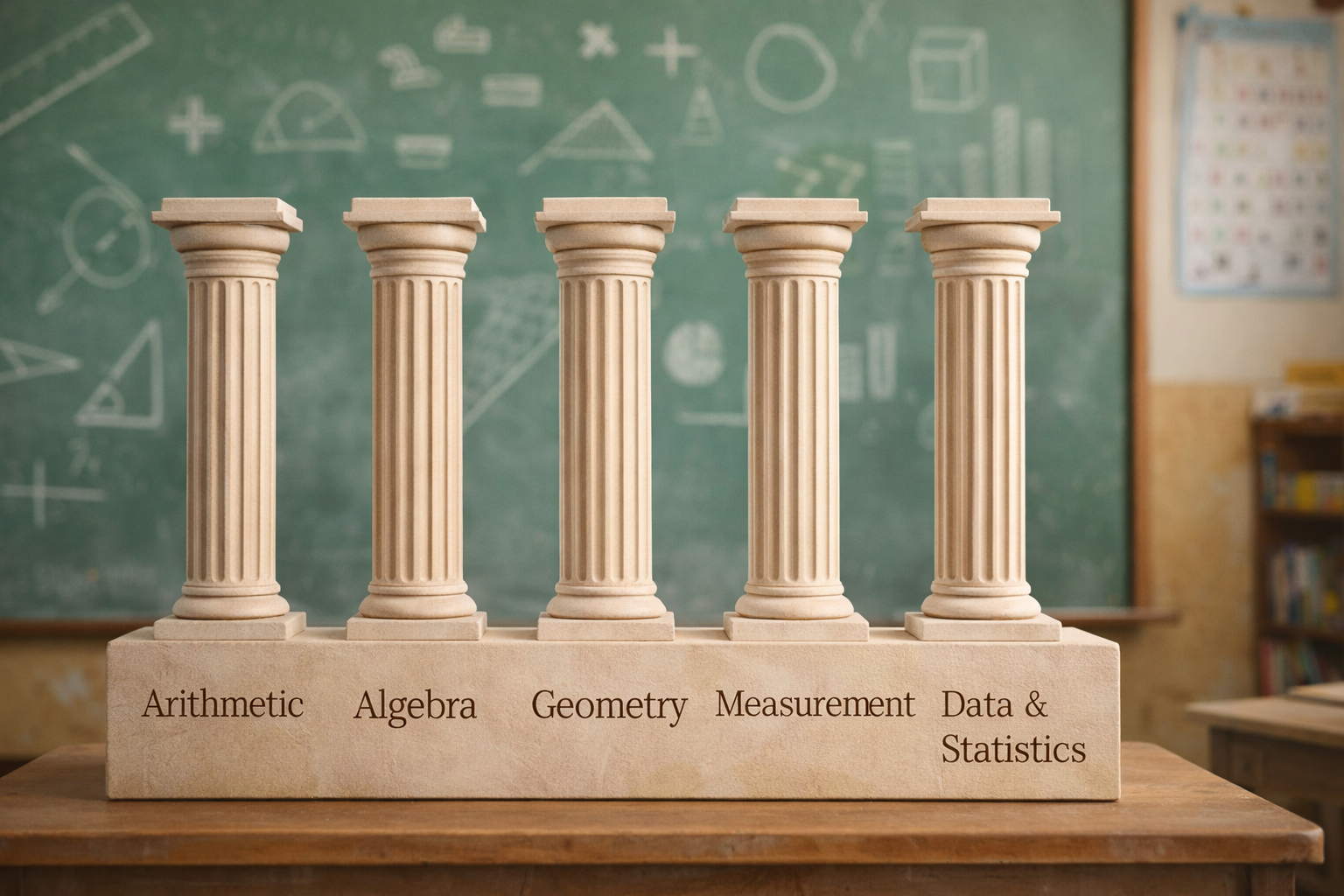
In most school curricula around the world, mathematics is organized into five foundational areas. While professional mathematicians classify the discipline differently at advanced levels (including fields like number theory, topology, and abstract algebra), K–12 education commonly structures learning around five core pillars:
- Arithmetic
- Algebra
- Geometry
- Measurement
- Data and Statistics
As an educator reviewing curriculum frameworks and working with learners who struggle with foundational gaps, I’ve consistently observed that difficulties in advanced math almost always trace back to weaknesses in one of these five areas. Understanding them clearly helps students, parents, and adult learners build confidence and long-term competence.
Why These Five Areas Matter in Education
Organizations such as the National Council of Teachers of Mathematics emphasize that mathematical proficiency develops through structured, connected domains of learning. Strong foundational skills support reasoning, problem-solving, and real-world application.
Rather than viewing math as isolated topics, these pillars show how mathematical understanding develops progressively and coherently.
1. Arithmetic: The Foundation of Numerical Fluency
Arithmetic focuses on numbers and fundamental operations:
- Addition
- Subtraction
- Multiplication
- Division
It also includes:
- Fractions and decimals
- Percentages
- Ratios and proportions
Why Arithmetic Is Foundational
Arithmetic builds number sense—the ability to understand magnitude, compare values, and perform calculations accurately. Research in mathematics education consistently shows that weak number sense is one of the strongest predictors of later difficulty in algebra.
In practical terms, arithmetic governs:
- Budgeting and financial literacy
- Shopping discounts
- Tipping and taxes
- Time management calculations
Applied Example
If a $40 item is discounted by 25%, arithmetic allows you to calculate that the discount is $10 and the final price is $30.
Without fluency in arithmetic, higher-level mathematical reasoning becomes unnecessarily difficult because cognitive effort is spent on basic computation instead of conceptual understanding.
2. Algebra: Modeling Relationships and Patterns
Algebra extends arithmetic by introducing symbols (variables) to represent unknown or changing quantities.
Instead of:
5 + 3 = ?
Algebra asks:
x + 3 = 8
Now the task is solving for the unknown value.
Core Algebra Concepts
- Variables
- Expressions
- Equations
- Inequalities
- Functions
Why Algebra Is Critical
Algebra develops abstract reasoning. It allows us to describe patterns, predict outcomes, and model real-world systems.
Examples include:
- Calculating loan payments
- Modeling population growth
- Analyzing business revenue
- Computer programming logic
In education research, algebra is often described as a “gatekeeper subject” because success in algebra strongly predicts readiness for advanced STEM fields.
3. Geometry: Understanding Shape, Space, and Structure
Geometry examines properties of space, including:
- Lines and angles
- Polygons and triangles
- Circles
- Area and perimeter
- Surface area and volume
It strengthens spatial reasoning, a skill linked to success in engineering, architecture, and design.
Practical Applications
- Determining floor area for renovation
- Calculating material volume in construction
- Designing buildings and bridges
- Interpreting maps and blueprints
When students struggle with geometry, it is often due to weak connections between visual reasoning and algebraic formulas. Strong integration between pillars improves comprehension.
4. Measurement: Quantifying the Physical World
Measurement connects abstract numbers to real-world quantities. It includes:
- Length (meters, inches)
- Mass/weight (kilograms, pounds)
- Time (seconds, hours)
- Temperature (Celsius, Fahrenheit)
- Volume and capacity
Modern trade, engineering, and science rely heavily on standardized systems of measurement. While commerce existed historically without global standardization, standardized units dramatically increased accuracy, consistency, and scalability in industry and research.
Why Measurement Builds Mathematical Maturity
Measurement requires:
- Unit conversion
- Estimation
- Precision
- Dimensional reasoning
It reinforces arithmetic and geometry while developing practical quantitative literacy.
5. Data and Statistics: Interpreting Information in a Data-Driven World
Data and statistics involve:
- Organizing data
- Reading graphs and charts
- Calculating averages (mean, median, mode)
- Understanding probability
- Identifying trends
In modern society, statistical literacy is essential for evaluating news, research claims, public health data, and financial information.
For example, interpreting a statement such as “70% of customers prefer online shopping” requires understanding:
- Sample size
- Data collection methods
- Margin of error
Educational research also links statistical reasoning with improved critical thinking skills.
How the Five Pillars Interconnect
These pillars are not isolated categories. They form an integrated system:
- Arithmetic supports calculations everywhere.
- Algebra builds on arithmetic relationships.
- Geometry often relies on algebraic formulas.
- Measurement uses arithmetic and geometry.
- Statistics relies on arithmetic and algebraic modeling.
Example:
Calculating the area of a rectangular garden requires:
- Measurement (length and width)
- Geometry (area formula)
- Arithmetic (multiplication)
This interconnectedness reflects how mathematics operates in real-world problem-solving.
Common Learning Gaps (And Why They Matter)
From reviewing student performance patterns, three recurring gaps appear:
- Weak fraction understanding → Later algebra difficulty
- Poor number fluency → Slower problem-solving speed
- Limited data literacy → Difficulty evaluating information critically
Addressing foundational pillars early reduces cumulative learning gaps.
Practical Ways to Strengthen Each Pillar
Strengthen Arithmetic
- Practice mental math regularly
- Master fractions and percentages
- Apply skills to real budgeting scenarios
Improve Algebra Skills
- Focus on understanding relationships, not memorizing procedures
- Solve real-world word problems
- Practice equation balancing consistently
Develop Geometry Understanding
- Draw diagrams when solving problems
- Visualize shapes in everyday environments
- Practice area and volume calculations
Enhance Measurement Skills
- Learn unit conversions thoroughly
- Estimate before calculating
- Apply measurement in cooking or DIY tasks
Build Data Literacy
- Analyze charts in news articles
- Compare averages from small data sets
- Learn basic probability rules
Frequently Asked Questions
Are these five pillars universal in mathematics?
In higher mathematics, fields expand into areas such as abstract algebra, calculus, topology, and number theory. However, in most school systems worldwide, these five areas represent foundational instructional domains.
Is one pillar more important than the others?
Arithmetic often forms the base, but long-term success requires balanced development across all five areas.
Why do students struggle with math?
Research suggests that math difficulty often results from cumulative gaps, limited conceptual understanding, or math anxiety—an issue studied extensively in educational psychology.
Conclusion: The Structural Framework Behind Mathematical Success
While mathematics as an academic discipline is vast and highly specialized, foundational education typically rests on five interconnected pillars:
- Arithmetic
- Algebra
- Geometry
- Measurement
- Data and Statistics
Understanding these pillars provides clarity, structure, and direction for learners at any stage. Strengthening them builds not just computational skill, but logical reasoning, quantitative literacy, and analytical confidence.
Whether you are a student revisiting fundamentals, a parent supporting homework, or an adult refreshing core skills, focusing on these five areas creates a clear roadmap toward mathematical competence.