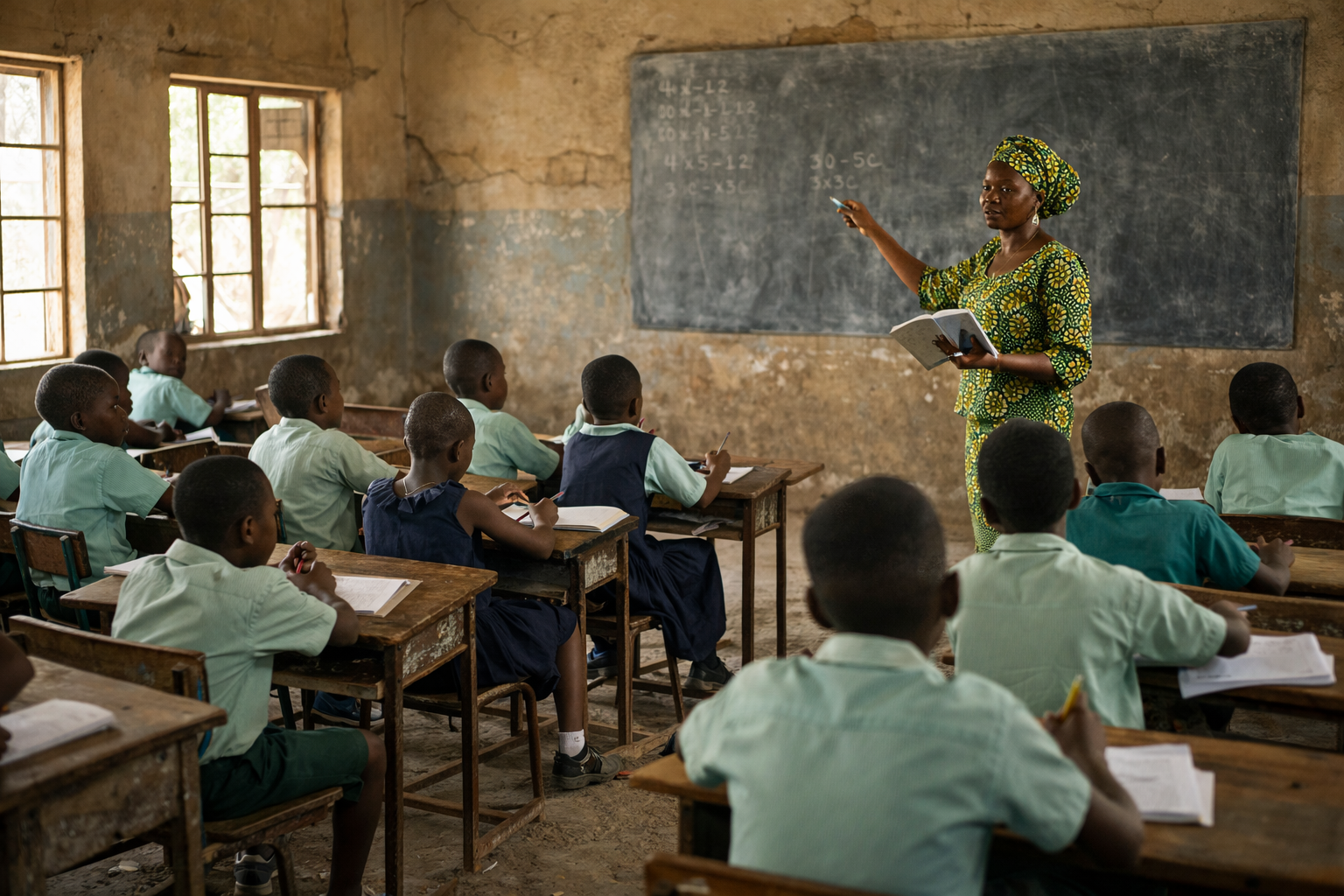







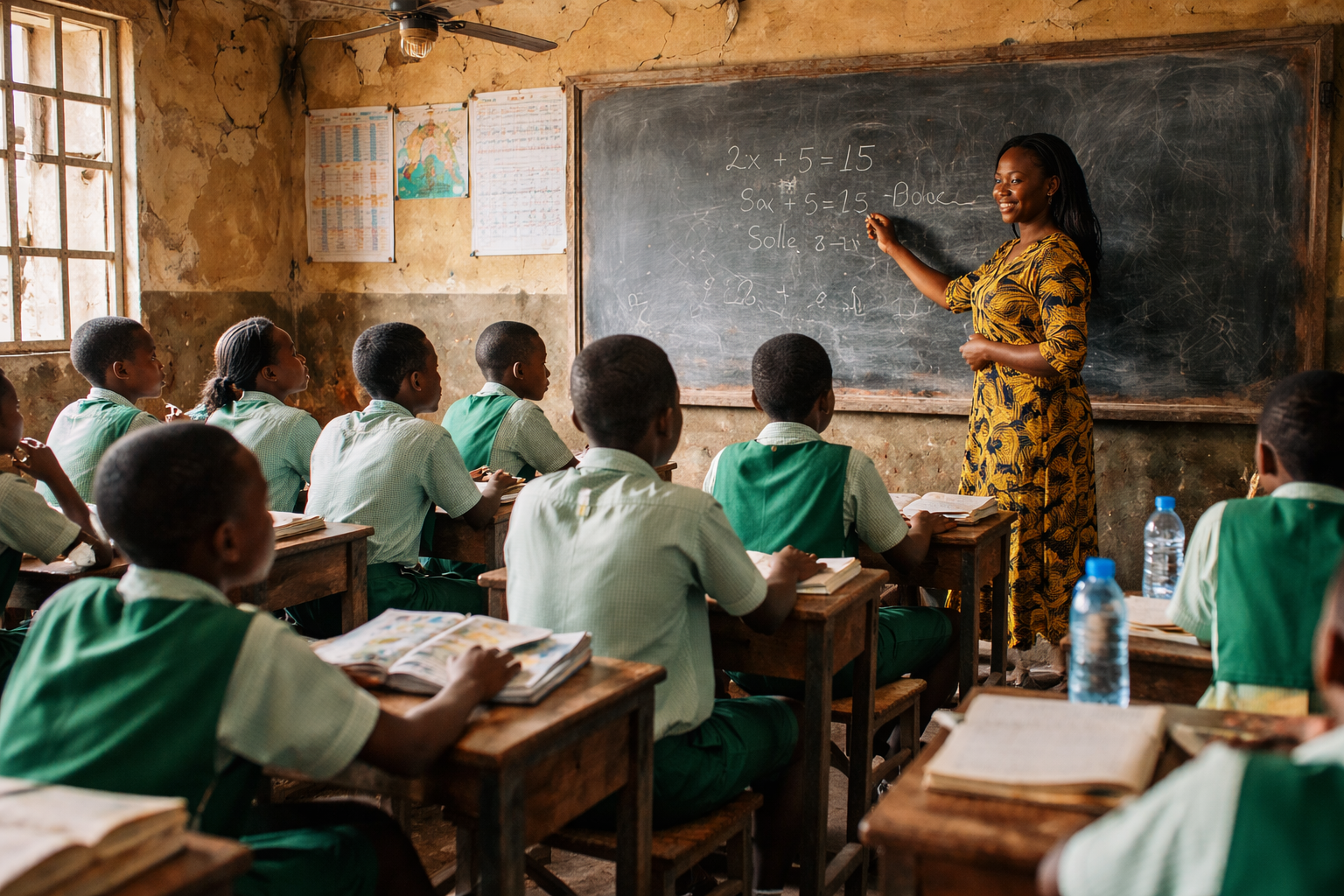
Education in Nigeria sits at a critical crossroads. As Africa’s most populous country—with over 220 million people—Nigeria’s education system plays a decisive role in shaping its economic future, workforce development, and social stability.
While enrollment rates have improved over the past two decades, deep structural challenges remain. Issues such as underfunding, infrastructure deficits, teacher shortages, regional inequality, and prolonged university strikes continue to affect outcomes.
This 2025 analysis provides a data-backed, expert-informed overview of:
- The structure of Nigeria’s education system
- Current enrollment trends
- Funding realities
- Quality concerns
- Regional and gender disparities
- Tertiary education disruptions
- The future outlook
All data is drawn from authoritative sources including UNICEF, UNESCO, the World Bank, and Nigeria’s Federal Ministry of Education.
Overview of the Education System in Nigeria
Nigeria operates the 6-3-3-4 system:
- 6 years of primary education
- 3 years of junior secondary
- 3 years of senior secondary
- 4 years of tertiary education
Education governance is decentralized. While policy is coordinated by the Federal Ministry of Education, state and local governments manage implementation, leading to regional variation in quality and outcomes.
Basic education is supported through the Universal Basic Education (UBE) programme.
Access to Education in Nigeria: Progress and Gaps
School Enrollment Trends
Primary school enrollment has increased over the past two decades due to free basic education policies and school feeding initiatives.
However, access remains uneven.
According to UNICEF, Nigeria has approximately 20 million out-of-school children, the highest number globally. This represents one of the most significant education access crises in the world.
Source: UNICEF Nigeria Education Fact Sheets (latest available data)
Why So Many Children Are Out of School
Major contributing factors include:
- Poverty and child labor
- Armed conflict and insecurity in northern states
- Early marriage affecting girls
- Limited infrastructure in rural areas
In regions affected by insecurity, schools have been temporarily closed, disrupting learning continuity.
Education Funding in Nigeria: How It Compares Globally
Funding remains one of the most pressing structural issues.
UNESCO recommends that governments allocate 15–20% of total public expenditure to education.
Nigeria’s education allocation has typically fallen below this benchmark in recent national budgets.
Source: UNESCO Global Education Monitoring Reports
Underfunding has direct consequences:
- Overcrowded classrooms
- Delayed teacher salaries
- Insufficient learning materials
- Poor maintenance of facilities
The World Bank has repeatedly noted that improving education financing efficiency is critical to Nigeria’s long-term economic growth.
Quality of Education: Structural Challenges
Access alone does not equal quality.
1. Teacher Shortages
According to government and development partner assessments:
- Some rural schools have student-teacher ratios exceeding recommended standards.
- Continuous professional development is limited in underserved areas.
Teacher recruitment and training reforms remain central policy priorities.
2. Infrastructure Deficits
In several public schools:
- Classrooms lack adequate furniture
- Laboratories are under-equipped
- Electricity and clean water access is inconsistent
These factors directly affect learning outcomes.
Tertiary Education in Nigeria: Strikes and Institutional Instability
Nigeria’s university system has experienced recurring industrial actions led by the Academic Staff Union of Universities (ASUU).
Strike actions have historically centered on:
- Funding shortfalls
- Staff welfare
- Infrastructure improvements
- Agreement implementation
Extended strikes in recent years have delayed graduation timelines and reduced academic continuity.
Despite disruptions, institutions such as the University of Ibadan continue to maintain strong academic reputations within West Africa.
The Rise of Private Education in Nigeria
Private education has expanded significantly, particularly in urban centers like Lagos and Abuja.
Private Primary & Secondary Schools
Parents often cite:
- Smaller class sizes
- Better infrastructure
- More consistent academic calendars
However, tuition fees create accessibility barriers for lower-income families.
Private Universities
Private universities generally offer more stable calendars than many public institutions.
However:
- Tuition fees are substantially higher
- Access remains limited to higher-income households
Regional and Gender Disparities
Urban vs Rural Divide
Urban schools typically benefit from:
- Better teacher availability
- Stronger infrastructure
- Higher concentration of private institutions
Rural communities face infrastructure and staffing constraints.
Gender Disparities
While gender parity has improved nationally, regional disparities remain.
According to UNICEF, girls in certain northern states are more likely to experience educational interruption due to early marriage and economic pressures.
Digital Learning and Educational Technology
The COVID-19 pandemic accelerated remote learning discussions.
Schools experimented with:
- Radio lessons
- Television broadcasts
- Online platforms
However, digital inequality remains significant due to:
- Limited internet penetration
- High data costs
- Limited device access
Closing the digital divide is now central to Nigeria’s education modernization strategy.
Technical and Vocational Education (TVET)
Technical and vocational education is increasingly recognized as critical for reducing youth unemployment.
Polytechnics and technical colleges provide training in:
- Engineering
- Agriculture
- ICT
- Skilled trades
Development institutions, including the World Bank, emphasize that strengthening TVET systems is essential to bridge Nigeria’s skills gap.
Government Reform Efforts
Recent reform efforts include:
- Universal Basic Education funding programs
- Teacher certification reforms
- Curriculum modernization (digital literacy & entrepreneurship)
- Expanded school feeding programs
The challenge remains implementation consistency across states.
Key Data Snapshot (Recent Available Estimates)
- ~20 million out-of-school children (UNICEF)
- Education budget below UNESCO’s 15–20% benchmark
- Persistent teacher shortages in rural areas
- Recurrent university strikes affecting academic calendars
The Future of Education in Nigeria
Nigeria’s population is projected to continue growing rapidly, increasing pressure on education infrastructure.
To improve outcomes, policy priorities include:
- Meeting international funding benchmarks
- Strengthening teacher training pipelines
- Expanding digital infrastructure
- Addressing insecurity affecting schools
- Investing in vocational education
If sustained reforms align with demographic realities, Nigeria’s education system can become a powerful driver of economic transformation.
Conclusion
The current situation of education in Nigeria is defined by both progress and persistent structural challenges.
Enrollment has expanded, private education has grown, and policy reforms are ongoing. However, underfunding, infrastructure deficits, teacher shortages, regional disparities, and institutional instability continue to affect quality and access.
Backed by data from UNICEF, UNESCO, the World Bank, and Nigeria’s Federal Ministry of Education, the evidence suggests that meaningful improvement will require sustained financial commitment, governance reform, and targeted investment in equity and quality.
Education remains Nigeria’s most powerful long-term development tool. Whether it fulfills that promise depends on how effectively reforms are implemented in the coming years.