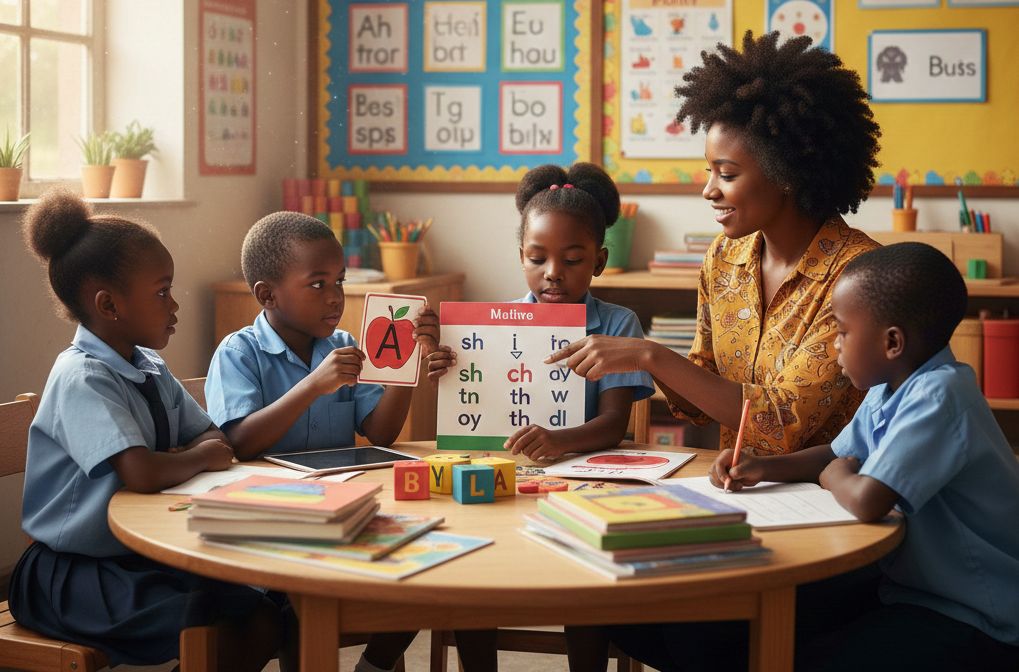









Teaching children to read is one of the most impactful responsibilities in early education. As a literacy-focused approach, phonics instruction plays a central role in helping children decode words, build reading fluency, and develop long-term comprehension skills.
In my experience working with early readers (ages 4–7), I’ve seen a clear pattern: children make faster, more confident progress when phonics instruction is structured, multisensory, and consistent — but also playful and engaging.
This guide combines practical teaching strategies with research-backed literacy principles to help parents, teachers, and tutors deliver effective phonics instruction that truly works.
Why Phonics Matters in Early Literacy (What Research Shows)
Phonics is the method of teaching children to connect letters (graphemes) with sounds (phonemes). It allows children to decode unfamiliar words instead of memorizing them.
According to the National Reading Panel, systematic phonics instruction significantly improves:
- Word recognition
- Spelling ability
- Reading fluency
- Early comprehension skills
Similarly, the U.S. Department of Education has reported that structured phonics instruction is especially effective in kindergarten and first grade.
Phonics is most powerful when it is:
- Explicit (sounds are clearly taught)
- Systematic (skills build in sequence)
- Repetitive (with varied practice)
- Applied in real reading contexts
Understanding the Difference: Phonemic Awareness vs. Phonics
Before diving into activities, it’s important to clarify terminology.
- Phonemic awareness: The ability to hear and manipulate sounds in spoken words.
- Phonics: Connecting those sounds to written letters.
For example:
If a child can orally break “cat” into /c/ /a/ /t/, that’s phonemic awareness.
If they can match those sounds to the letters C-A-T and read the word, that’s phonics.
Research from the International Literacy Association emphasizes that phonemic awareness is a critical precursor to phonics success.
Practical, Research-Based Ways to Teach Phonics
Below are classroom-tested strategies that align with literacy science while keeping learning engaging.
1. Multisensory Letter-Sound Instruction
In early literacy sessions I’ve conducted, children retained letter sounds more effectively when they engaged multiple senses.
How to Implement:
- Say the sound aloud.
- Trace the letter in sand or on textured cards.
- Pair the sound with a movement.
For example:
- /s/ — move your hand like a snake.
- /m/ — rub your tummy as if saying “mmm.”
This approach aligns with structured literacy practices often recommended for early readers and children with dyslexia.
2. Sound Treasure Hunts (Active Engagement)
Choose a target sound (e.g., /b/) and ask children to find objects beginning with that sound:
- Ball
- Book
- Box
In my sessions, this activity dramatically increases participation because it connects phonics to real-world objects.
Why it works:
- Reinforces sound recognition
- Builds vocabulary
- Strengthens listening skills
3. Blending and Segmenting Practice (The Core of Decoding)
The National Reading Panel identified blending and segmenting as essential decoding skills.
Blending Example:
Say:
“/c/ – /a/ – /t/”
Children respond:
“cat”
Segmenting Example:
Ask:
“What sounds do you hear in ‘dog’?”
Child responds:
- /d/
- /o/
- /g/
Start with simple CVC (consonant-vowel-consonant) words before progressing to:
- Digraphs (sh, ch, th)
- Blends (bl, st, cr)
- Long vowel patterns
Structured progression is key.
4. Phonics Through Storytelling (Context Matters)
Children learn faster when phonics is embedded in meaningful reading.
Create short, sound-focused stories:
For /m/:
“Mom made muffins on Monday morning.”
After reading, ask:
- “Which words started with /m/?”
This reinforces:
- Sound recognition
- Listening comprehension
- Word awareness
5. Sound Sorting for Discrimination Skills
Sound confusion (like mixing up /b/ and /d/) is common.
Provide picture cards and sort by beginning sound.
Example:
/t/
- Tiger
- Table
- Tree
/p/
- Pig
- Pen
- Pizza
Sorting strengthens auditory discrimination — a foundational literacy skill.
6. Phonics Bingo (Reinforcing Letter-Sound Connections)
Instead of calling letter names, call out sounds:
“Find the letter that makes /k/.”
This reinforces sound-symbol relationships rather than alphabet memorization alone.
7. Encourage Invented Spelling
If a child writes “kat” instead of “cat,” celebrate it.
This shows phonetic understanding — a positive developmental step.
The International Literacy Association supports developmentally appropriate spelling as part of literacy growth.
Correct gently while reinforcing effort.
Adapting for Different Learners
Effective phonics instruction must be flexible.
For Struggling Readers:
- Short, focused sessions (10–15 minutes)
- Extra repetition
- Multisensory reinforcement
- Explicit modeling
For Advanced Readers:
- Introduce digraphs earlier
- Explore word families
- Practice decoding multisyllabic words
Children with reading challenges, including dyslexia, often benefit from structured, systematic phonics approaches supported by evidence-based literacy frameworks.
Common Mistakes to Avoid
Based on classroom observation and literacy research:
Teaching letter names before sounds.
Introducing too many sounds at once.
Relying only on worksheets.
Skipping blending practice.
Ignoring comprehension.
Phonics must be paired with meaningful reading experiences.
Sample 1-Week Phonics Plan (Ages 4–6)
Monday:
Introduce letter + sound explicitly.
Tuesday:
Multisensory tracing + sound repetition.
Wednesday:
Blend simple CVC words using that letter.
Thursday:
Read a short decodable story featuring the sound.
Friday:
Play a review game (Bingo or Sound Hunt).
Consistency builds mastery.
How to Monitor Progress
You don’t need formal testing to assess phonics development.
Look for:
- Can the child say the correct sound?
- Can they blend 3 sounds?
- Can they segment simple words?
- Can they apply sounds while reading?
If blending remains difficult after consistent practice, additional structured support may be beneficial.
Creating a Positive Literacy Environment
Confidence is crucial.
Children who feel safe making mistakes become stronger readers.
Effective phonics instruction should be:
- Structured but flexible
- Repetitive but varied
- Encouraging, not pressured
Celebrate progress, not perfection.
Conclusion: Building a Strong Reading Foundation
Phonics instruction is not about drills alone — it’s about equipping children with the tools to decode language independently.
Research from the National Reading Panel and guidance from the U.S. Department of Education confirm that systematic phonics instruction significantly improves early reading outcomes.
When phonics is:
- Explicit
- Engaging
- Structured
- Applied in meaningful reading
Children build not only decoding skills — but confidence, independence, and a lifelong foundation for literacy.
References
- National Reading Panel. Teaching Children to Read: An Evidence-Based Assessment.
- U.S. Department of Education. Early Literacy Reports.
- International Literacy Association. Literacy Research and Position Statements.